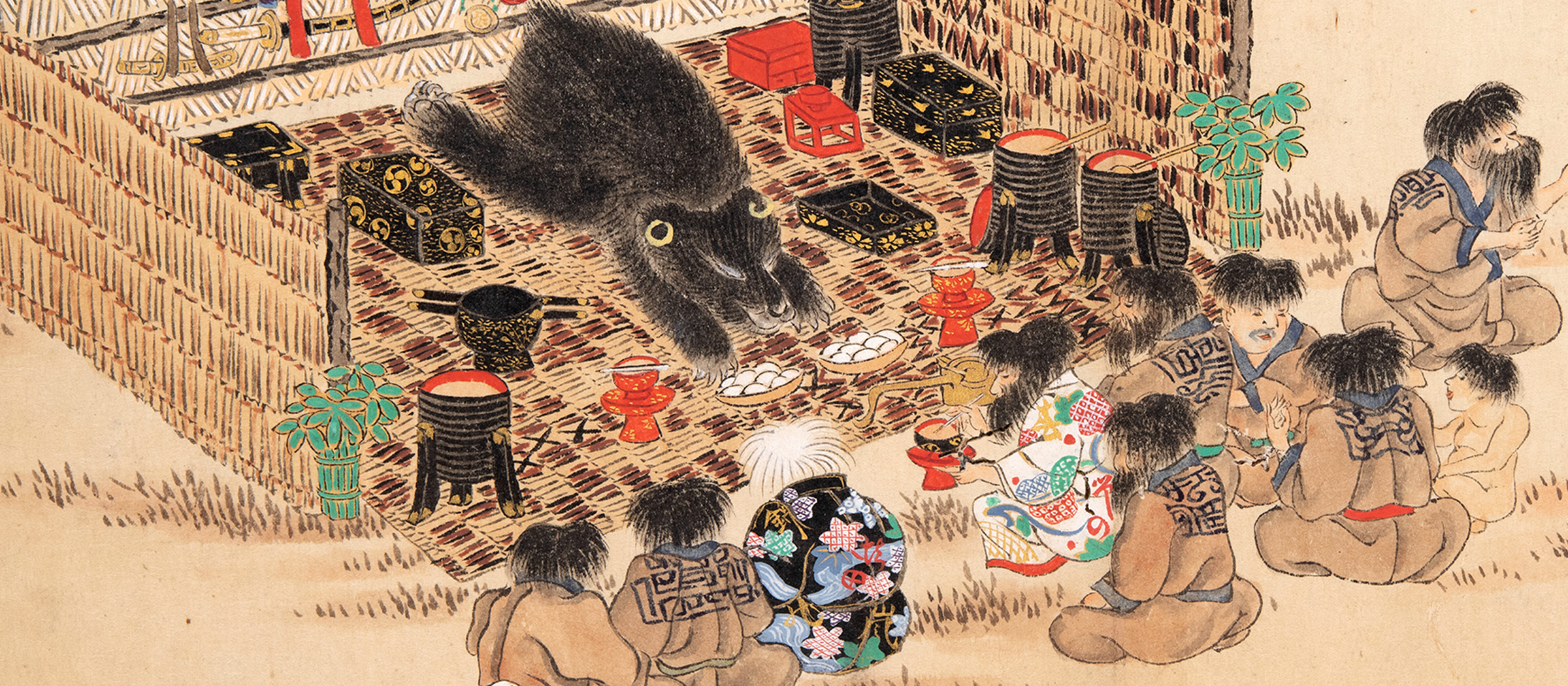
Portraits and Verses of the Daoist Immortals
Ressen zusan 列僊圖賛
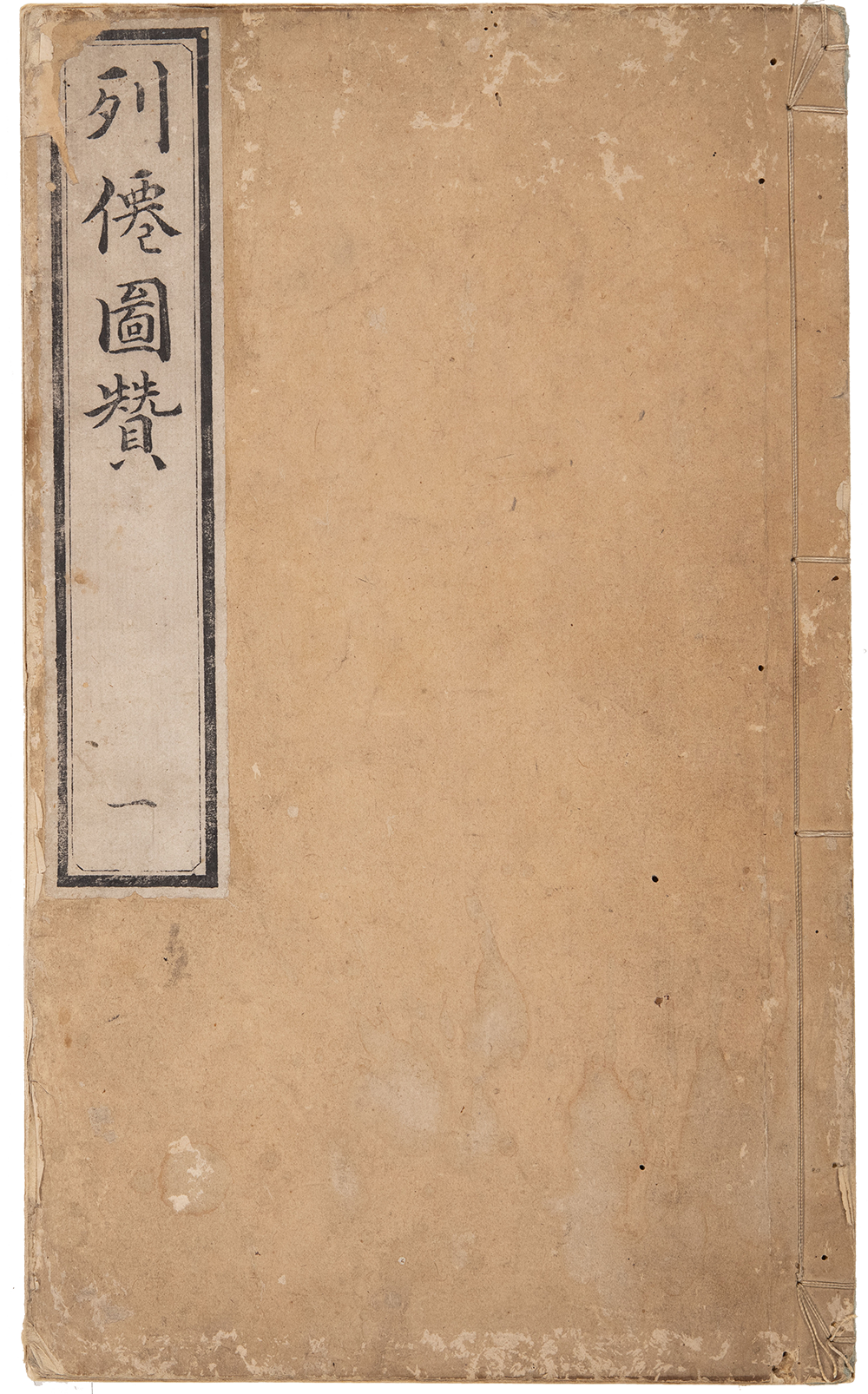
The Portraits and Verses of the Daoist Immortals (Ressen zusan 列僊図賛) is a printed black and white illustrated manuscript from Tenmei 4 (1784) by Gessen 月僊 (1741–1809), a Buddhist monk and painter. The manuscript is held by the UCLA Charles E. Young Library as a part of the Julian C. Wright Collection. Printed in three volumes and including a preface in volume 1, the book depicts a range of both men and women (though mostly male figures), and each page varies between portraits of individuals and portraits of two figures together. Each page also features a Chinese poem.
The paper in each volume is somewhat delicate, thin, and slightly yellowed with age. Each volume consists of a different number of pages; volume one is 55 pages, volume 2 is 40 pages, and volume 3 is 47 pages. The books are relatively small, making it easy for someone to carry them in hand or transport. The illustrations of Daoist immortals contain fine line work in black and white, with layered folds depicting skin and clothing that highlight textures in detail. The figures are often portrayed in dynamic poses and expressions. The figure is the main subject of each page, as there is no landscape background, though some portraits include surrounding objects or animals, such as turtles or dragons (Fig. 2).
Gessen painted a range of artistic subjects that included not only the Daoist immortals, but also heroes, landscapes, and bird and flower paintings. He was familiar with traditional Chinese painting genres and artists, which can be seen in this manuscript’s figural designs. The unique art style of the sages in the manuscript appear to be heavily influenced by traditional figure painting Yuan and Ming Dynasty prints, which he studied under the tutelage of Japanese paints of the time. Chinese figural art styles were widely circulated through printing, making the style accessible for Edo period Japanese artists like Gessen to draw inspiration from. Gessen borrowed elements from many traditional Chinese prints while adding his own style of dynamic movement, exaggerated poses, elongated bodies, and highly expressive, sometimes bizarre facial features. His depiction of lined wrinkles and sometimes distorted facial expressions suggests Gessen's transformation to his own distinct art style.1Hiromitsu Kobayashi, “Figure compositions in seventeenth-century Chinese prints and their influences on Edo period Japanese painting manuals” (PhD diss., University of California, Berkeley, 1987), 143-146.
Gessen’s Ainu Connection
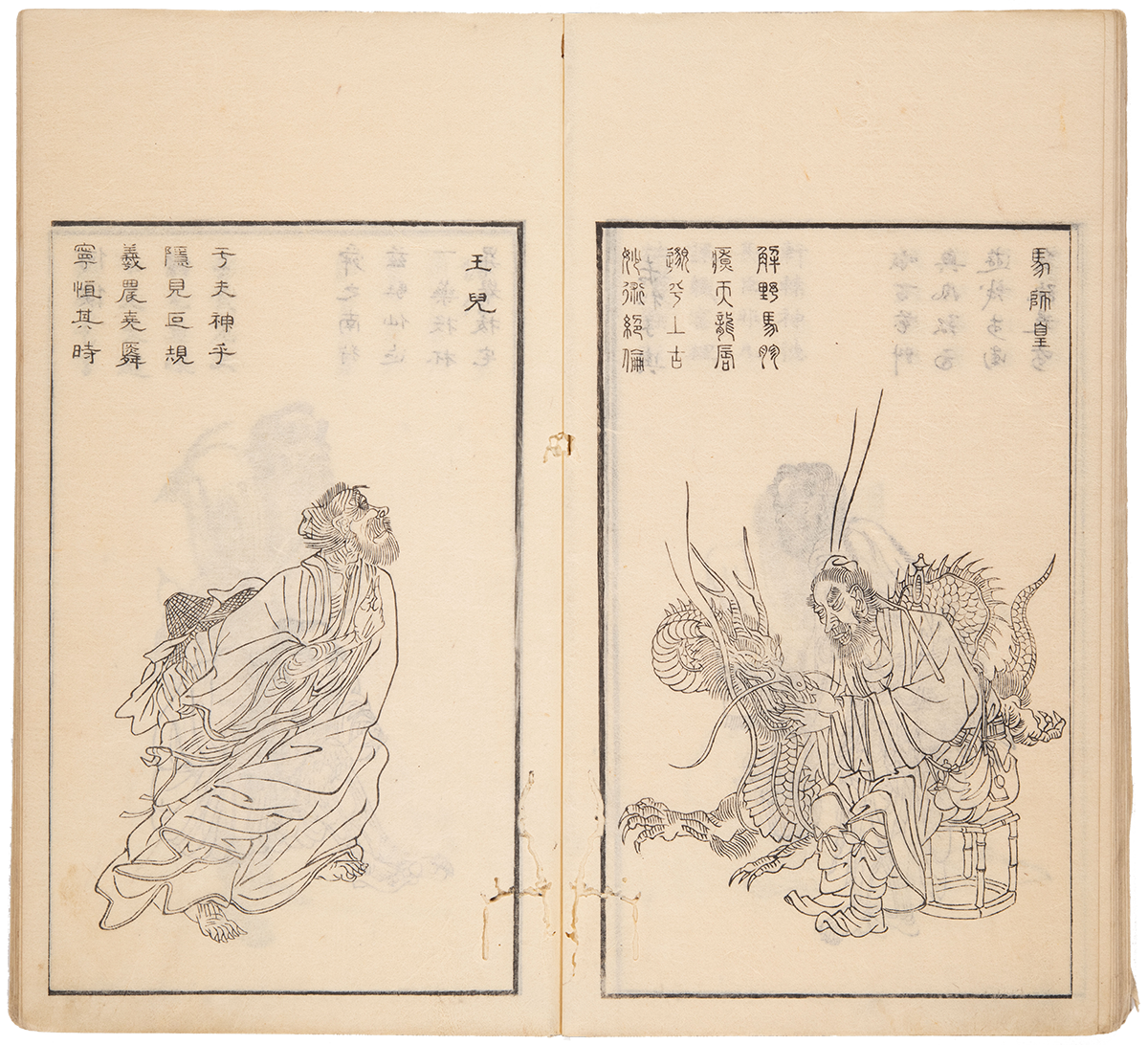
Why feature Gessen’s Ressen zusan in this website? Gessen’s portraits of the Daoist immortals are believed to have served as a model for a famous Ainu portrait series by Kakizaki Hakyō 蠣崎波響 (1764–1826). Hakyō was a painter and a senior official in the Matsumae Domain in the southern Hokkaido region of Japan. Hakyō created A Series of Paintings of Ainu chieftains (Ishū Retsuzō 夷酋列像) in 1790, depicting twelve Ainu chieftains. The chieftains depicted are who sided with the Matsumae domain and helped stop an Ainu uprising that took place in 1789, later known as the Battle of Kunashiri-Menashi. The portraits were made in order to honor the deeds of the chiefs and, some argue, were modeled closely on Chinese portrait practices as a way to represent traditional Chinese Confucian ideals promoted by government elites at the time.2Eri Shiraishi, “Fictitious Images of the Ainu,” Japan Review 36 (2021), 89–90, 101–102.
Both Gessen’s book and Kakizaki Hakyō’s portraits depict these important figures in a mixed artistic style that is very visually striking, with Hakyo’s portraits appearing to be influenced by a combination of traditional Chinese styles of decorative realism and Western artistic styles of expression that incorporate significant shading into their figures.3Shiraishi, 94, 99. Though Hakyō’s portraits borrowed poses and compositional elements from portraits of Chinese sages, he also reproduced visual tropes used by the Japanese to depict the Ainu as foreign "others." The Ainu chieftains are depicted with remarkable detail but reproduce some of the standard exotic stereotypes of the time, such as thick, large noses and ears, long bushy beards, unibrows, and heavily emphasized body hair.4Shiraishi, 100. Given the accessibility of printed works at the time, Gessen’s manuscript was likely available to Kakizaki Hakyō.
In the example below, we have prepared several overlay sliders that show comparisons between Gessen’s manuscript and the Hakyō portraits. In addition to being able to see Gessen’s flare for dramatic poses and facial structures, one can see Hakyō’s style of using bright colors, shading, and also his detailed attention to Ainu features, patterned clothing, and ornate jewelry. More importantly, you can see how similar many of the poses appear. As you move the sliders side to side, pay close attention to the placement of feet, hands, and arms. Gessen’s portraits of the Daoist immortals are on the left and Kaikizaki Hakyō’s Ainu figures are on the right.
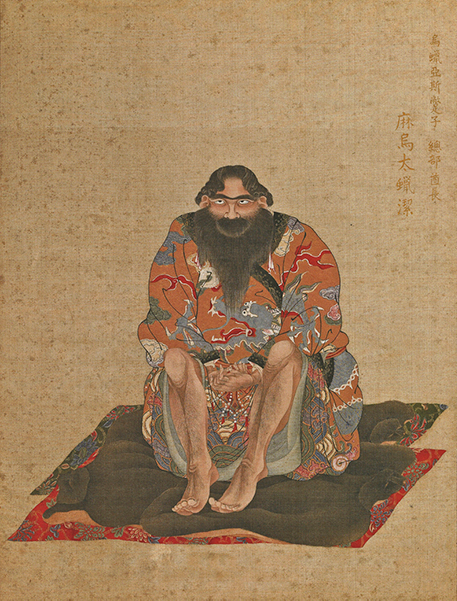
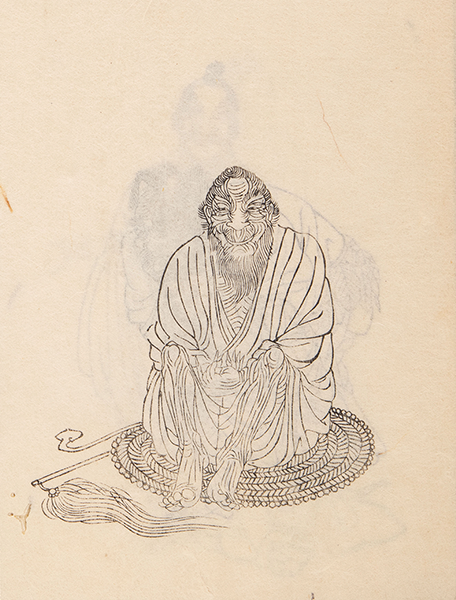
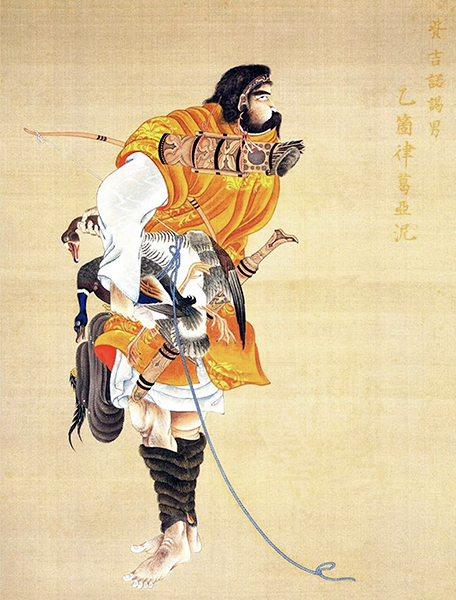
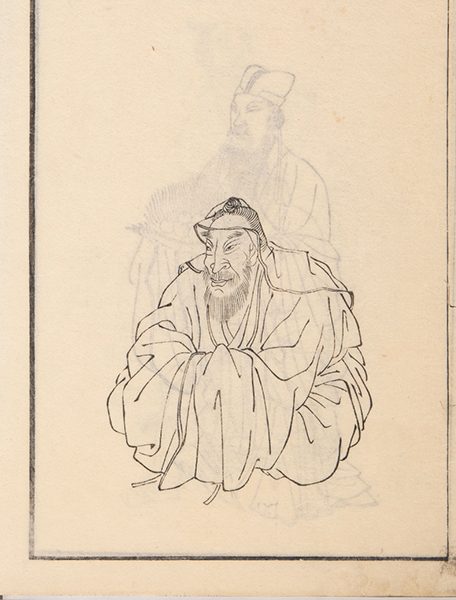
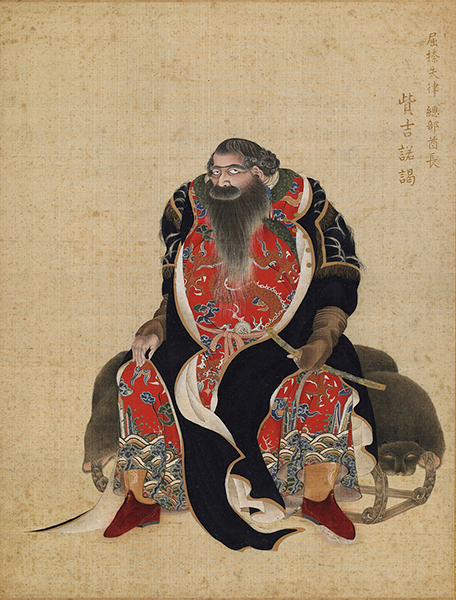
In Figure 3 each of the men depicted are shown in extremely similar seated positions with their knees drawn to their chests and their hands resting in their laps. Both are seated on a mat, though the shapes differ. The angles of the legs and the curls of the toes are nearly an exact match, as are the fingers curled up between the legs. Both men are bearded, and the shape of the upper lip on Gessen’s figure is matched in Hakyō’s portrait, though it is represented as the shape of the chieftain’s moustache. Although the Ainu chieftain is shown with a unibrow, the overall shape of his hair mimics the curled shape of the eyebrows into the hairline for Gessen’s figure. Both men are gazing to the same side For Figure 4, Hakyō used a similar standing position as Gessen’s original, though he reversed the side to which the body is curved. Despite changing the directionality of the body, Hakyō kept the positions of the feet nearly identical, with the back foot twisted to the side and the front foot facing forward. Both figures are leaning to one side with their shoulders turned slightly.
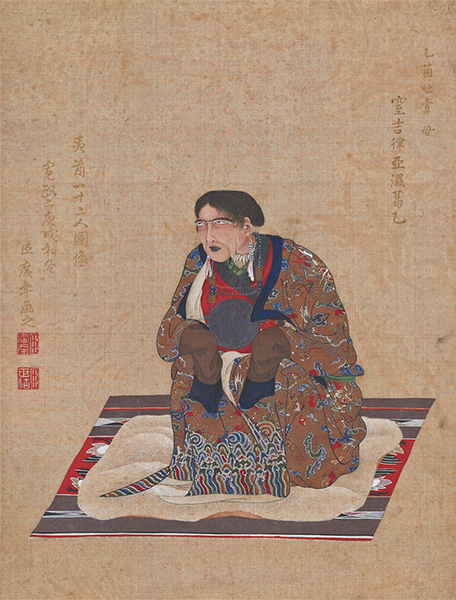
The two portraits in Figure 5 are not an exact match, and the Gessen portrait is of a man, while the Hakyō portrait depicts the only woman from the Ainu portrait series: However, both figures are seated in the same position, with their legs pulled to their chest under their robes, and both have their heads pointing to left, gazing to an unseen point. The overall composition of their seated figures is very similar as is the gathering of their robes towards the chest, and the tassels of the male figure’s outfit and edges of the female figure’s robes fall in the same manner.
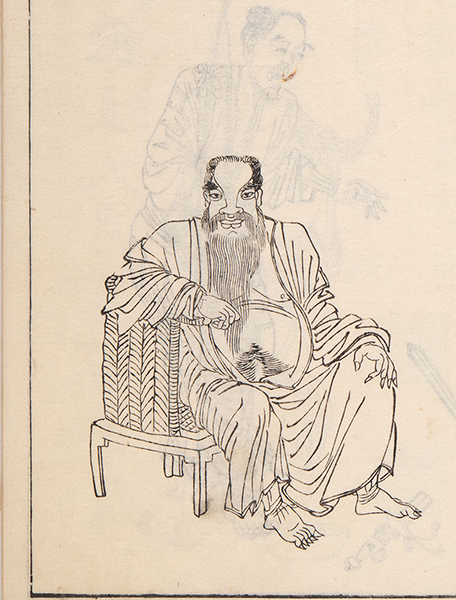
Figure 6 features two men, each seated in a short chair that is low to the ground. Both figures sit in a similar position, with an arm resting on one knee. Both are shown to have large bellies that are pushing a layer of their clothing aside from their chests and stomachs. Their beards are roughly the same length and shape and they gaze directly at the viewer.
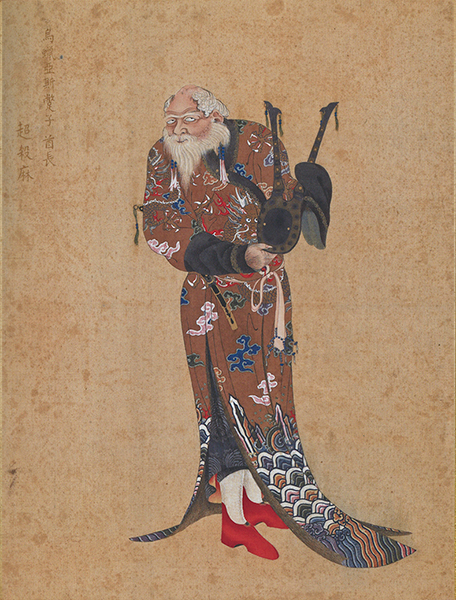
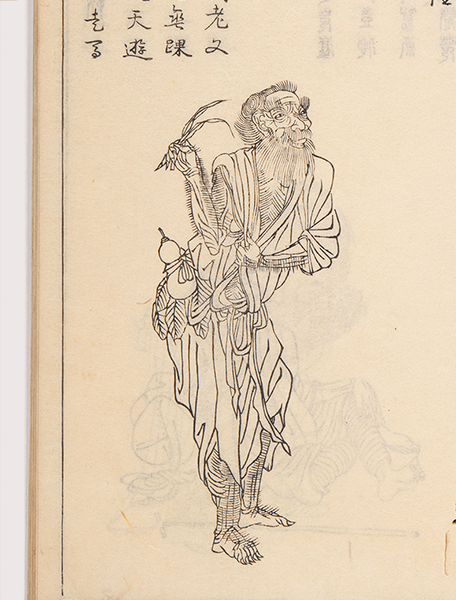
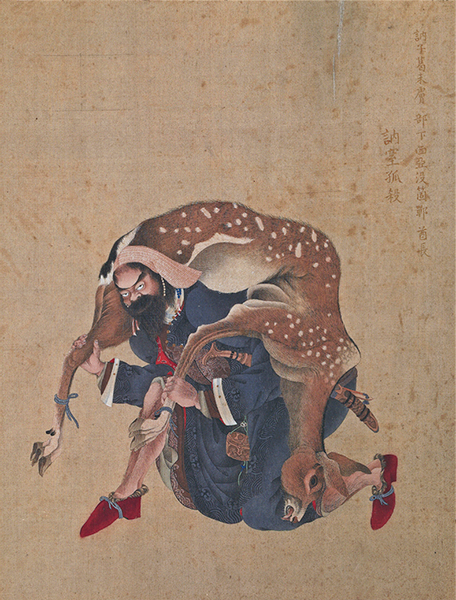
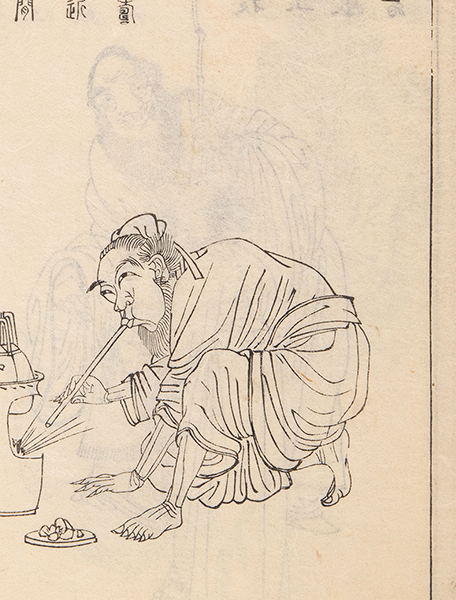
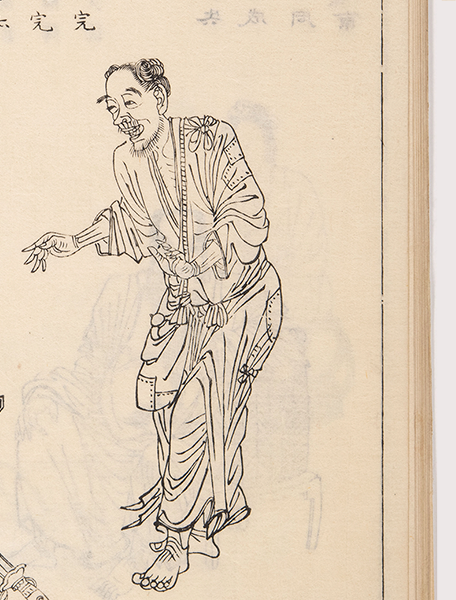
Figure 7 is another example of Hakyō flipping the directionality of a pose. Both of the men shown are positioned with the feet in nearly identical positions, the back foot to the side and the front foot pointing more forward, and though both are leaning Hakyō has flipped the direction of the lean. They both feature short, unkempt beards, and the arms that are shown lowered are reaching across the body in a curve.
Finally, in Figure 8, both figures are crouching in the same position, facing the left with one arm extended. Their feet are placed roughly at the same angles stretched with one behind and one placed forward with a raised knee. Both are leaning forward in a very exaggerated pose, though Hakyō’s position appears more exaggerated because of the deer carried on the man’s back. Gessen’s portrait shows the man holding a pipe to blow air heating up a figure, while the same compositional line for Hakyō is the deer’s leg.
References
* Eleven of the twelve of Hakyō’s A Series of Paintings of Ainu chieftains (Ishū Retsuzō 夷酋列像) can be viewed online in the digital collections of Musée des Beaux-Arts et d'archéologie de Besançon (link).
Gessen 月僊. Ressen zusan 列僊図賛.Tenmei 4 [1784]. Early Japanese Books at UCLA. UCLA Library Digital Collections. https://digital.library.ucla.edu/catalog/ark:/21198/z1v50pvv. Accessed 24 May 2026.
Kobayashi, Hiromitsu. “Figure compositions in seventeenth-century Chinese prints and their influences on Edo period Japanese painting manuals.” PhD diss., University of California, Berkeley, 1987.
Shiraishi, Eri. “Fictitious Images of the Ainu.” Japan Review 36 (2021): 89–110.
Wikipedia. "夷酋列像 (Ishū Restsuzō)." Last modified May 12, 2026. https://ja.wikipedia.org/wiki/%E5%A4%B7%E9%85%8B%E5%88%97%E5%83%8F. Accessed 24 May 2026.
Yamaguchi Yasuhiro 山口泰弘. "Gessen no shoki sakufū no tayōsei to yōshiki keisei: jinbutsuga wo chūshin toshite" 月僊の初期作風の多様性と様式形成-人物画を中心として [Diversity of Style and Style Formation in Gessen's Early Work: Focusing on Figure Painting]. Kenkyū ronshū 研究論集 3 (1991). Mie Prefectural Art Museum. https://www.bunka.pref.mie.lg.jp/art-museum/53399036475.htm. Accessed 24 May 2026.