Bracelets
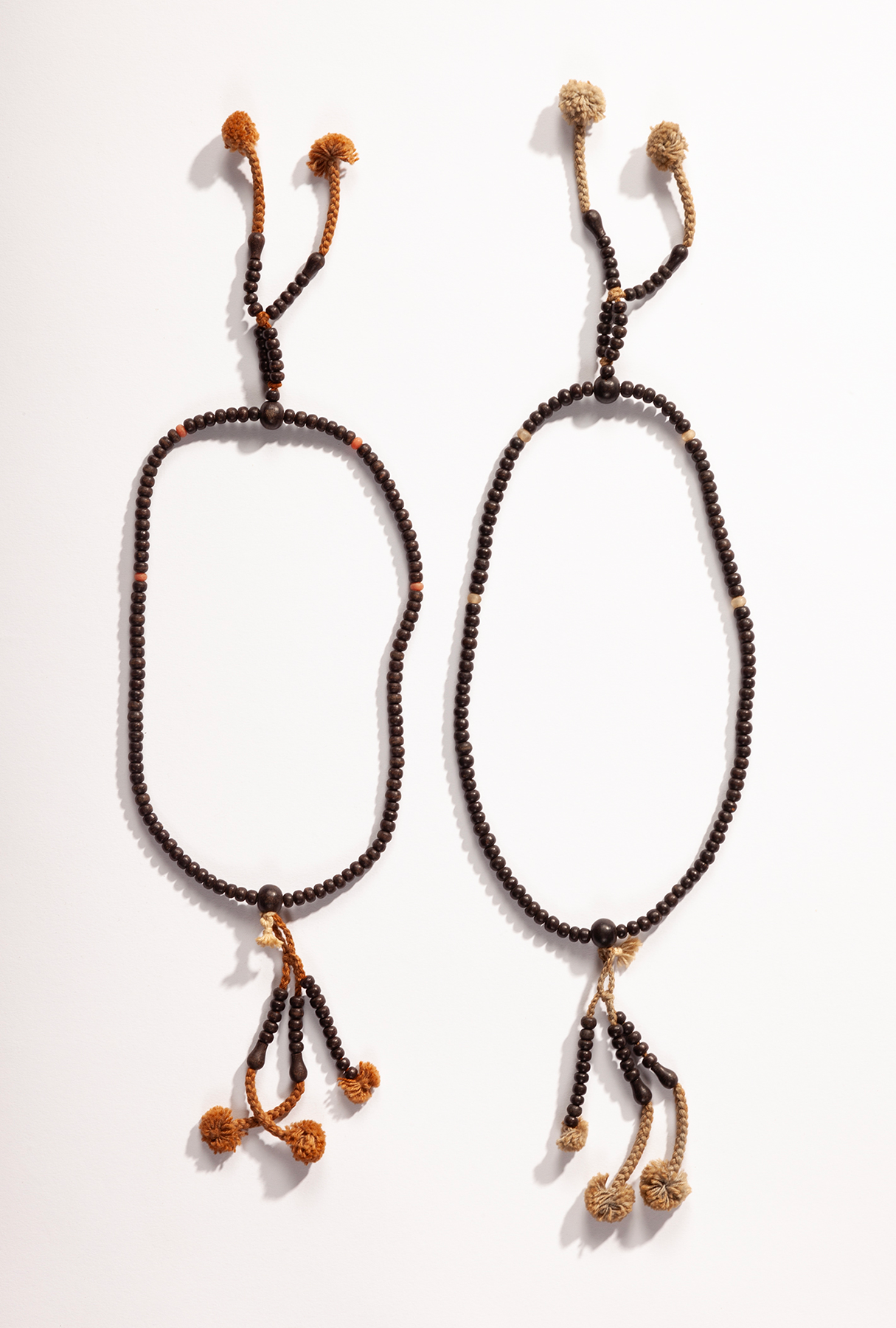
Held in the Fowler Museum collection, these bracelets, each 46-47 cm in length, consist of beaded cords connected with a fibrous twine (Fig. 1). Like all of Fowler's Ainu holdings transferred from the Anthropology Department in 1965, the date (given as c. 1917 in the collection notes) is uncertain. The majority of the beads are wooden, with four glass beads, two on each side of a large bead on the end. Each side of the cords are marked with a larger wooden bead roughly equidistant. Both endings on each cord are very similar but consist of different numbers of beaded strand endings. On the bottom end of each there are three beaded strands which are connected to the main cord, threaded through the large bead. Each of the three beaded strands has a spherical tuft at the end.
The left cord seems to show damage to the original three-strand twine fastener, so it appears the bracelet was repaired, with the three bead strands reconnected using a new twine through the top of the bead hole, which then was tied to the original twine. This new fibrous twine is marked by a difference in color which could either suggest a different fiber was used or a newer, cleaner version of the original fiber. The top of each cord is marked with one beaded strand connected through the fibrous twine that then splits into two beaded strands towards the bottom. Similar to the other end, the new bead strand is connected through a larger bead.
The ends to these beaded strands also feature spherical tufts of fiber. While both cords seem to be identical in creation, their coloring is different in terms of twine and glass beads used. The cord on the left has a more brown/tan coloring palette, while the cord to the right has a green/grey color. Both cords use the same three shapes of wooden beads. One bracelet contains 116 beads in the center loop, while the other bracelet contains 114 beads. Each tail, top and bottom on both bracelets, contains 20 beads on each tail, creating a symmetrical and intentional design.
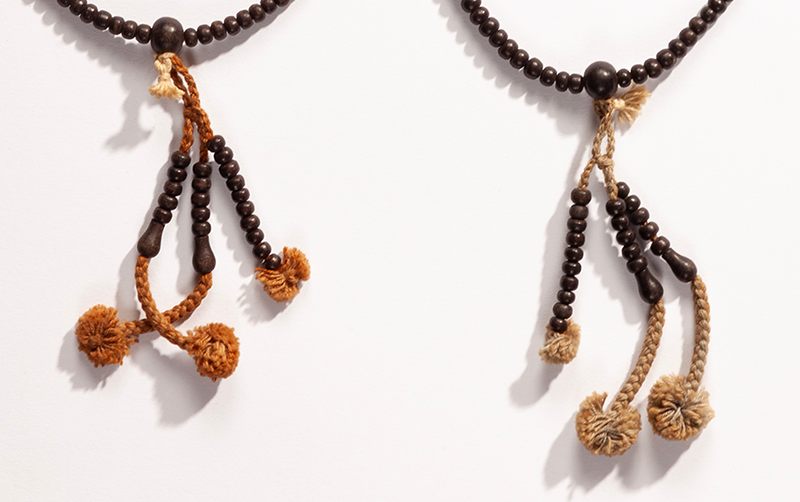
Given that the Fowler catalog had no information other than “bracelet” for this item, we initially began our research by exploring the kinds of jewelry worn by Ainu. One thought was that this beaded cord could be a tamasay/tamasai タマサイ necklace, which are traditional imported glass bead necklaces worn by Ainu women.1Shiro Sasaki, "Trading Brokers and Partners with China, Russia, and Japan" and Mari Kodama, "Clothing and Ornamentation," in Ainu: Spirit of a Northern People, Fitzhugh William W. and Chisato O. Dubreuil, eds. (Arctic Studies Center, National Museum of Natural History, 1999), 91; 324–325. In the Brooklyn Museum, we found a necklace that appears to be a similar style with a larger bead on each end of the string, though it is entirely made of glass beads and seemed too distinct to be the same kind of object (Fig. 3).
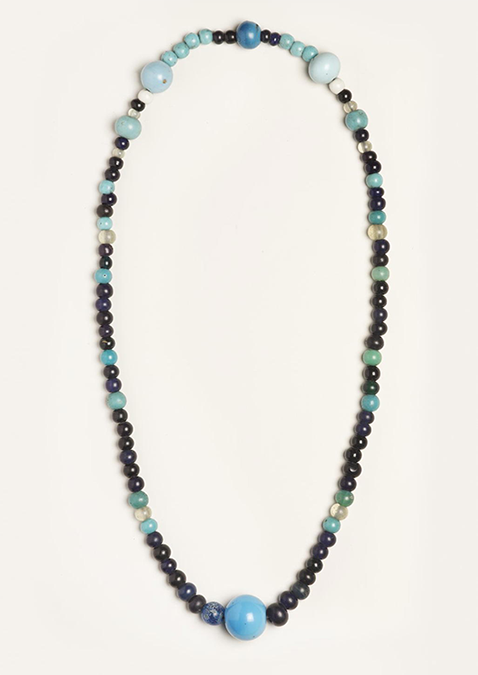
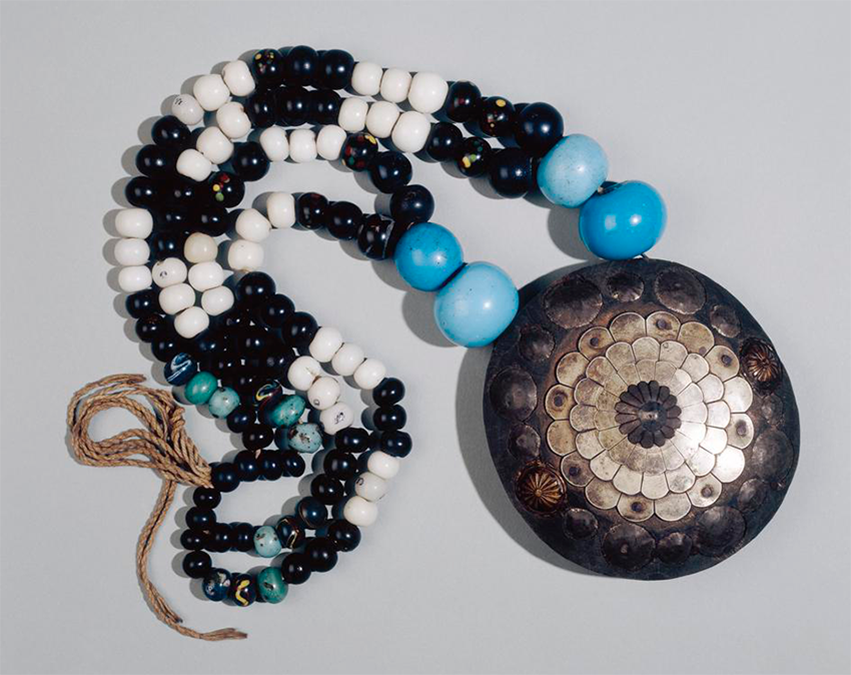
In addition, though tamasay necklaces have ornate large and small glass beads strung on a fibrous twine, many also have a large (typically metal) medallion known as shitoki シトキ hanging in the center, and some are left open on the ends so it can be tied around the neck (Fig. 4). In contrast to these much more ornate traditional necklaces, the beaded cords from the Fowler archives are mostly wooden, with no medallion ornamentation (or a place for it).
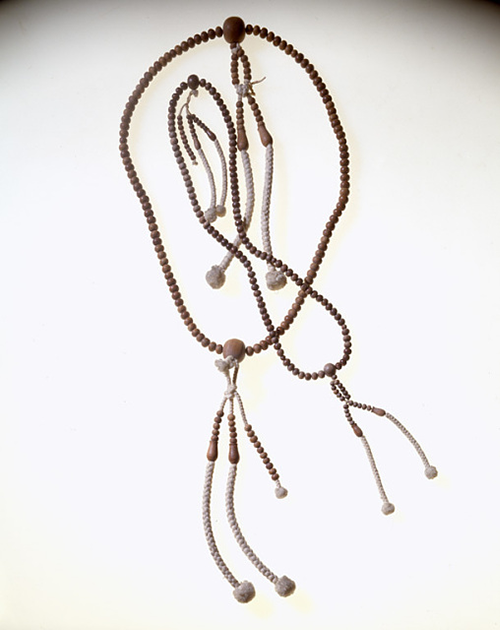
We therefore turned our attention to other possibilities, and found that the bracelet’s structure closely resembles a Buddhist rosary (juzu 数珠), a ritual object that was used throughout Japan for prayers, chanting, and meditation. Buddhist rosaries may contain slightly different numbers of beads, though many 108, signifying the 108 worldly desires that people sought to overcome. In addition to the main string of beads, Japanese rosaries often have larger beads, smaller beads, and tassel strand extensions. The tassel sections were used to distinguish sections of the rosary to help with counting, and the rosaries were worn around the wrist as they were counted, which helps explain why an item such as ours in the Fowler was listed as “bracelet.”2Michaela Mross, “Prayer Beads in Japanese Sōtō Zen,” in Zen and Material Culture, eds. Pamela D. Winfield and Steven Heine (New York: Oxford University Press, 2017), 105–107. A near identical rosary to the one in the Fowler can be found in the Smithsonian collections, dated to 1889 (Fig. 5). From these similarities in bead type, structure, and fiber features, we can conclude these bracelets are in fact Buddhist rosaries.
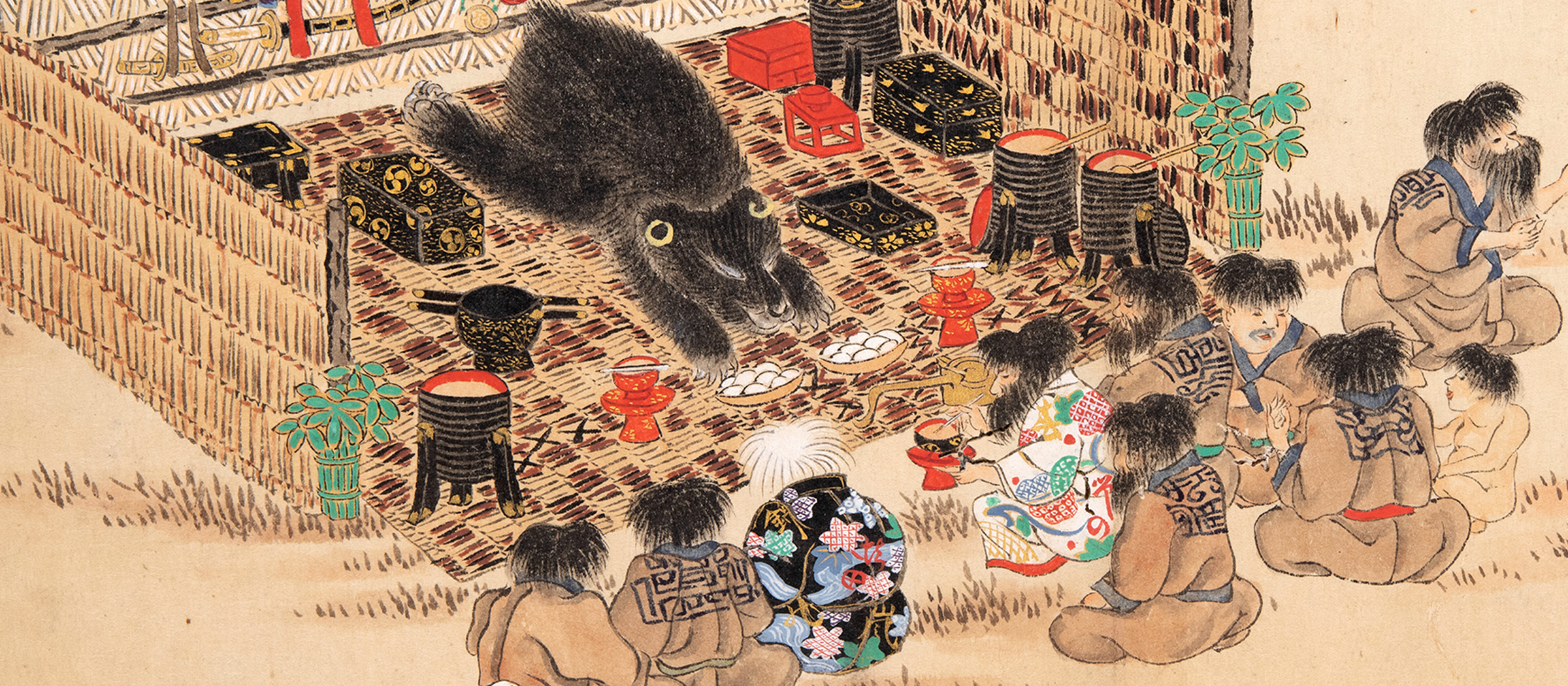
It is uncertain if the Ainu people used these rosaries for Buddhist ceremonial functions or if the rosaries were obtained from the Japanese and considered to be a treasure like Japanese swords or lacquerware. Buddhist practitioners were sent to Hokkaido in the late nineteenth century to proselytize to Ainu.3James Edward Ketelaar, “Hokkaido Buddhism and the Early Meiji State,” in New Directions in the Study of Meiji Japan, Helen Hardacre and Adam L. Kern, eds. (Brill, 1997), 543–544.
References
Beads For Praying, 1889, wooden beads and twine. Smithsonian National Museum of Natural History (E130683-0). http://n2t.net/ark:/65665/3c05d03d3-b7c2-49d1-bbdb-f7808c1776f9
Beads Strung on Cord, late 19th–early 20th century, glass beads, 4 cm x 126 cm. Brooklyn Museum, Gift of Herman Stutzer (12.446). https://www.brooklynmuseum.org/objects/6265
Ketelaar, James Edward Ketelaar. “Hokkaido Buddhism and the Early Meiji State.” In New Directions in the Study of Meiji Japan. Edited by Helen Hardacre and Adam L. Kern, 531–548. Brill, 1997.
Kodama Mari Kodama. "Clothing and Ornamentation." In Ainu: Spirit of a Northern People. Edited by William W. Fitzhugh and Chisato O. Dubreuil, 86–91. Arctic Studies Center, National Museum of Natural History, 1999.
Mross, Michaela Mross. “Prayer Beads in Japanese Sōtō Zen.” In Zen and Material Culture. Edited by Pamela D. Winfield and Steven Heine, 102–136. New York: Oxford University Press, 2017.
Necklace, date unknown, glass beads, wood, and metal, 31.2 cm. British Museum Collection Online (As1910,1119.3). https://www.britishmuseum.org/collection/object/A_As1910-1119-3
Sasaki Shiro. "Trading Brokers and Partners with China, Russia, and Japan." In Ainu: Spirit of a Northern People. Edited by William W. Fitzhugh and Chisato O. Dubreuil, 313–326. Arctic Studies Center, National Museum of Natural History, 1999.