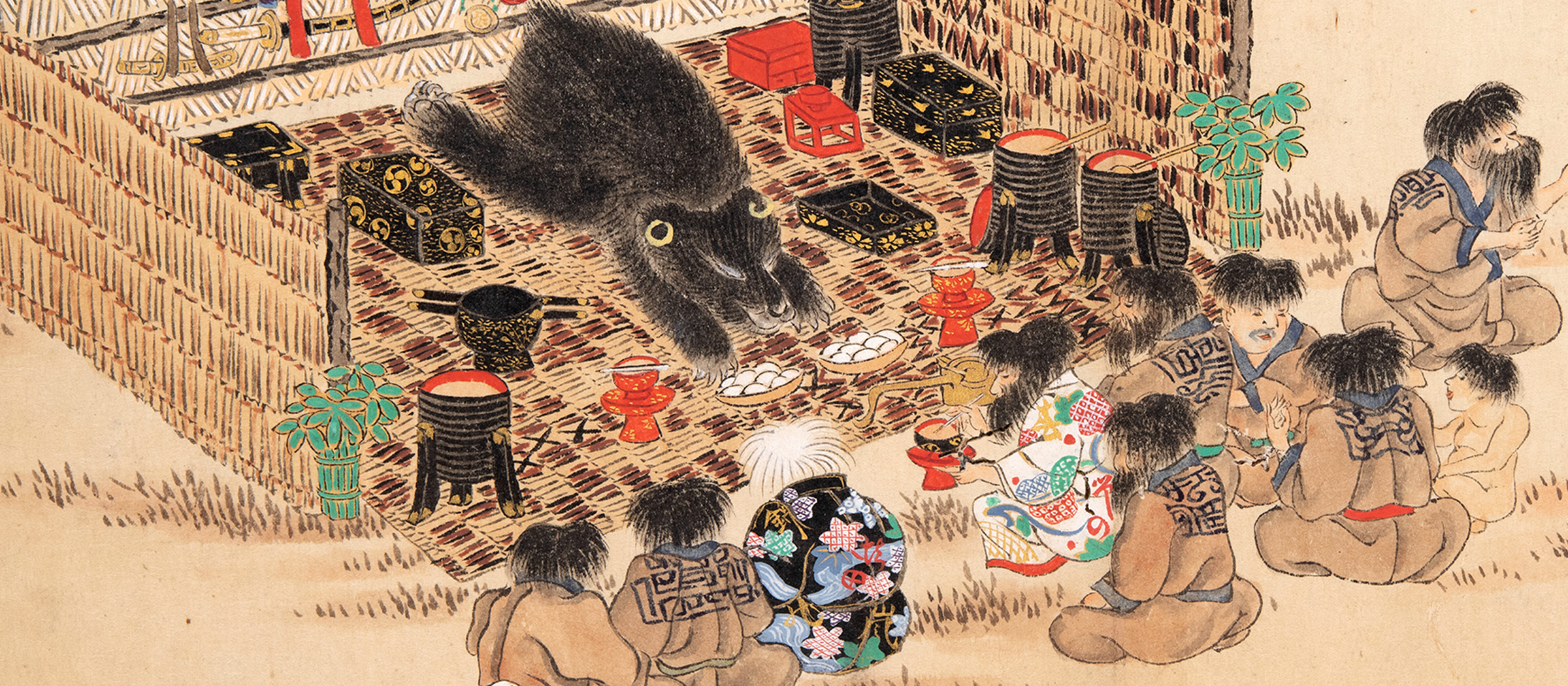
Ikupasuy (prayer sticks)
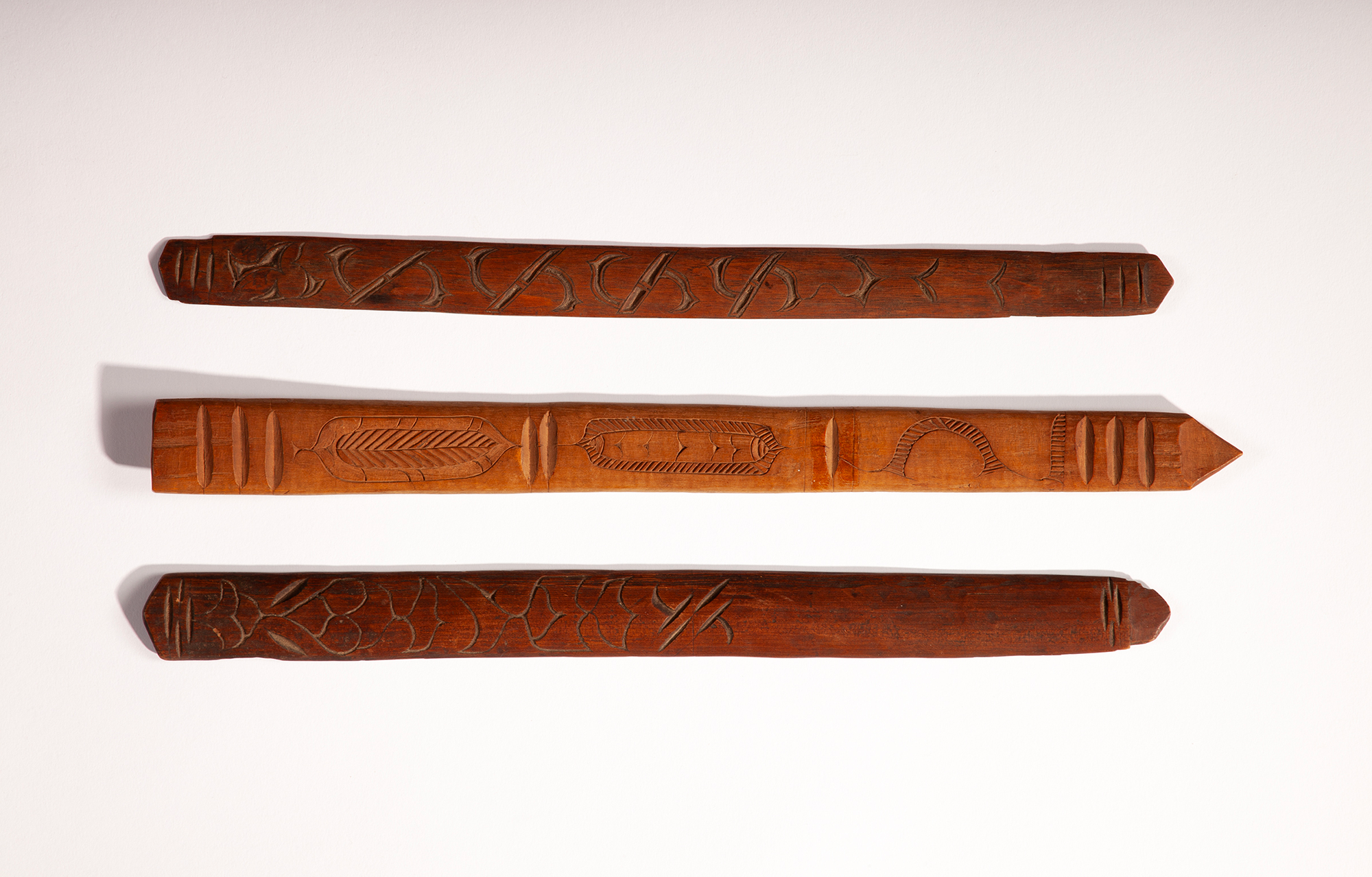
The Fowler Museum at UCLA holds several ikupasuy (イクパスイ), carved wooden ceremonial sticks or prayer sticks used for ritual purposes.1The Fowler Museum has three ikupasuy clearly indicated in its holdings records, but there may be a fourth held in offsite storage labeled as “Ainu wine spatula” (Object ID: X92.406). We were unable to confirm the nature of this holding firsthand. Ainu people used ikupasuy in ceremonial practices when offering millet beer or rice wine to kamuy.
The three ikupasuy viewed by our team (Fig. 1) range from between 33.5 cm and 35.6 cm in length and 2.5 cm and 3.2 cm in width. We do not know the exact wood used to make these ikupasuy, but ikupasuy are typically made of Japanese yew or willow wood.2Japan Tourism Agency, "Ikupasuy: Offering Sticks to Commune with Kamuy," JTA Sightseeing Database, 2024. https://www.mlit.go.jp/tagengo-db/en/R6-00299.html. The ikupasuy are long and narrow, with carved symbols on the surface and a slightly rounded end on one side and a pointed end on the other. Each stick varies in shades of a natural wooden brown color, though some parts of the wood appear darker on each stick, especially around the carved areas and lower end, where people would have held it for regular use.
Many museum collections identify ikupasuy as “mustache lifters” in their labels or object records, an inaccurate and misleading term. One possible origin of this name may be traced as far back as the sixteenth century. The Portuguese Jesuit missionary Luís Fróis wrote a letter about his activities and observations in Japan in 1565 in which he described the people of Ezo (Hokkaido) as having “wondrous beards and enormous mustaches, which they lift with a small wand when they are about to drink.”3Fosco Maraini, “Ikupasuy: It’s Not a Mustache Lifter!” in Ainu: Spirit of a Northern People, Fitzhugh William W. and Chisato O. Dubreuil, eds. (Arctic Studies Center, National Museum of Natural History, 1999), 327. Even though this passage provides an image of how ikupasuy was used, it misunderstands the ritual purpose of ikupasuy. Frois’s record seems to be the beginning of this misunderstanding, but the use of the name “mustache lifter” became more fixed in later English writing from the late nineteenth and early twentieth century.
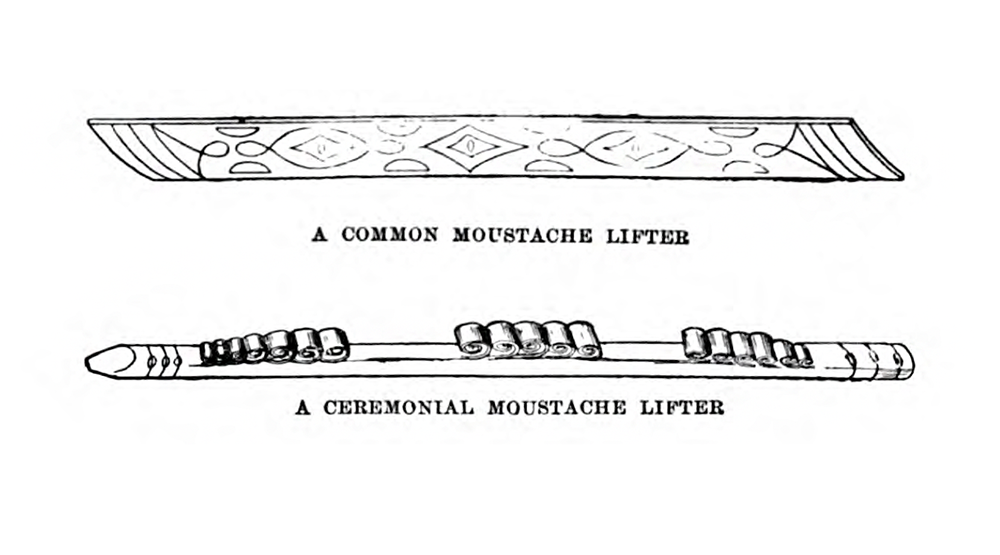
For example, we see the term appear in the work of John Batchelor (1854–1944), an archdeacon of Church Mission Society (a British Anglican mission organization) and missionary to the Ainu. Beginning in 1889, he authored several books on Ainu, including The Ainu of Japan (1892), a book that introduced Ainu religion, customs, and history to English-speaking readers. In this book, Batchelor labels ikupasuy as “A Common Moustache Lifter” and “A Ceremonial Moustache Lifter” (Fig. 2) He also describes ikupasuy as “moustache lifters” multiple times in the text, and notes that they were used to offer drops of wine to the gods during ceremonies.4John Batchelor, The Ainu of Japan: The Religion, Superstitions, and General History of the Hairy Aborigines of Japan (New York: Fleming H. Revell Company, 1892), 77–78, 124, 204. This shows that Batchelor recognized (to a degree) the ritual use of ikupasuy, but still presented ikupasuy under this misleading name. Because Batchelor lived among Ainu communities for nearly seventy years and became an important English-language authority on Ainu culture, his wording likely helped spread this inaccurate label in later scholarship and museum collections.
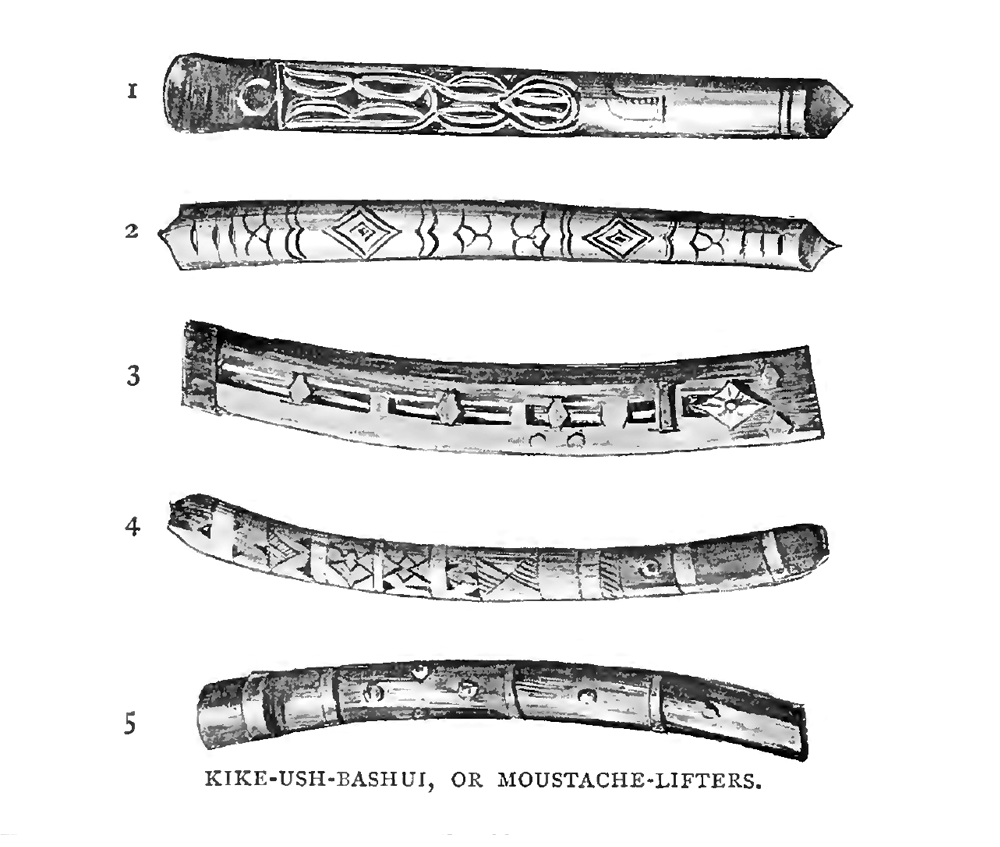
Another example appears in A.H. Savage Landor’s Alone With The Hairy Ainu (1893), published only a year after Batchelor’s The Ainu of Japan. Landor also used the term “moustache-lifters” several times in the text. His list of illustrations are captioned “Kike-Ush-Bashui, or moustache-lifters,” (Fig. 3) further showing how this misinterpretation was not only limited to Batchlor’s writing, but widely circulated in English-language descriptions of ikupasuy.5A. H. Savage Landor, Alone with the Hairy Ainu, or, 3,800 Miles on a Pack Saddle in Yezo and a Cruise to the Kurile Islands (London: John Murray, 1893), 29, 32, 208, 218, 220–223, 246, 289. While Frois’s 1565 letter is an early source that demonstrates, and perhaps is the origin of, this incorrect name, Anglophone writers helped transform that simple misunderstanding into a commonly used definition.
In the Fowler collections, our team found that the provenance card included for one of the ikupasuy donated by Henry Wellcome reiterated this misnomer:
![A provenance record of typed text that says 12.939 [1936] KWV X65-11996 MOUSTACHE LIFTER. Slat of wood, light colour, decorated with incised carving. Used for raising moustache when drinking from bowl. 35.8 x 3.2 cm. Ainu, Yezo, Japan. 16.815 [R]](/assets/images/ikupasuy-wellcome.png)
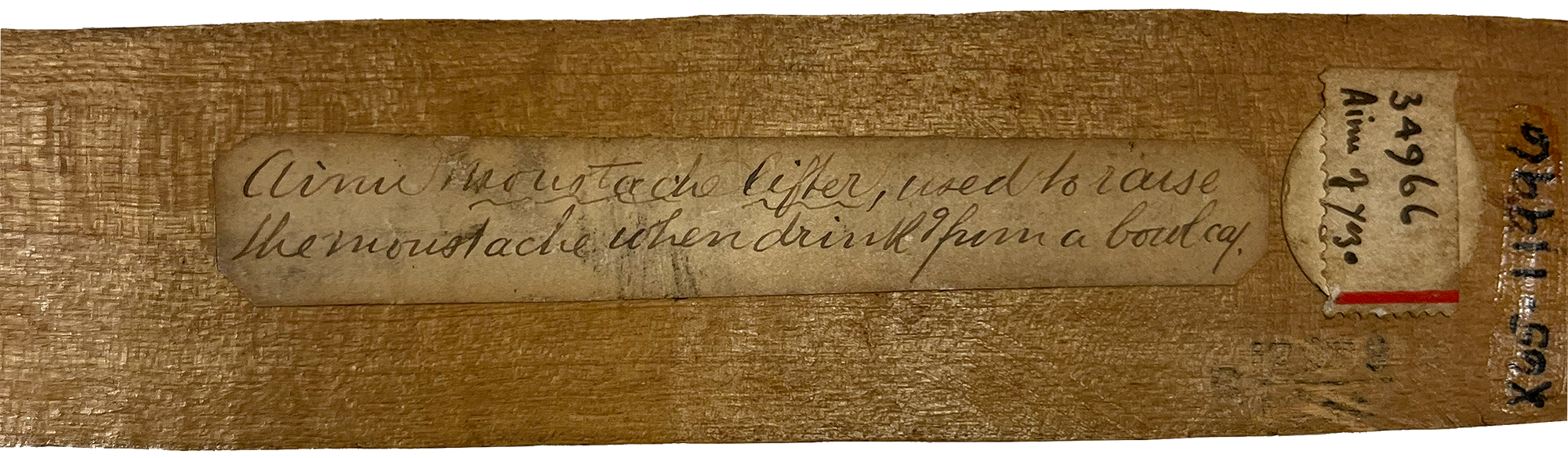
There is a label on the back of the ikupasuy donated by Wellcome (Fig. 5) with a hand-written note that reads "Ainu moustache lifter, used to raise the moustache when drinking from a bowl." We are pleased to be able to correct this error through our research and make a positive contribution to the museum’s catalog records in collaboration with the Fowler staff.
Ikupasuy are used during ceremonies to facilitate connections between and communication among Ainu men and kamuy, the deities of the Ainu people. ikupasuy are adorned with carvings that represent the owner so that the kamuy will recognize their prayers.6Japan Tourism Agency. The patterns or symbols carved into ikupasuy are therefore one of their most important features. It identifies the owner of the ikupasuy, so the kamuy can know from whom the prayer is being conveyed or who is making the offering, and is believed to have the power to reach the deities directly, bolstering anything that might be found lacking in the human prayer itself.7Kōeki zaidan hōjin Ainu minzoku bunka zaidan 公益財団法人アイヌ民族文化財団 [The Foundation for Ainu Culture]. "Ikupasui 捧酒箸(イクパスイ)" in Ainu seikatsu bunka zaigen manyuaru アイヌ生活文化再現マニュアル (公益財団法人アイヌ民族文化財団, 2019). 7.
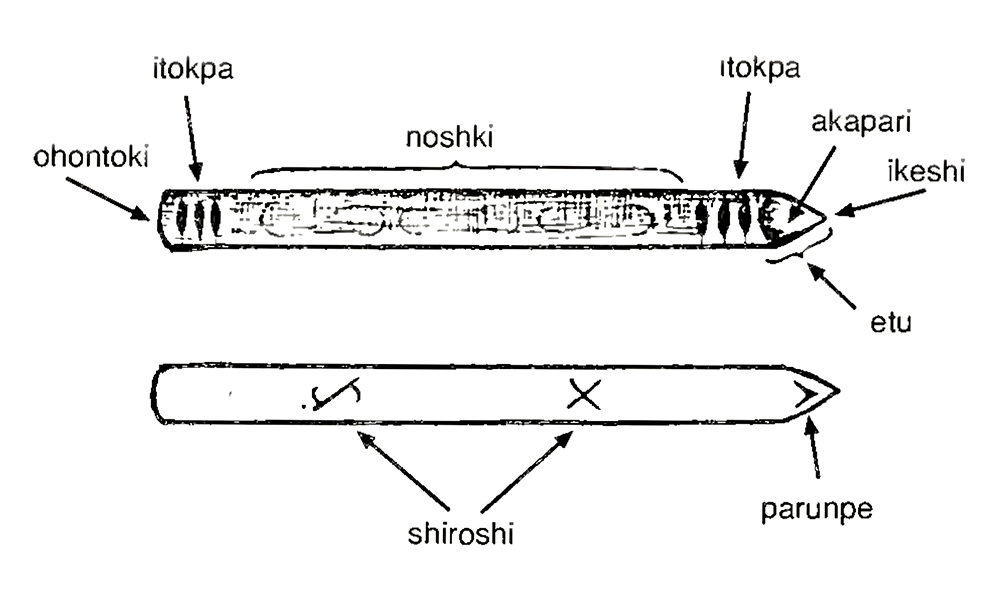
Given the specificity of ikupasuy to the owner, the designs of ikupasuy vary from one carving to another. They include complex symbols that represent family crests (itokpa), animals, flowers, or abstract patterns depicting elements of Ainu life and customs. Some parts of the ikupasuy allowed more freedom for carving, but the designs of itokpa are often fixed because it represents the patrilineage of the ikupasuy owner. In addition, ikupasuy are typically a ritual item carved and used exclusively by men. The equivalent of ikupasuy for women would be their secret woven grass belts, which were handed down from mother to daughter.8Maraini, “Ikupasuy,” 331; British Museum. "Ikupasuy; Ceremonial Equipment." Collection Online. Accessed June 1, 2026. https://www.britishmuseum.org/collection/object/A_As1910-1119-44; Japan Tourism Agency; University of Michigan Museum of Art. “Ikupasuy (Prayer Stick).” Collection Online. Accessed June 1, 2026. https://umma.umich.edu/objects/ikupasuy-prayer-stick-1991-1-81/
References
Batchelor, John. The Ainu of Japan: The Religion, Superstitions, and General History of the Hairy Aborigines of Japan. New York: Fleming H. Revell Company, 1892.
British Museum. "Ikupasuy; Ceremonial Equipment." Collection Online. Accessed June 1, 2026. https://www.britishmuseum.org/collection/object/A_As1910-1119-44.
Japan Tourism Agency. "Ikupasuy: Offering Sticks to Commune with Kamuy." JTA Sightseeing Database. 2024. https://www.mlit.go.jp/tagengo-db/en/R6-00299.html.
Kōeki zaidan hōjin Ainu minzoku bunka zaidan 公益財団法人アイヌ民族文化財団 [The Foundation for Ainu Culture]. "Ikupasui 捧酒箸(イクパスイ)" in Ainu seikatsu bunka zaigen manyuaru アイヌ生活文化再現マニュアル. 公益財団法人アイヌ民族文化財団, 2019. https://www.ff-ainu.or.jp/web/learn/culture/manual/files/r02_ikupasui.pdf.
Landor, A. H. Savage. Alone with the Hairy Ainu, or, 3,800 Miles on a Pack Saddle in Yezo and a Cruise to the Kurile Islands. London: John Murray, 1893.
Maraini, Fosco. “Ikupasuy: It’s Not a Mustache Lifter!” In Ainu: Spirit of a Northern People. Edited by William W. Fitzhugh and Chisato O. Dubreuil, 327–333. Arctic Studies Center, National Museum of Natural History, 1999.