A Brief History of Ainu
The history of the Ainu people is long, complex, and deserves far more space and depth than we can offer for a website such as this one. However, below we attempt to outline some of the significant developments and moments in Ainu history that help situate the collections introduced through the museum and library holdings of UCLA.
To begin, it is worth noting that Ainu history has long been conflated with that of the Emishi, a term used for northern peoples who were labeled “barbarians” by the nascent Yamato state as it attempted to assert its identity and authority in relation to people living beyond what it defined as its northern and southern frontiers.1Tomio Takahashi, “The Classical Polity and Its Frontier,” translated by Karl F. Friday in Capital and Countryside in Japan, 300-1180: Japanese Historians in English, edited by Joan R. Piggott (Cornell East Asia Series, 2006), 130–133. The name Emishi 蝦夷, written with characters meaning “prawn,” “shrimp,” or “toad” (蝦) and “barbarian” (夷), was one applied by the Yamato state to various peoples who lived in northern Honshu and southern Hokkaido. We do not know what these people called themselves, but the existing records suggest that they existed in a variety of small communities with loose connections to one another that resisted Yamato intrusion into their territories from the fifth century well into the medieval period. With the exception of a handful of government petitions quoted within Yamato histories, there are no extant textual sources written by or reflecting the perspective of these northern peoples, and therefore we know very little about Emishi culture and society. Nevertheless, the archaeological and textual sources we do have suggest they had at least a distinct language and were perceived to be culturally distinct from the Yamato people. Thus, it is possible to infer they were ethnically distinct from Yamato peoples, suffering discrimination as people who were “different” from the Yamato population even centuries into assimilation.2For a detailed study of the Emishi as an ethnic group and the term “Emishi” as a function of administrative policy, see the forthcoming article by Nadia Kanagawa, “‘Submit and Be Transformed': The Incomplete Integration of Emishi as Subjects in Eighth- and Ninth-Century Japan,” which will appear in their The Medieval World series in a volume tentatively titled Ethnicity and Race in Inner and East Asia with Bloomsbury.
But were Emishi, in fact, Ainu? While this question long dominated scholarship on the peoples of northern Japan, present day scholarship has largely moved past this debate to consider more nuanced questions. The North was an area of significant intermingling between culturally distinct communities over thousands of years (including Jomon peoples migrating from Honshu), with communication, trade, and conflict taking place regularly in the Sea of Okhotsk region among today’s Hokkaido, the Kuril Islands, Sakhalin Island, and the Amur River Valley, largely independent of activities in Honshu.
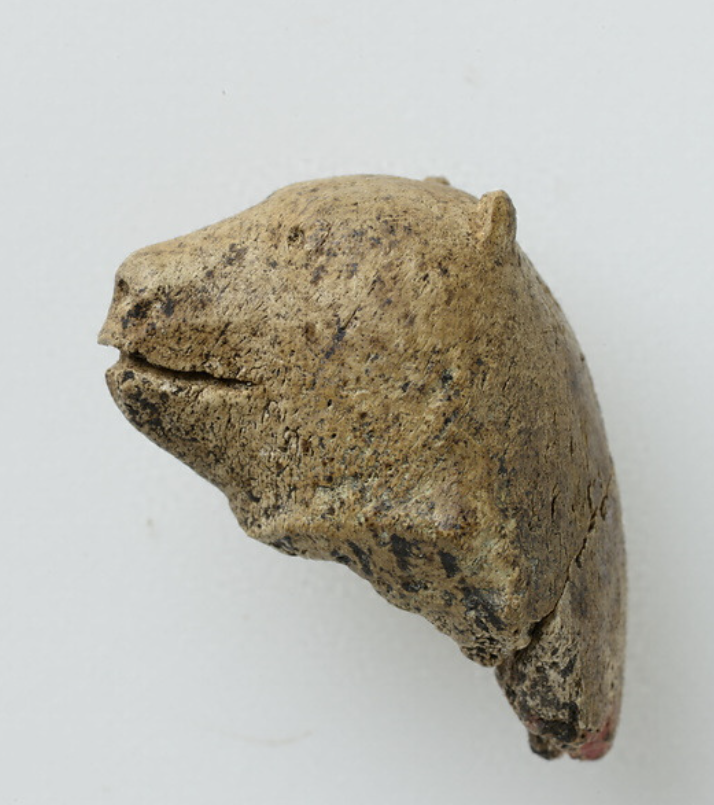
The people and culture known today as Ainu are believed to have emerged around the late twelfth to early thirteenth centuries, demonstrating cultural influences from the earlier Okhotsk people, active c. 600–1,000, and the Satsumon people, active c. 700–1,200. Among the Okhotsk people we find bear worship (Fig. 1), which would later become significant to Ainu practices, and among the Satsumon similar lifestyle, migration, and hunting practices.3Brett L. Walker, The Conquest of Ainu Lands: Ecology and Culture in Japanese Expansion, 1590–1800 (University of California Press, 2001), 20–23. We have no records of writing practices among these northern cultures; relying on Japanese records, which have inconsistent descriptions and naming practices for various northern peoples, it is difficult to pin down clear origins or distinctions. Scholars rely heavily on archaeological evidence and material culture for their inferences.
The perception of the north as a land of barbarians began with the emergence of the concept of Emishi during the ancient period and continued throughout the medieval and early modern periods. The characters for Emishi (蝦夷) came to be read as “Ezo” and after the northernmost areas of Honshu were considered more or less incorporated into the realm (albeit under the rule of former Emishi who had assimilated) “Ezo,” “Ezogashima,” (蝦夷島, literally “Barbarian Islands”), and “Ezochi” (蝦夷地, “Barbarian Land”) became the general term for places north of Honshu. Ainu, who inherited the Japanese stereotypes of their southern Emishi neighbors as “savages” and “hairy barbarians,” lived throughout the so-called northern frontier in culturally diverse communities throughout Hokkaido, the Kurils, and Sakhalin.
As a region somewhat unknown, rich in resources, and positioned precariously close to the northern edges of the mainland, the north was always of interest to those in power. Throughout the medieval period the (ironically, Emishi descent) rulers of the north in Mutsu and Dewa Provinces were militarily powerful and managed northern trade, periodically becoming entangled in internecine wars and conflicts with the warrior governments based just to the southeast.4On the subject of ruling families of the north and their Emishi origins, see Mimi Yiengpruksawan’s Hiraizumi: Buddhist Art and Regional Politics in Twelfth-Century Japan. Harvard East Asian Monographs, 1999, particularly Chapter 2, “The Kitakami Rulers.” Ainu were not mere spectators to the interference of Japanese into their lands and trading routes; during the fifteenth century there were periodic outbreaks of violence, such as Koshamain’s War (1456–1458), a briefly unified Ainu attack on Japanese set off by the murder of an Ainu youth by a Japanese blacksmith.5 Walker, 27. Other periodic conflicts took place in 1512–1515 and 1528–1531, no doubt driven by the inequities and violent displacements that persisted throughout the north.6Howell, David L., “The Ainu and the Early Modern Japanese State, 1600–1868,” in Ainu: Spirit of a Northern People, Fitzhugh William W. and Chisato O. Dubreuil, eds. (Arctic Studies Center, National Museum of Natural History, 1999), 96–97.
By the sixteenth century, when the Kakizaki family came to manage northern affairs, major players such as Oda Nobunaga, Toyotomi Hideyoshi, and Tokugawa Ieyasu, knowing the strategic importance of Ezo, kept the Kakizaki close. The Kakizaki would eventually be invested as the Matsumae family, and in 1604, having been made lords of the Matsumae Domain on the southern tip of Hokkaido, they were given exclusive rights to oversee trade with the Ainu, rights that would continue throughout the early modern period.7Walker, 27–47. With more and more Japanese settlers and merchants displacing Ainu communities and disrupting Ainu ways of life by taking control of trade and forcing Ainu into Japanese systems of commerce, Ainu communities found their political and cultural systems significantly eroded. Ainu came to rely on Japanese commodities for their survival while more and more Japanese trading posts were set up that exploited Ainu labor and threatened northern ecological stability. At the same time, Ainu communities were disproportionately impacted by the physical and biological violence of settler colonization, such as sexual violence against Ainu women by Japanese and the spread of smallpox, which could wipe out entire villages at a time.8For a substantial study of the impact of disease on Ainu communities in the early modern period, see Chapter 7, “Epidemic Disease, Medicine, and the Shifting Ecology of Ezo” in Brett Walker’s The Conquest of Ainu Lands. The last major revolt against Japanese authority, Shakushain’s War, took place from roughly 1669 to 1672. This conflict began as a local dispute among Ainu communities over resources (and, ultimately, the growing disconnect between traditional Ainu ways of life and subsistence), but quickly escalated to involve Japanese authorities and resulting in shogunal orders to mobilize against Ainu. After a brief coalition of Ainu resistance against Matsumae forces and a series of violent clashes, Ainu communities eventually surrendered and Matsumae control over Ezo was further consolidated.9Walker, 49–52, 64–72.
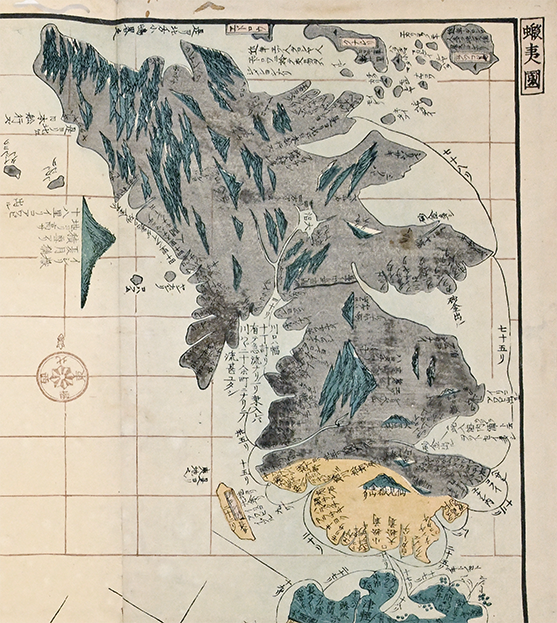
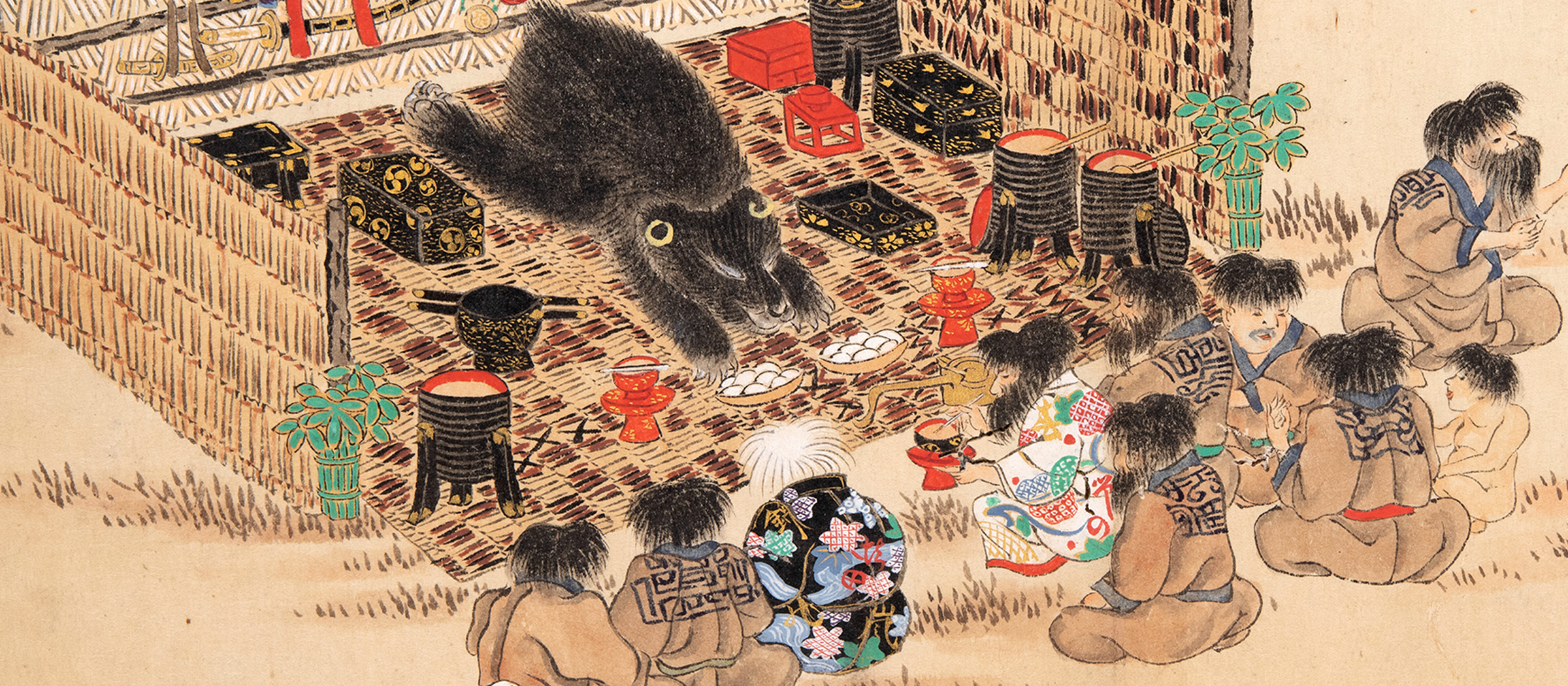
At the same time as Ainu communities were being devastated by the activities of Japanese in the north, they also became a source of fascination for Japanese explorers and geographers. As interest in the north continued to grow–not only for the exploitation of its resources but also for its critical location in relation to Russia–more Japanese were sent to survey Hokkaido, the Kurils, and Sakhalin. Expeditions from the mid to late eighteenth century produced some of the earliest ethnographic records of the Ainu. While many of the images and commentary reflect “frontier barbarian” perspectives of Ainu communities, these sources also provide detailed information on material, cultural, and social practices that might otherwise have been lost.10Toshikazu Sasaki provides a helpful overview of Ainu-e as a genre and many of the Japanese figures who produced the earliest ethnographic records of the Ainu in his “Ainu-e: A Historical Review,” in Ainu: Spirit of a Northern People, Fitzhugh William W. and Chisato O. Dubreuil, eds. (Arctic Studies Center, National Museum of Natural History, 1999), 79–85. These sources can be triangulated with Ainu oral histories and other Indigenous records to better understand the elements that are accurate as well as those that are biased.
During the late nineteenth century, as Japan transitioned from its early modern state to aspirations of modernity on the global stage as the Meiji state, the formal colonization and annexation of Ezo took place, and Ezo was officially renamed to Hokkaido in 1869. Government projects were immediately undertaken to construct highways that would make Hokkaido more accessible to Japanese and even missionary work was sponsored to bring Buddhism to the Indigenous populations.11Pia M. Joliffe, “Forced Labour in Imperial Japan’s First Colony: Hokkaidō,” The Asia-Pacific Journal: Japan Focus 18, issue 20, no.2 (2020): 4–5. From the 1870s through the beginning of the twentieth century the accessibility of Hokkaido to outsiders resulted in studies of Ainu communities and society being circulated to English-language audiences by many Americans and Europeans mentioned throughout this site. Their activities, along with many others who were fascinated by the presence of Indigenous peoples in Japan, resulted in many of the major Ainu collections outside of Japan.
Meiji policies toward Ainu, often using euphemistic terms like “protection,” were aimed at both ensuring Ainu could be assimilated into the new modern state as Japanese citizens and eliminating elements of Ainu identity and society that did not adhere to new standards of “civilized” modern society. Agriculture was encouraged, Ainu language and customs were discouraged, and the exploitation of Ainu workers and women continued.12Howell, Geographies of Identity in Nineteenth Century Japan (University of California Press, 2005), 172–175. When Sakhalin was ceded to Russia in 1875 and the Kurils formally came under Japanese control, hundreds of Ainu were forced to relocate out of these areas, deeply impacting the welfare and cohesion of their communities.13Howell, Geographies, 186–187.
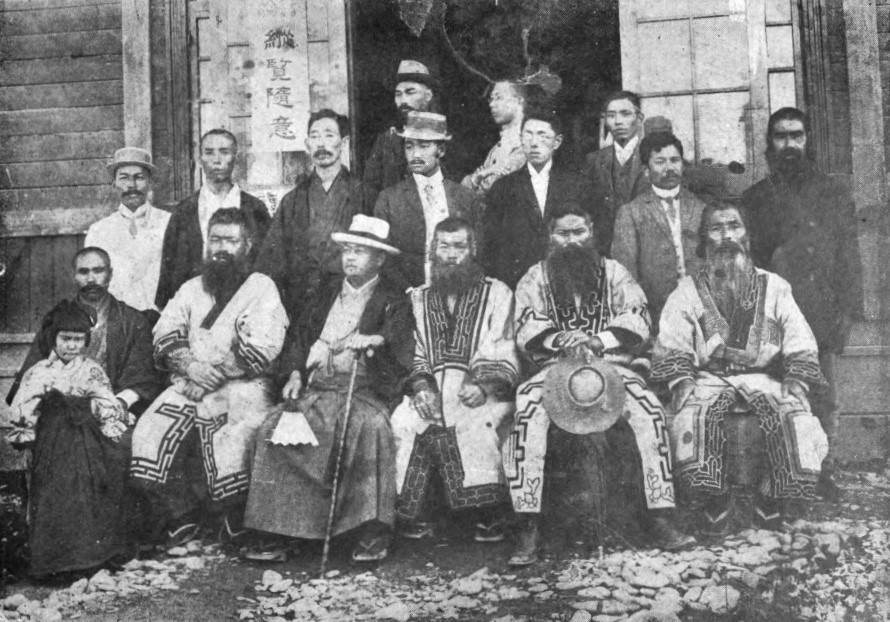
The early twentieth century witnessed more advocacy on behalf of and by Ainu. Particularly in the 1920s an educated generation of Ainu began to engage in activism in tandem with other minority groups such as Korean laborers, rejecting Japanese views of Ainu as a “dying race.”14Richard Siddle, Race, Resistance, and the Ainu of Japan (Routledge, 1996), 120–122. Though the 1930s saw limited gains, namely in the establishment of the Ainu Association of Hokkaido (Hokkaidō Ainu Kyōkai 北海道アイヌ協会), intense pressures to assimilate, intermarry with Japanese, and abandon Ainu identity remained, changed little even by the outcomes of World War II. Movements in the ‘60s and ‘70s were more radical, inspired by activist trends in and outside of Japan (particularly other Indigenous communities), and many young Ainu sought to challenge even groups like the Ainu Association of Hokkaido, which some felt were conservative institutions still rooted in generations-old assimilation rhetoric. The ‘80s and ‘90s, in turn, saw greater social cohesion within Ainu communities with ongoing efforts toward reclamation of cultural identity and legal advocacy for the Indigenous rights of Ainu.15For extensive and detailed overviews of Ainu activism in the early twentieth century in English, see Richard Siddle’s Race, Resistance, and the Ainu of Japan, especially “Ainu protest and resistance, 1869–1945” (113–146) and “Ainu liberation and welfare colonialism” (147–170) as well as Siddle’s “Ainu: Japan’s indigenous people,” in Japan’s Minorities: The illusion of homogeneity, Michael Weiner, ed. (Routledge, 1997), 21–39.
These movements would continue to develop, evolve, and grow, at times limited by restrictive frameworks of Japanese governance that sought (and in many ways still seek) to preserve purported racial homogeneity among Japanese while exoticizing Ainu cultural traditions and systematically discriminating against communities.16For extensive and detailed overviews of Ainu activism in the early twentieth century in English, see Richard Siddle’s Race, Resistance, and the Ainu of Japan, especially “Ainu protest and resistance, 1869–1945” (113–146) and “Ainu liberation and welfare colonialism” (147–170) as well as Siddle’s “Ainu: Japan’s indigenous people” (21–39). As our page on commercialization of Ainu products discusses, there have been numerous organizations over the decades that promoted Ainu culture within and outside of these problematic frameworks. It is worth noting that only in 2008 did the National Diet in Japan establish their “Resolution Calling to Ensure the Rights of the Ainu People” and only in 2019 were Ainu recognized formally as an Indigenous people of Japan. Though it is beyond the scope of this project to go into the details of the many modern-day advocates and artists within Ainu communities that have contributed to the last hundred years of change and growth for Ainu, we hope that this short overview has provided grounding for understanding the many museum objects related to these histories and a starting point for further exploration.
References
Howell, David L. Geographies of Identity in Nineteenth Century Japan. University of California Press, 2005.
Joliffe, Pia M. “Forced Labour in Imperial Japan’s First Colony: Hokkaidō.” The Asia-Pacific Journal: Japan Focus 18, Issue 20, No. 2 (2020): 1–15.
Sasaki Toshikazu. “Ainu-e: A Historical Review.” In Ainu: Spirit of a Northern People. Edited by Fitzhugh William W. and Chisato O. Dubreuil, 79–85. Arctic Studies Center, National Museum of Natural History, 1999.
Siddle, Richard. Race, Resistance, and the Ainu of Japan. Routledge, 1996.
Siddle, Richard. "Ainu: Japan’s indigenous people.” In Japan’s Minorities: The illusion of homogeneity. Edited by Michael Weiner, 21–39. Routledge, 1997.
Walker, Brett L. The Conquest of Ainu Lands: Ecology and Culture in Japanese Expansion, 1590–1800. University of California Press, 2001.