Commercialization of Ainu Products & Related Organizations
Ainu history is marked by centuries of displacement and exploitation. This is one reason why our team spent time trying to discover more about how the collections of actual Ainu objects actually came to our university as well as the history of Ainu materials as commercial products. One item from the Fowler Museum collection in particular, a pair of chopsticks with a box, sparked questions about the difference between items removed from northern communities versus items sold by northern communities. This page provides some background on this subject.
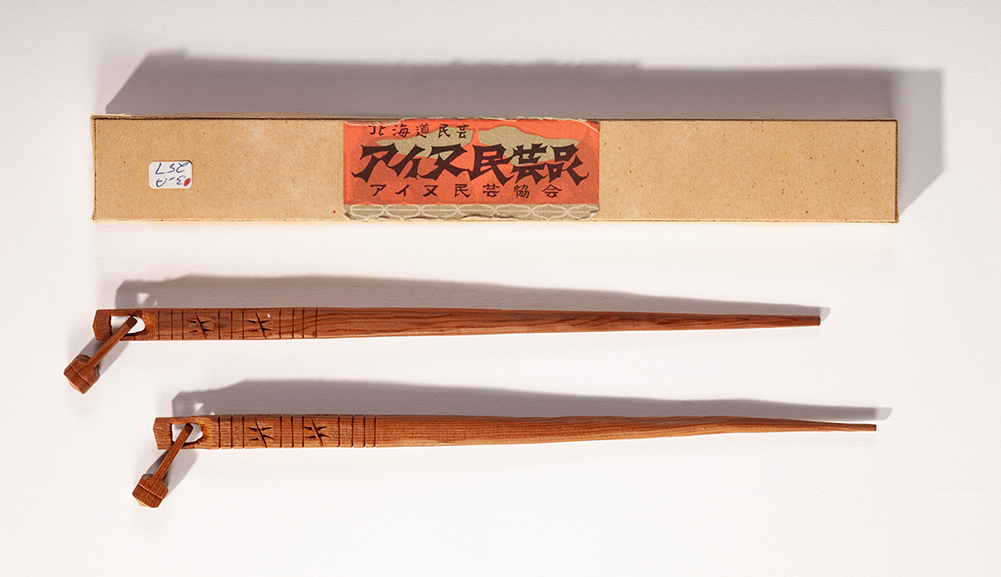
The Fowler Museum at UCLA holds a pair of chopsticks donated by Catherine E. Tierney and P. Lennox Tierney in 1991. The chopsticks are handcarved, with the upper end of each stick carved into a chain link design connected to a bell shaped decoration. The chopsticks measure 1 cm × 23.6 cm × 0.9 cm, are a dark brown in color, and are made from an unidentified type of wood, though likely Japanese yew.1Satō Masahiko 佐藤昌彦, “Considerations on the Use of Tum-us-kot-pasuy for teaching material–Exploring the Educational Value of Traditional Ainu Folk Art トウムシコツパスイ(木鈴つきの箸)の教材化考(1):アイヌ民族の伝統的造形の教育的意義と造形教材としての可能性を探る,” Bijutsu kyōikugaku: bijutsuka kyōikugaku kaishi 美術教育学―美術科教育学会誌― 23 (2002), 86. A closer examination reveals uneven surfaces on the openings connecting the bell links, suggesting the practice typical for this type of chopstick design in which the carver creates it from one piece of wood. Additionally, decorative patterns of traditional Ainu motifs are inscribed on the sides of the chopsticks near the upper end.
The chopsticks come with their original packaging: a light-colored wooden box with a slightly peeling orange adhesive label. The label displays the text “Ainu Folk Craft” (Ainu mingeihin アイヌ民芸品) in a large, stylized font in the middle, and on either sides in a smaller fonts “Hokkaido Folk Craft” (Hokkaidō mingei 北海道民芸) and “Ainu Folk Craft Association” (Ainu mingei kyōkai アイヌ民芸).
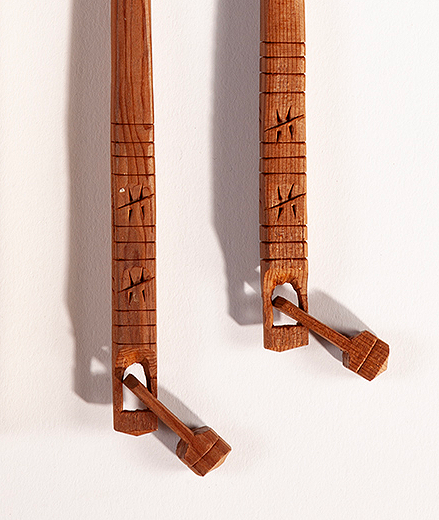
Different from everyday chopsticks, known as ipepasuy イペパスイ, these chopsticks are known as tum-us-kot-pasuy (トゥムシコツパスイ), which translates roughly to “chopsticks with bells attached.” Tum-us-kot-pasuy are characterized by their skilled carving techniques that produce both the bells at the end and length of the chopsticks from a single piece of wood, rather than being made separately and connected after. The size of the chopsticks varies depending on the individual user.2Satō, 85
Tum-us-kot-pasuy is a traditional Ainu folk art, and used exclusively during special occasions, rituals, or for celebratory purposes, though they may be found today as a souvenir. These chopsticks are not for everyday use like ipepasuy because of the wood from which they are made; while ipepasuy are carved from mulberry wood or spindle trees, which are harder and easier to craft, tum-us-kot-pasuy are made of Japanese yew, a more dense and elastic wood that is prone to staining if washed frequently.3Satō, 87–89.
Tum-us-kot-pasuy may be gifted for the celebration of weddings or the first time Ainu children eat solid food or take their first steps. The tum-us-kot-pasuy would be carved by the child’s father or grandfather. According to some, should the child break the bell off while playing, it is taken as a sign that they will grow up strong and become an isonkuru イソンクル, or skilled hunter.4Satō, 91–92. It is notable that unlike the other items held in the Fowler, these chopsticks are the only objects explicitly tied to the promotion and sale of Ainu art in a commercial context, one in which we see tum-us-kot-pasuy as a product, rather than its true cultural function.
This chopstick set from the Fowler Museum is not dated and there is no identified maker. However, a tentative production date may be inferred from the operational period of the organizations listed on its label. The Ainu Folk Craft Association listed on the box was founded in 1938, presumably with the goal to promote and provide instruction for Ainu folk crafts.5Satō, 51–52. Since this item was cataloged in the Fowler collections in 1991, a tentative date between 1938 to 1991 is possible. The “Hokkaido Folk Craft” label printed on the label could be referring to the Hokkaido Folk Craft Association (Hokkaidō mingei Kyōkai), one of the branches of Japan Folk Craft Association (Nihon mingei kyōkai), which established its Hokkaido branch in 1946, but we cannot be sure. The label might simply be identifying the chopsticks as part of the cultural sphere of “Hokkaido.”6"Mingei kyōkai no ayumi: Shōwa 20-nen–Shōwa 39-nen (1945–1964) 民藝協会のあゆみ 昭和20年〜昭和39年(1945年~1964年)," Nihon Mingei Kyōkai 日本民藝協会, accessed June 6, 2026.
From the late Meiji period Ainu handicrafts were sold on a limited basis and mostly gifted. However, Meiji period regulations that prohibited the Ainu from hunting within their traditional hunting grounds, the pressure of lifestyle changes as Ainu communities were incorporated into the Japanese system (where Japanese currency became increasingly essential), and a growing emphasis on tourism stimulated the production and sale of handicrafts as a supplementary income source and product aimed at Japanese visitors. At the same time, exhibitions and international expositions were held that further commodified Ainu traditional crafts.7Saitō Reiko 齋藤玲子, “Ainu kōgei no 200nen: sono rekishi gaikan アイヌ工芸の200年:その歴史概観.” in Sekai no naka no Ainu āto 世界のなかのアイヌ・アート, Yamazaki Kōji 山崎幸治 and Itō Atsunori 伊藤敦規, eds. (Center for Ainu and Indigenous Studies, Hokkaido University 北海道大学アイヌ・先住民研究センター, 2017), 47.
In 1935, the Hokkaido prefectural government established the Hokkaido Ainu Handicraft Exhibition (Hokkaido Ainu Shukō Geihin Tanrankai 北海道アイヌ手工芸品展覧会), which had a stated goal of helping Ainu communities achieve financial independence. 500 folk crafts were produced and 172 were sold during the exhibition. Eligibility to display was restricted to Ainu people living in Hokkaido, with provision of written proof from village chiefs, stating that the work was made by someone (in their Ainu name) who lives there. Similar exhibitions were held again in 1936 and 1937, this time under the purview of the Social Welfare Corporation Hokkaido Social Welfare Service (Shakai Fukushi Hoōjin Hokkaidō Shakai Jigyō Kyōkai 社会福祉法人 北海道社会事業協会), reflecting the continued precarious state of Ainu communities.8"Hokkaidōchō shusai 'Hokkaidō Ainu shukōgeihin tenrankai' 北海道庁主催「北海道アイヌ手工芸品展覧会」," in Shin Sapporo shishi 新札幌市史, Tsūshi 通史4. Sapporo: Sapporo City, n.d. Sapporo City Central Library / Shin Sapporo Shishi Digital Archive 札幌市中央図書館/新札幌市史デジタルアーカイブ, accessed June 6, 2026. https://adeac.jp/sapporo-lib/text-list/d100040/ht860930
Below we offer a handful of short summaries that highlight some of the historical associations tied to the commercialization and/or promotion of Ainu products, as well as contemporary advocacy organizations.
Japan Folk Craft Association was established in 1931 by Muneyoshi Yanagi (also known as Yanagi Sōetsu 柳宗悦) (1889–1961) who started the Folk Craft (mingei 民芸) Movement throughout Japan. The Association’s goal was to promote and preserve folk crafts, and its main activities included visiting craftsmen's workshops throughout Japan, collecting craft works, and holding exhibitions where craft works were sold.9For a full overview of Yanagi and the Folk Craft Movement, see Brian D. Moeran, “Yanagi Muneyoshi and the Japanese Folk Craft Movement,” Asian Folklore Studies 40, no. 1 (1981): 87–99. Although many branches and locations were closed due to financial hardship following the movement’s decline, the Japanese Folk Craft Association overcame these challenges and continues to operate today through exhibitions and educational programs across Japan.
The Hokkaido Folk Craft Association was established by Miyake Chuichi 三宅忠一 (1900–1980) in 1946 along with several branches of the association in locations across Hokkaido, including Hakodate, Otaru, Sapporo, Iwamizawa, Asahikawa, and Monbetsu. Miyake Chuichi was a follower of Muneyoshi Yanagi and worked under his Folk Craft Movement until 1949, when he left the Japan Folk Craft Association due to differences regarding the direction of the movement. After separating from the organization, he founded his own museum, the Japan Craft Museum (Nihon kogeikan 日本工芸館) as well as the Japan Folk Craft Society (Nihon Mingei Kyōdan 日本民芸協団).10"Mingei kyōkai no ayumi.”; Moeran, 91.
Unfortunately, there is no information we could locate on what happened to the Hokkaido Folk Craft Association after Miyake left the Japan Folk Craft Association. The Japan Folk Craft Association currently does not have any branches in Hokkaido. The only Hokkaido-based branch mentioned on Japan Folk Craft Association’s official webpage for historical overview is the Sapporo Folk Craft Association, which was established in 1960 and closed down in 2002.11"Mingei kyōkai no ayumi: Shōwa 60-nen–Heisei 19-nen (1985–2004)" 民藝協会のあゆみ 昭和60年から平成16年(1985年~2004年),” Nihon Mingei Kyōkai 日本民藝協会, accessed June 6, 2026.
Ainu Folk Craft Association was established in 1938 with Katō Kensei 加藤顕清 (1894–1966), a well known sculptor at Tokyo University of Arts, as its head. The specific goals and activities of the Ainu Folk Craft Association require more research.12Saitō, 51–52. The date this organization ceased to exist is unclear.
The Ainu Association of Hokkaido is currently the largest Indigenous association in Japan. It was established in 1946 and consists primarily, though not exclusively, of Ainu people residing in Hokkaido. The Association was established to protest discrimination against Ainu peoples, seek official recognition as Indigenous ethnic group by the Japanese government, and to protect the rights and livelihood of the Ainu community.13The association was renamed to Hokkaido Utari Association 北海道ウタリ協会 in 1961, utari 仲間・同胞 meaning “brethern” or “compatriot.” It was reverted to Ainu Association of Hokkaido in 2009. "Kyōkai gaiyō 協会概要,” 公益社団法人北海道アイヌ協会, accessed June 6, 2026. Over the decades, the Association has not only continued to demand partnership with and support from the Japanese government to address inequity, but also sought international recognition and collaboration as a part of their activism on behalf of Indigenous communities.14Nomura Giichi 野村義一, "Kokuren sōkai kinen enzetsu 国連総会記念演説,”, speech delivered at the United Nations General Assembly, International Year of the World's Indigenous People, New York, December 10, 1992 (公益社団法人北海道アイヌ協会 Ainu Association of Hokkaido), accessed June 6, 2026.
Recent work by the Ainu Association of Hokkaido includes making financial aid possible for Ainu students entering universities, professional training colleges, and private high schools, as well as financial support for low-income Ainu families in Hokkaido.15"Reiwa 8-nendo shingaku ichiji shikin kashitsuke kitei" 令和8年度進学一時資金貸付規程. 公益社団法人北海道アイヌ協会 Ainu Association of Hokkaido, 2026. https://www.ainu-assn.or.jp/style/files/291772260aa17aba20a7c1a1605045f087ef8fbb.pdf In addition, the association has continued to hold cultural events aiming to promote Ainu culture and combat biases from its establishment to the present day.
References
"Hokkaidōchō shusai 'Hokkaidō Ainu shukōgeihin tenrankai' 北海道庁主催「北海道アイヌ手工芸品展覧会」." In Shin Sapporo shishi 新札幌市史, Tsūshi 通史4. Sapporo: Sapporo City, n.d. Sapporo City Central Library / Shin Sapporo Shishi Digital Archive 札幌市中央図書館/新札幌市史デジタルアーカイブ. Accessed June 6, 2026. https://adeac.jp/sapporo-lib/text-list/d100040/ht860930
"Kyōkai gaiyō 協会概要,” 公益社団法人北海道アイヌ協会. Accessed June 6, 2026. https://www.ainu-assn.or.jp/outline/overview.html
"Mingei kyōkai no ayumi: Shōwa 20-nen–Shōwa 39-nen (1945–1964) 民藝協会のあゆみ 昭和20年〜昭和39年(1945年~1964年).” Nihon Mingei Kyōkai 日本民藝協会. Accessed June 6, 2026. https://www.nihon-mingeikyoukai.jp/society/history/history02/
"Mingei kyōkai no ayumi: Shōwa 60-nen–Heisei 19-nen (1985–2004)" 民藝協会のあゆみ 昭和60年から平成16年(1985年~2004年),” Nihon Mingei Kyōkai 日本民藝協会. Accessed June 6, 2026. https://www.nihon-mingeikyoukai.jp/society/history/history04/
Moeran, Brian D. “Yanagi Muneyoshi and the Japanese Folk Craft Movement.” Asian Folklore Studies 40, no. 1 (1981): 87–99. https://doi.org/10.2307/1178143
Nomura Giichi 野村義一. "Kokuren sōkai kinen enzetsu 国連総会記念演説.” Speech delivered at the United Nations General Assembly, International Year of the World's Indigenous People, New York, December 10, 1992. Published by 公益社団法人北海道アイヌ協会 Ainu Association of Hokkaido. Accessed June 6, 2026. https://www.ainu-assn.or.jp/united/speech.html
"Reiwa 8-nendo shingaku ichiji shikin kashitsuke kitei" 令和8年度進学一時資金貸付規程. 公益社団法人北海道アイヌ協会 Ainu Association of Hokkaido, 2026. https://www.ainu-assn.or.jp/style/files/291772260aa17aba20a7c1a1605045f087ef8fbb.pdf
Saitō Reiko 齋藤玲子. “Ainu kōgei no 200nen: sono rekishi gaikan アイヌ工芸の200年:その歴史概観.” In Sekai no naka no Ainu āto 世界のなかのアイヌ・アート. Edited by Yamazaki Kōji 山崎幸治 and Itō Atsunori 伊藤敦規, 45–60. Center for Ainu and Indigenous Studies, Hokkaido University 北海道大学アイヌ・先住民研究センター, 2017. https://minpaku.repo.nii.ac.jp/records/8234
Satō Masahiko 佐藤昌彦. “Considerations on the Use of Tum-us-kot-pasuy for teaching material–Exploring the Educational Value of Traditional Ainu Folk Art トウムシコツパスイ(木鈴つきの箸)の教材化考(1) : アイヌ民族の伝統的造形の教育的意義と造形教材としての可能性を探る.” Bijutsu kyōikugaku: bijutsuka kyōikugaku kaishi 美術教育学―美術科教育学会誌― 23 (2002): 85–96. https://doi.org/10.24455/aaej.23.0_85