UCLA & Provenance
Museum and library collections build over time, the result of complex processes of purchasing, donations, and even inter-departmental transfers. They thus bring with them varied and often uncertain histories. As our team researched the UCLA holdings related to Ainu, we learned more about some of the individuals who contributed to the collections, but also at times found more questions than answers.
The Ainu-related objects held by the Fowler Museum at UCLA come from several sources, namely Sir Henry Solomon Wellcome (1853–1936), the UCLA Anthropology Department (donor unidentified), and Catherine E. Tierney (n.d.–2008) and Patrick Lennox Tierney (1914–2015). Only one item in the collection can be traced to a donation from Wellcome, an ikupasuy, although the larger Wellcome Collection of the Fowler museum exceeds 30,000 objects. Wellcome was a British-American pharmaceutical entrepreneur who used his wealth to compile one of the largest collections in the world on diverse subjects, items now spread across numerous museums.1Review of An Infinity of Things: How Sir Henry Wellcome Collected the World, by Frances Larson, Museum Anthropology Review 5, no. 1–2 (Spring–Fall 2011), 140–143. The ikupasuy he donated to the Fowler was cataloged with the following record:
![A provenance record of typed text that says 12.939 [1936] KWV X65-11996 MOUSTACHE LIFTER. Slat of wood, light colour, decorated with incised carving. Used for raising moustache when drinking from bowl. 35.8 x 3.2 cm. Ainu, Yezo, Japan. 16.815 [R]](/assets/images/ikupasuy-wellcome.png)
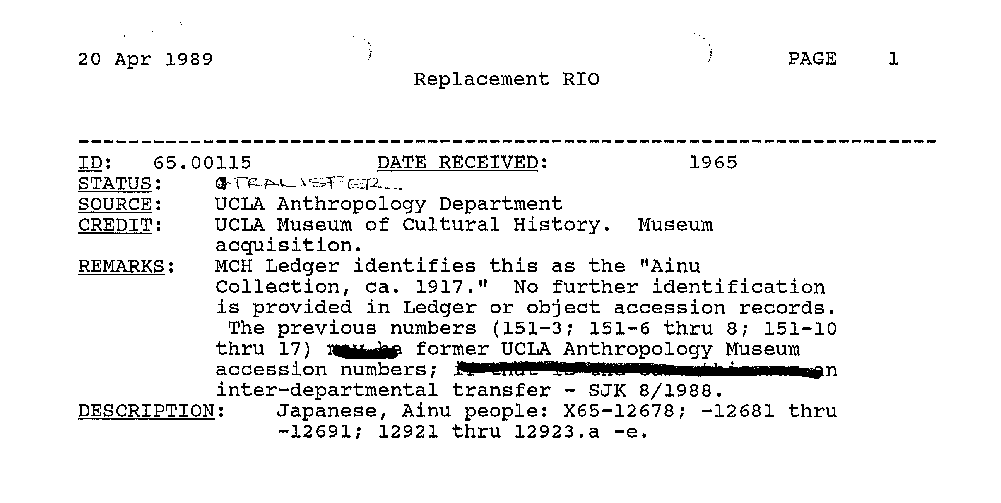
The bulk of the Fowler’s Ainu objects can be traced back to the UCLA Anthropology Department, though from whom they were originally provided remains unknown. We have two records (Figs. 2 & 3) from the Fowler Museum that provide some insights. The first (Fig. 2) is a record of transfer, from 1989 recording a transfer in 1965 from the UCLA Anthropology Department to the UCLA Museum of Cultural History (Fowler). According to our Fowler Museum contacts, around this time the university was making an effort to centralize their collections, which helps explain the movement of the objects from a department home to the museum. The date “c. 1917” for the objects, which we cannot verify, appears in this record.
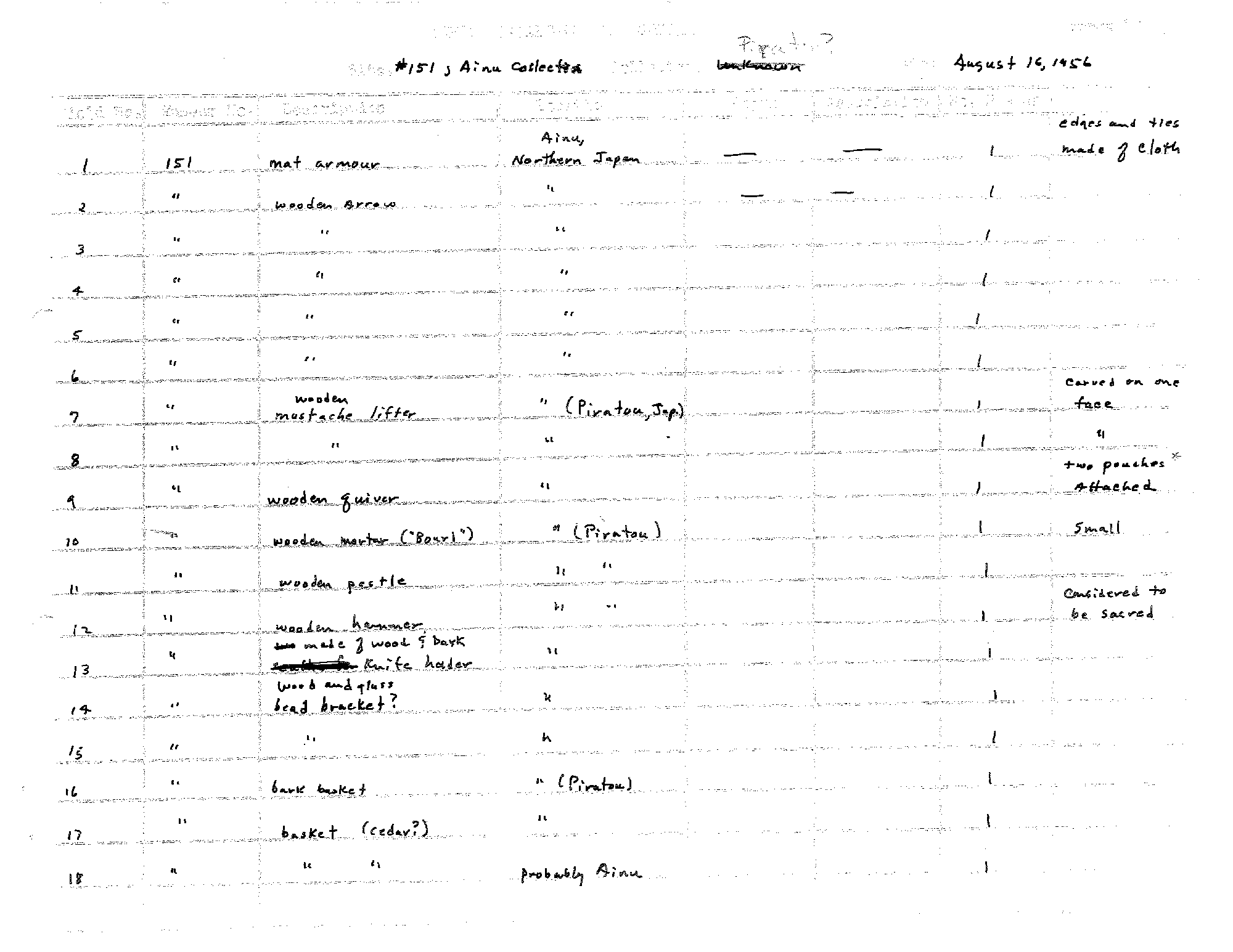
The transfer was also accompanied by a handwritten-spreadsheet (Fig. 3), dated August 16, 1956, which identifies some details about the objects. A location for some of the objects is given as what looks like “Piratou, Japan,” though we were unable to identify the site mentioned. The notations about the items vary in accuracy, and our research has amended some of the uncertainties therein, such as the “wooden mustache lifter,” the nature of the bracelets, and the quiver’s “two pouches” (one of which is actually a cap). The reference to the “mat armour” is likely simply a mat, discussed in our weaving section.
The Fowler also contains several Ainu-related items donated by Catherine E. Tierney and Patrick Lennox Tierney, including the Meiji charts, a chopstick set, and an item likely an ikupasuy. Patrick Tierney received his B.A. from UCLA and an M.A. from Columbia in art history, after which he served as a Commissioner of Art and Monuments during the Allied Occupation of Japan (1945–1952). He met his wife Catherine while she was studying in Japan. They spent their lives dedicated to teaching Japanese art and culture, making significant donations of their collections and papers to academic institutions.2Lennox Tierney Papers, 1911–2010. ACCN 1180. Special Collections, J. Willard Marriott Library, University of Utah, Salt Lake City. https://archiveswest.orbiscascade.org/ark:80444/xv02947; "Obituary for Patrick Lennox Tierney." Holbrook Mortuary, Salt Lake City, UT. June 12, 2015. https://www.holbrookmortuary.com/obituary/PatrickLennox-Tierney
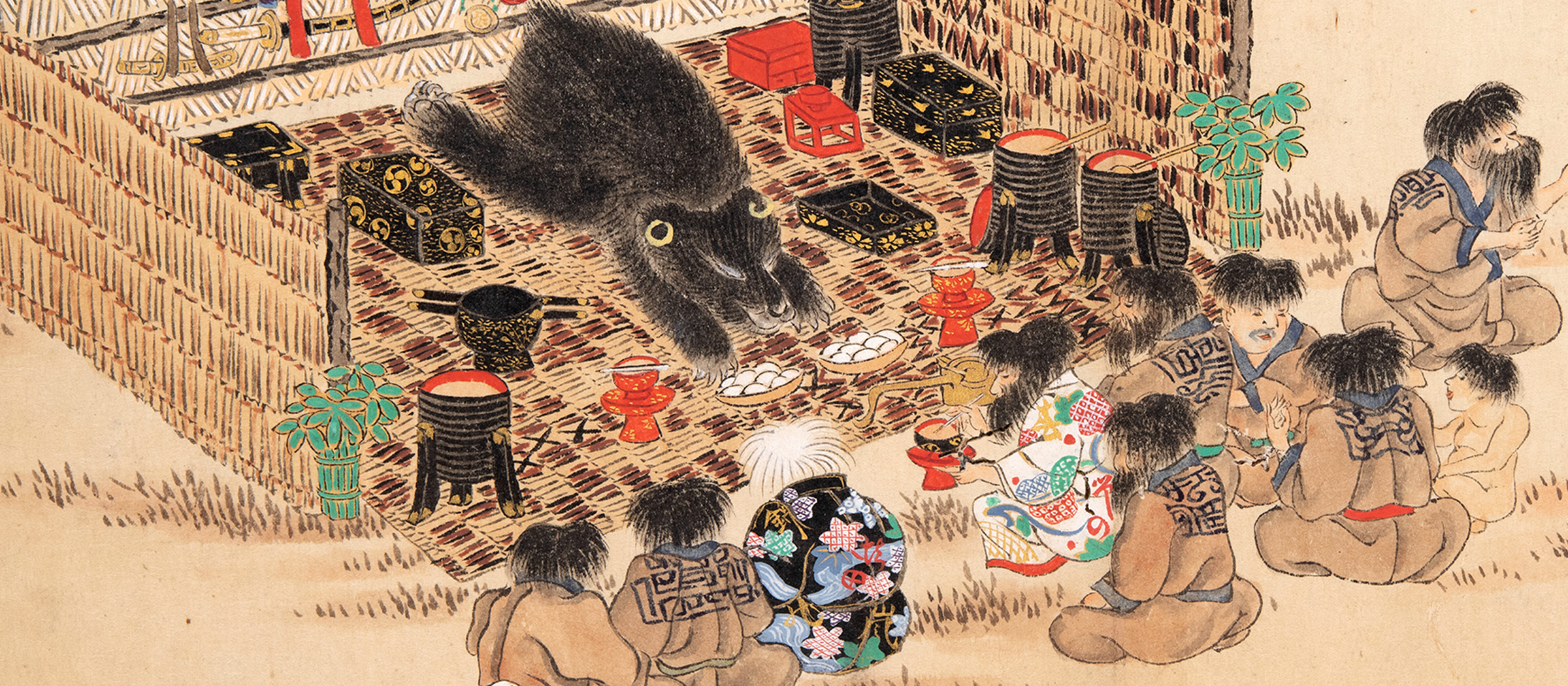
Some of the manuscripts held by the Charles E. Young Research Library and Special Collections at UCLA are more recent acquisitions. For example, the early modern manuscript Curious Views of Ezo (Ezogashima kikan 蝦夷島奇観) and the handscroll Depictions of the Ezo Bear Festival and the Customs of the People (Ezo kumamatsuri narabini jinmin fūzoku zue 蝦夷熊祭並人民風俗図絵) were purchased in 2024 from the shop Kōnandō 弘南堂書店 in Sapporo through their catalog issued for the 2024 World Rare Books and Japanese Rare Books Fair by The Antiquarian Booksellers Association of Japan 国際稀覯本フェア (ABAJ).
The Portraits and Verses of the Daoist Immortals (Ressen zusan 列僊圖賛) manuscript is part of the Julian C. Wright Collection, which is a gift collection bequeathed to UCLA in 1978 by Julian C. Wright (1904–1978), Los Angeles-based collector and public school teacher. Wright Collection at UCLA is primarily fine arts manuscripts and prints, with over 400 items related to Japan.3"Rare Materials," Japanese Studies Research Guide. UCLA Library, University of California, Los Angeles, accessed June 7, 2026. https://guides.library.ucla.edu/japanese/rare