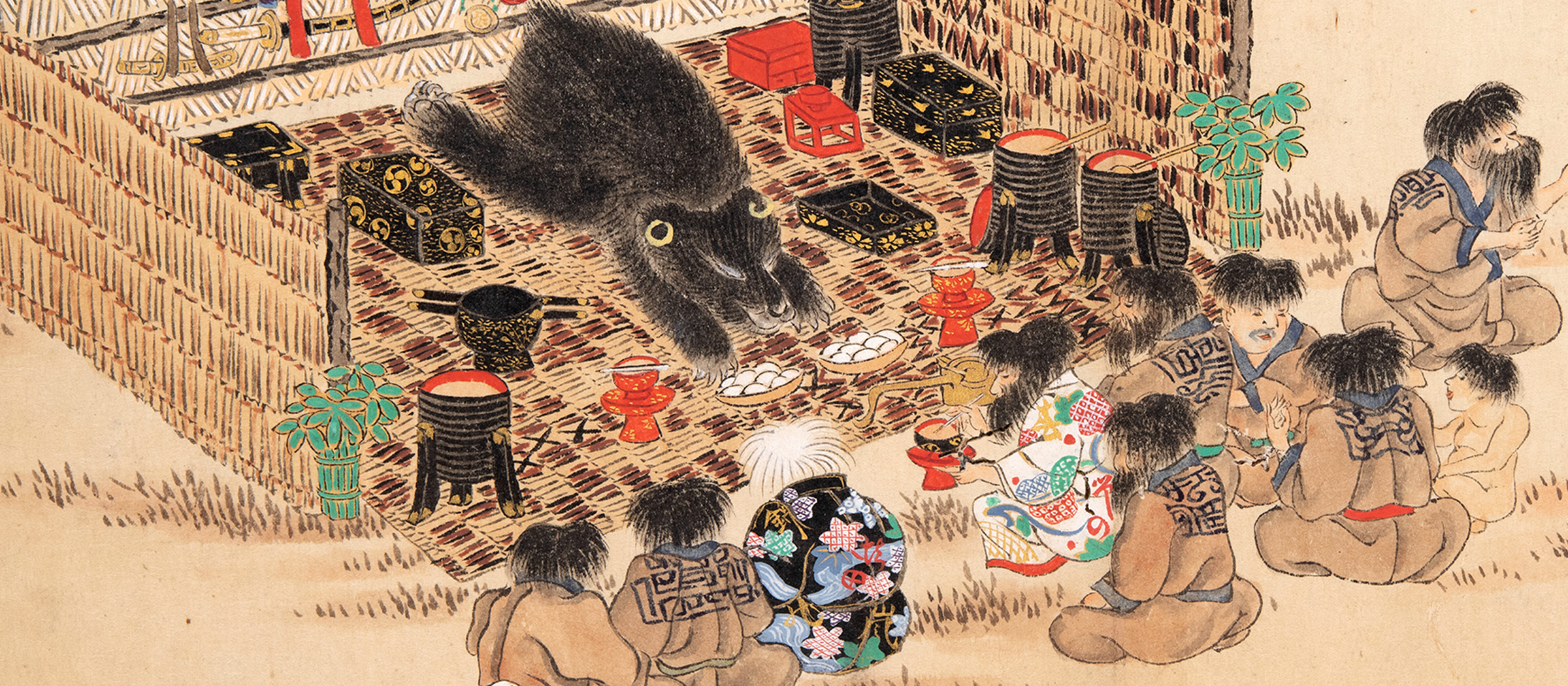
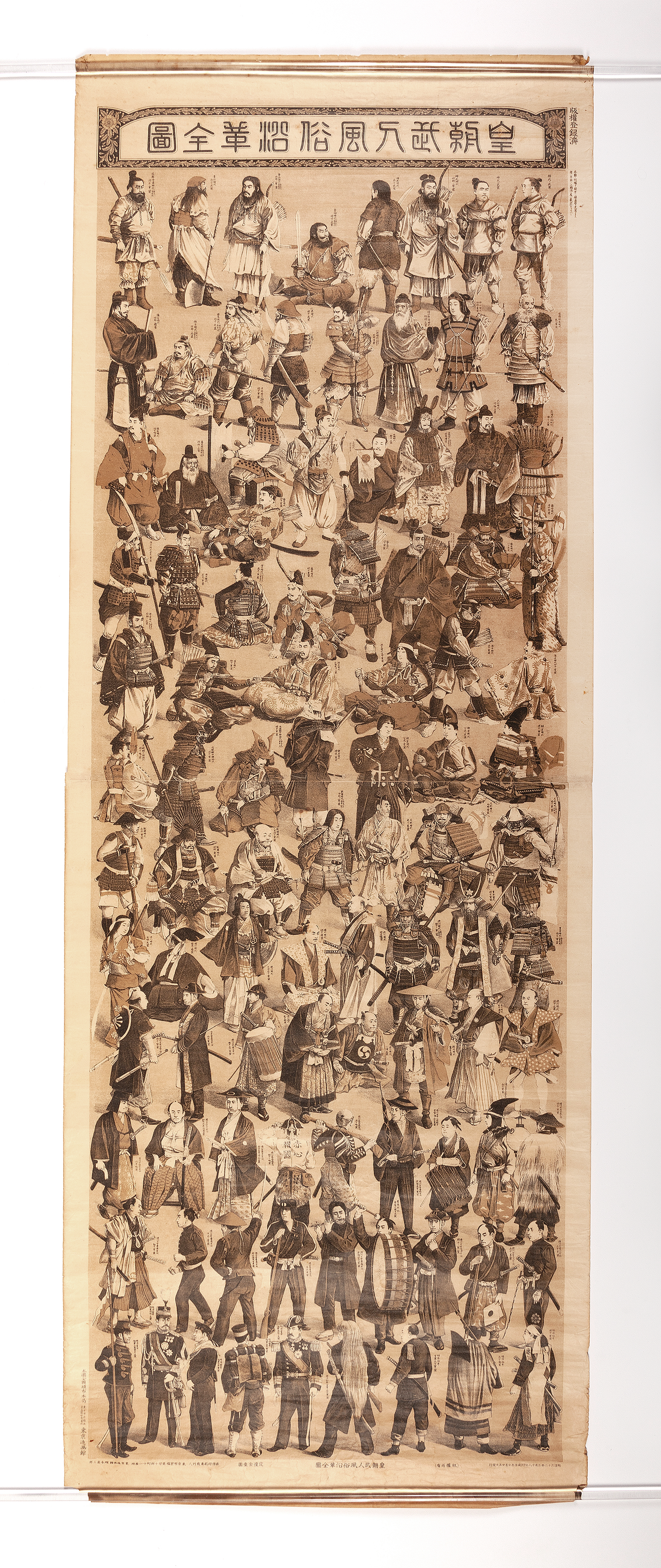
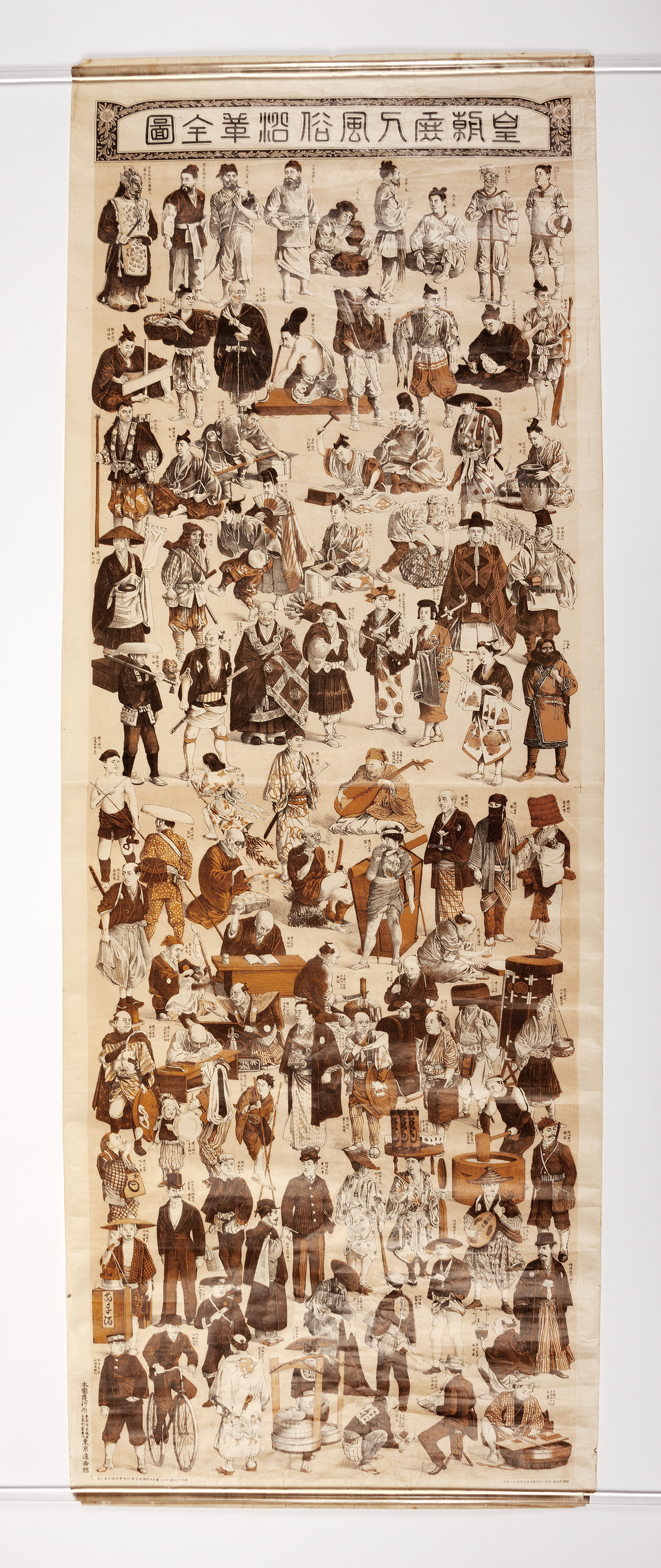
While not primarily focused on Ainu history and culture, the Fowler Museum at UCLA also holds two items of interest from the Meiji Period that depict Ainu. The two charts (Figs. 1 & 2) are titled A Complete Illustration of the History of Soldiers' Customs in the Japanese Empire (Kōchō bujin fūzoku enkaku zenzu 皇朝武人風俗沿革全図 ) and A Complete Illustration of the History of Commoners' Customs in the Japanese Empire (Kōchō shonin fūzoku enkaku zenzu 皇朝庶人風俗沿革全図 ). Measuring 148.50 cm × 53.50 cm and printed on paper, these lithograph prints illustrate soldiers and commoners through Japanese history, from mythic and semi-mythic figures to the nineteenth century. There are small notations next to each figure regarding the time period they are from and the type of figure they represent. The Fowler Museum at UCLA cataloged these charts, a donation from Catherine E. Tierney and P. Lennox Tierney, as part of the collection in 1991.
Information on the printing of each chart is provided in the bottom left and right hand corners, indicating the date of publication, artist, and even the location of the printing firm. The chart depicting soldiers states: 明治三十二年三月十八日印刷仝年仝月十日発行, which indicates both the date of printing and the date of issue:
明治三十二年三月十八日印刷
Date of Printing: March 18, 1899 (Meiji 32)年仝月十日発行
Date of Issue: March 10, 1899 (Meiji 32)
The commoners chart was released one year later:
明治 卅三年八月廿一日印刷
Date of Printing: August 21, 1900 (Meiji 33)仝年仝月廿五日発行
Date of Issue: August 25, 1900 (Meiji 33)
The use of wall charts for educational purposes was adopted and encouraged by the Meiji government in the late nineteenth and early twentieth century, as they were often used by Western nations in educational settings. During the period these charts were issued, wall chart printing was primarily done by private companies.1Makino Yuri 牧野由理, “Tokyo Zōgakan no kakezu ni kansuru kenkyū 東京造画館の掛図に関する研究,” Bijutsu kyōikugaki 美術教育学 41 (2020): 312.
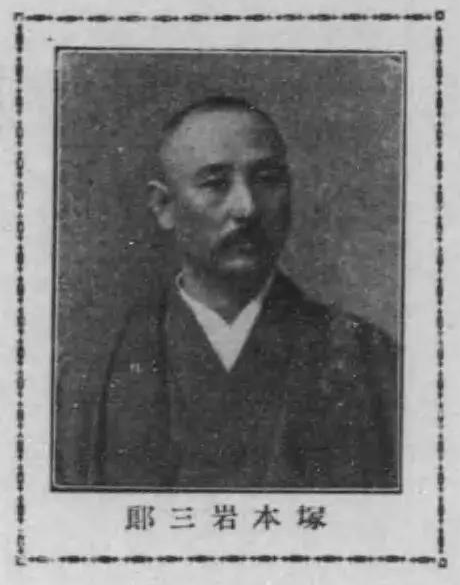
Both charts in the Fowler collection were created by Tsukamoto Iwasaburō 塚本岩三郎 (b. 1863–1923) (Fig. 3), an artist and entrepreneur who founded the printing firm where the prints were produced, Tokyo Zōgakan 東京造画館, in either 1890 or 1892. Prior to the establishment of his company, Tsukamoto had pursued education in Western painting and printing techniques both in Japan and the United States and been active in Japanese art societies dedicated to Western-style art.
Tsukamoto’s artistry using lithographs was well-known and his educational wall charts for primary and secondary schools highly prized, said to have been used for the education of the future Taishō Emperor himself. Many of the charts (including those described here) list Tsukamoto explicitly as 画作印刷兼発行人, or “Artist, Printer, and Publisher.”2Makino, 313–315. The charts in the Fowler collection also state the precise location of the publishing company:
Soldiers chart:
本図発行所(東京市京橋区宗十郎町十一番地)東京造画館
The publishing house of this image is Tokyo zōgakan (Tokyo-shi, Kyōbashi-ku, Sōjūrōchō, jūichiban-chi)Commoners chart:
本図発行所(東京市京橋区出雲町一番地)東京造画館
The publishing house of this image is Tokyo zōgakan (Tokyo-shi, Kyōbashi-ku, Izumochō, ichiban-chi)
These sites were located in the well-known Ginza district (still affluent today), which during the Meiji period became a booming commercial district after its reconstruction due to a devastating fire in 1872. Tsukamoto’s company was established only a couple of decades after the Japanese government had poured an immense amount of funds into the establishment of Ginza as a Western-style, modernized urban space. Ginza at the time housed a variety of newspapers, printing houses, and other publishers.3André Sorensen, The Making of Urban Japan: Cities and Planning from Edo to the Twenty First Century (New York: Routledge, 2002), 62–65; “Edo jidai no Ginza 江戸時代の銀座,” Tokyo Ginza Official, accessed May 26, 2026. https://www.ginza.jp/history
We are fortunate to have these posters unmounted; the Kyoto University Rare Materials Archive houses copies that are fully digitized but lack the publication information provided on the Fowler’s versions.4The Kyoto University Rare Materials Digital Archive also houses a collection of 356 modern educational wall charts. See: https://rmda.kulib.kyoto-u.ac.jp/en/collection/kakezu Kyoto University’s archive also includes a third poster that appears to be from the same series, focusing on women in history.
Ainu in Tsukamoto’s Wall Charts
Our team originally requested these charts due to a cataloging notation that stated “Depicts military costume of the Meiji period. Ninety-five figures (mostly male) wearing regional costumes. The top row are Ainu, some of figures in the bottom row wear European style military dress. Text at side of each figure.” Upon investigation with Kate Anderson of the Fowler Museum, we found that the collections contained not only the chart of soldiers (which did not include depictions of Ainu) but also the chart of commoners. This discovery reaffirmed the importance of revisiting potentially dated collections information and bringing our domain knowledge to the investigation of these items. In all likelihood, whoever provided the original collections notes identified the top row of the soldiers chart as containing Ainu purely on the basis of the hairiness of the individuals (a common descriptive and visual trope) and their accompanying bows and arrows (Fig. 4).
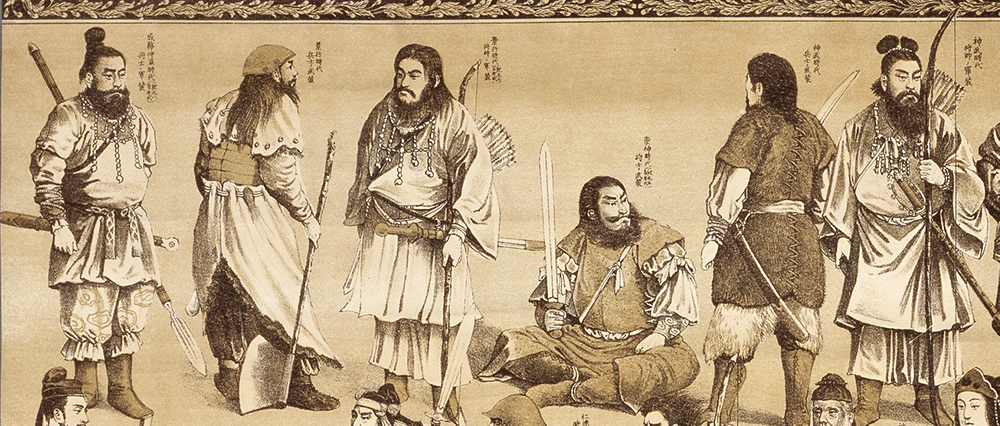
In reality, the top row of figures in the soldiers chart depicts various military figures from “the age of the gods,” specifying figures as being of “The Age of [Emperor] Seimu and Emperor Chūai (Seimu Chūai jidai 成務仲哀時代),” “The Age of [Emperor Keikō] (Keikō jidai 景行時代),” “The Age of [Emperor] Sujin (Sujin jidai) 崇神時代,” and “The Age of [Emperor] Jinmu (Jinmu jidai) 神武時代.” Each of these emperors, while appearing in various mytho-histories, is presumed legendary. Regardless of their historicity, they are not, in fact, Ainu.
However, our team did find two interesting representations in the commoners chart connected to Ainu that went unremarked on in the original museum records. Much like the soldiers chart, the commoners chart presents various figures through time, starting during legendary or ancient times and descending to the present (nineteenth century) at the bottom of the image. On the right-hand side at the center of the chart there is a depiction of an Ainu person (Fig. 5) accompanied by the label “Hokkaidō Ainu Fisherman (Hokkaidō Ainu gyōjin 北海道アイヌ漁人).”
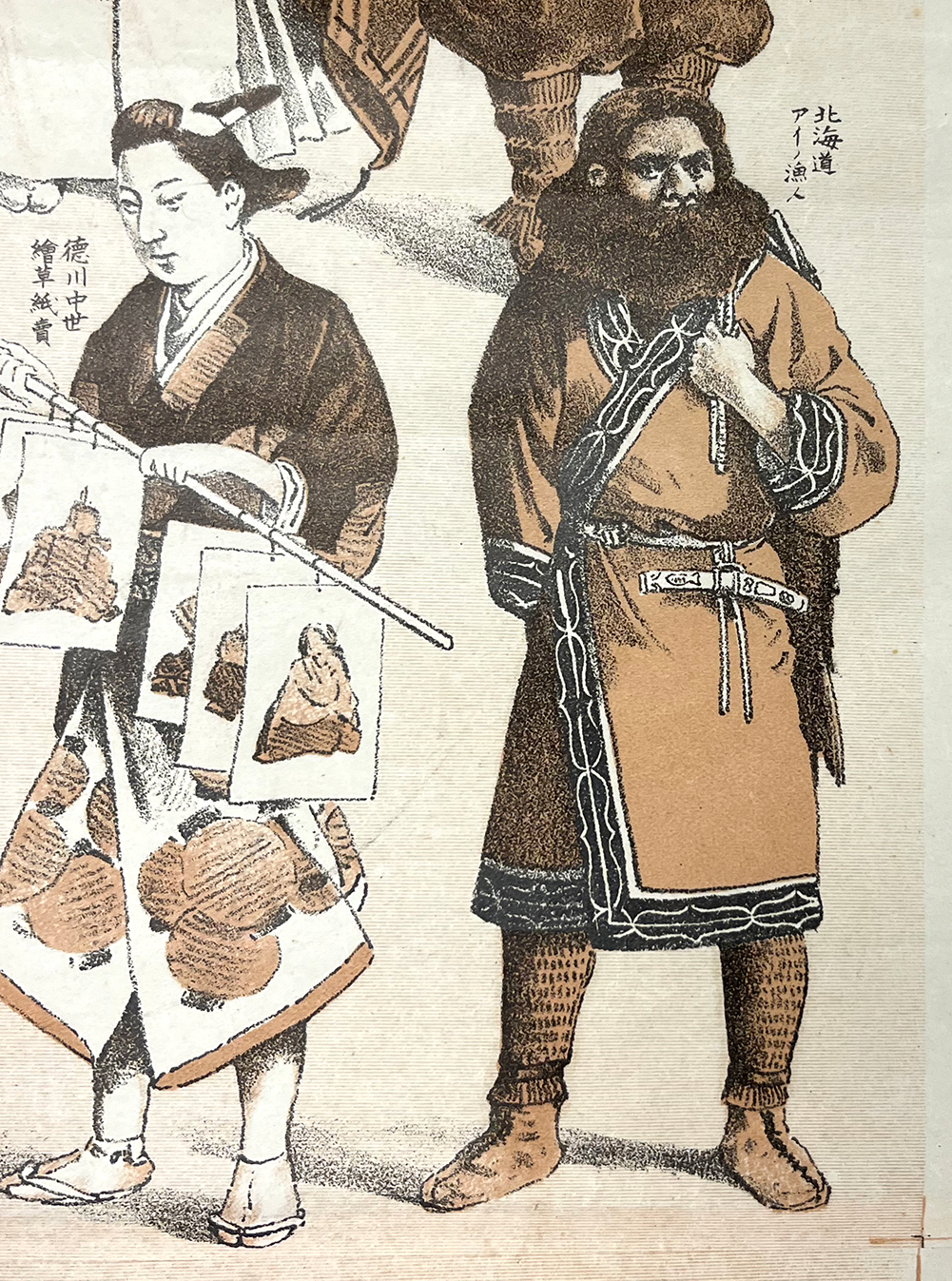
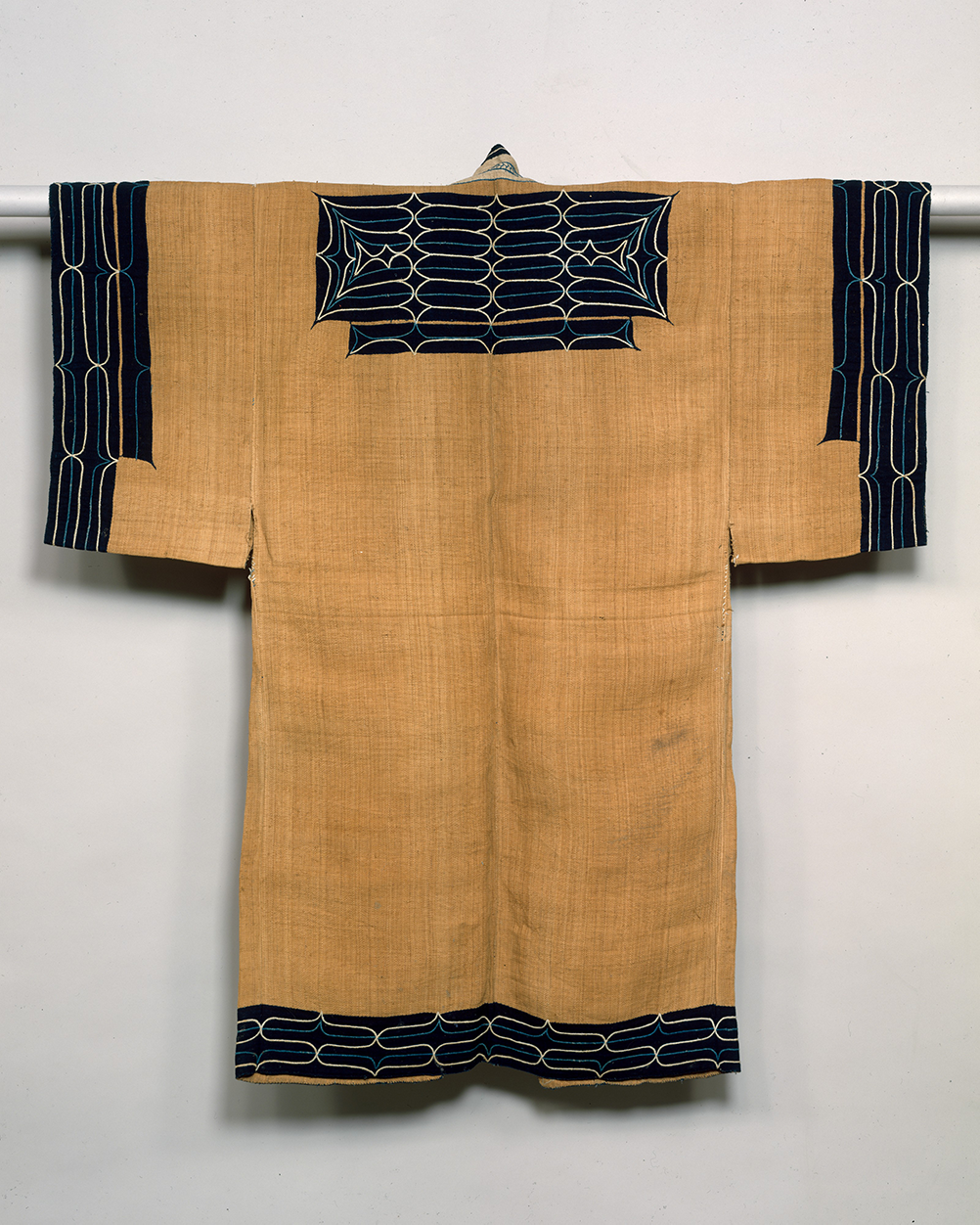
The Ainu man is depicted with darker skin than the Japanese figures and a large, very full beard. Note the distinct difference between the facial features and skin tone presented in comparison to the Japanese ezōshi (picture book) seller next to him. The Ainu man wears clothing with traditional Ainu embroidered designs (an attush アットゥㇱ robe made of traditional elm bark cloth) (Fig. 6). His shoes, which have a seam running up the center, look similar to patterns of fishskin boots from the nineteenth century.5Chisato O. Dubreuil, “Ainu Art: The Beginnings of Tradition,” in Ainu: Spirit of a Northern People, ed. Fitzhugh William W. and Chisato O. Dubreuil, eds. (Arctic Studies Center, National Museum of Natural History, 1999): 289–291. At his hip appears to be a knife or short sword in a holder, and he has a large fish slung over his shoulder. The illustration conforms with what many Japanese likely understood about the Ainu while echoing stereotypical images of dark skinned, hairy individuals; notably here the illustration of the bearded Ainu has his facial hair nearly overwhelming his entire face.
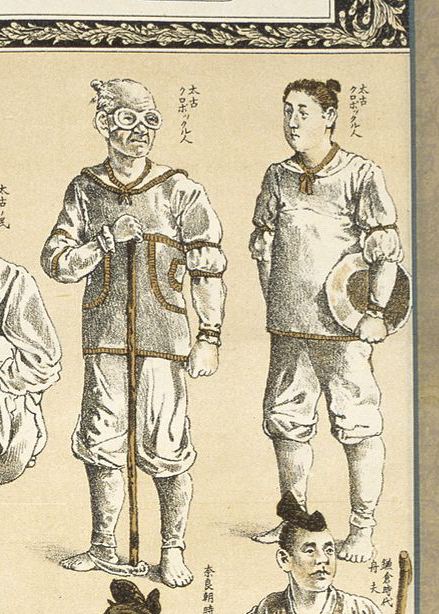
One more interesting find can be seen in the upper right-hand corner of the commoner chart. Two figures stand side by side and are labeled “Prehistoric Korpokkur People (taiko Kuropokkurujin 太古クロポックル人).” (Fig. 7) Sometimes romanized as Koropokkuru (コㇿポックㇽ in Ainu, クロポックル in Japanese), Korobokkuru, Koro-pok-kuru, or other variations, these were supposed a kind of little person who may have appeared in Ainu folklore.
Anthropologist and archaeologist Tsuboi Shōgōro 坪井正五郞 (1863–1913) wrote extensively theorizing about the origins of the Ainu people, believing that there were not, in fact, indigenous to the islands. Based on archaeological evidence that there were people before the Ainu who created pottery (which the Ainu did not) and his belief that skull sizes of (likely Jōmon) people unearthed were much smaller than contemporary skulls, Tsuboi theorized that little people had occupied the islands before Ainu. Tsuboi’s claims that Ainu were not indigenous to Japan was politically advantageous for his own nationalistic and racial views of the Japanese people.6Shingo Hamada, “Archaeology in Social Context: The Influence of Nationalism on the Discussions of Ainu,” (MA thesis, Portland State University, 2006) 49–51. Tsuboi also reported that there were Ainu oral traditions recounting a dwarf-like peoples who occupied the islands before Ainu arrived who reportedly lived underneath butterbur plants. The existence of Korpokkur was a point of contention among Japanese scholars during the late Meiji period, particularly those who disagreed that skull size was an indicator of little people.7Siddle notes that the topic of kuropukkuru was an active one in the debates on Ainu origins of the nineteenth century, with over 200 articles on Ainu were published in the The Journal of the Anthropological Society of Tōkyō (Tōkyō Jinrui Gakkai zasshi 東京人類学会雑誌) in the late Meiji period. Richard Siddle, Race, Resistance, and the Ainu of Japan (New York: Routledge, 1996), 81–82. Even Western scholars in Ainu Studies at the time weighed in on whether or not the Korpokkur people existed, with the missionary John Batchelor (1855–1944) writing in 1904 that the translation of コㇿポックㇽ did not refer to butterbur plants, but simply “under” or “below,” a reference to the pit-dwelling nature of early inhabitants, and that the Ainu did not, in fact, refer to a little people in their legends at all.8John Batchelor, The Koropok-Guru or Pit-dwellers of North Japan and a Critical Examination of the Nomenclature of Yezo (Yokohama: Japan Mail, 1904), 3. There is little concrete information on how these myths came about. In his book on korpokkur Segawa Takurō 瀬川拓郎 discusses his theories that the Northern Kurile Ainu were themselves the so-called "little people" of these legends, but his conclusion primarily relies on the fact that the Northern Kurile Ainu themselves had no such legends. Segawa Takurō, Koropokkuru to wa dare ka: chūsei no Chishima to Ainu densetsu コロポックルとはだれか―中世の千島列島とアイヌ伝説, 69–76.
The two figures as they appear in Tsukamoto’s chart do not have any particularly Ainu characteristics to them, with the exception of Tsukamoto’s depiction of them as wearing a slightly Ainu-inspired pattern. Both figures are shown much lighter in skin color than the Ainu from the center of the chart, with neither one sporting facial hair. It is unclear what the goggle-looking eye pieces on the one figure are, and they carry what looks like a farming implement and a dish. It is interesting to note that Tsukamoto included these figures at all, given the pseudo-historical nature, though the date of the chart (1900) does place it directly in the decades during which vigorous debate about the origins of the Ainu and Korpokkur was taking place.
References
Batchelor, John Batchelor. The Koropok-Guru or Pit-dwellers of North Japan and a Critical Examination of the Nomenclature of Yezo. Yokohama: Japan Mail, 1904.
Dubreuil, Chisato O. “Ainu Art: The Beginnings of Tradition.” In Ainu: Spirit of a Northern People. Edited by Fitzhugh William W. and Chisato O. Dubreuil, 287–300. (Arctic Studies Center, National Museum of Natural History, 1999): 289–291.
“Edo jidai no Ginza 江戸時代の銀座.” Tokyo Ginza Official. Accessed May 26, 2026. https://www.ginza.jp/history
Makino Yuri 牧野由理. “Tokyo Zōgakan no kakezu ni kansuru kenkyū 東京造画館の掛図に関する研究,” Bijutsu kyōikugaki 美術教育学 41 (2020): 311–322. https://doi.org/10.24455/aaej.41.0_311
Segawa Takurō 瀬川拓郎. Koropokkuru to wa dare ka: chūsei no Chishima to Ainu densetsu コロポックルとはだれか―中世の千島列島とアイヌ伝説. Shintensha 新典社新書, 2012.
Shingo Hamada. “Archaeology in Social Context: The Influence of Nationalism on the Discussions of Ainu." MA thesis, Portland State University, 2006
Siddle, Richard. Race, Resistance, and the Ainu of Japan. New York: Routledge, 1996.
Sorensen, André. The Making of Urban Japan: Cities and Planning from Edo to the Twenty First Century. New York: Routledge, 2002.