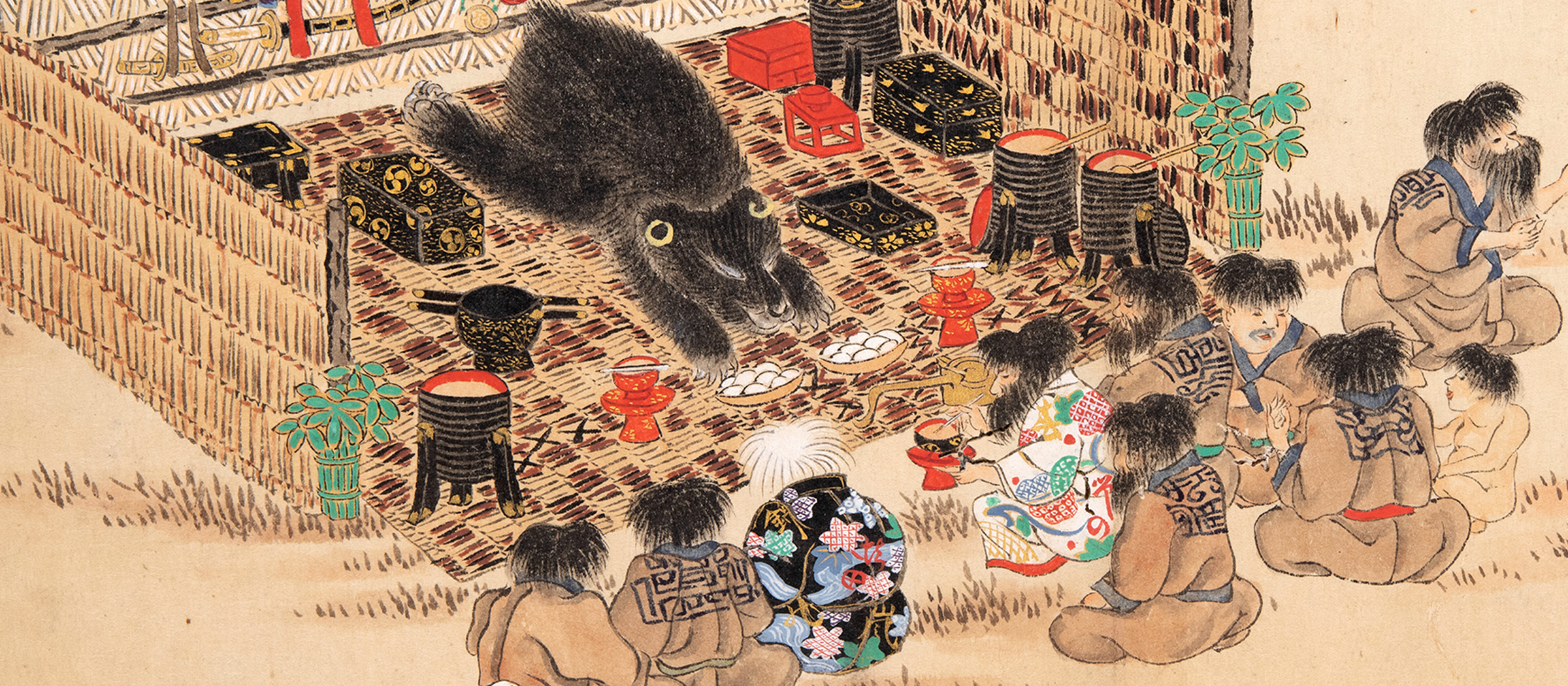
Depictions of the Ezo Bear Festival and the Customs of the People
Ezo kumamatsuri narabini jinmin fūzoku zue 蝦夷熊祭並人民風俗図絵
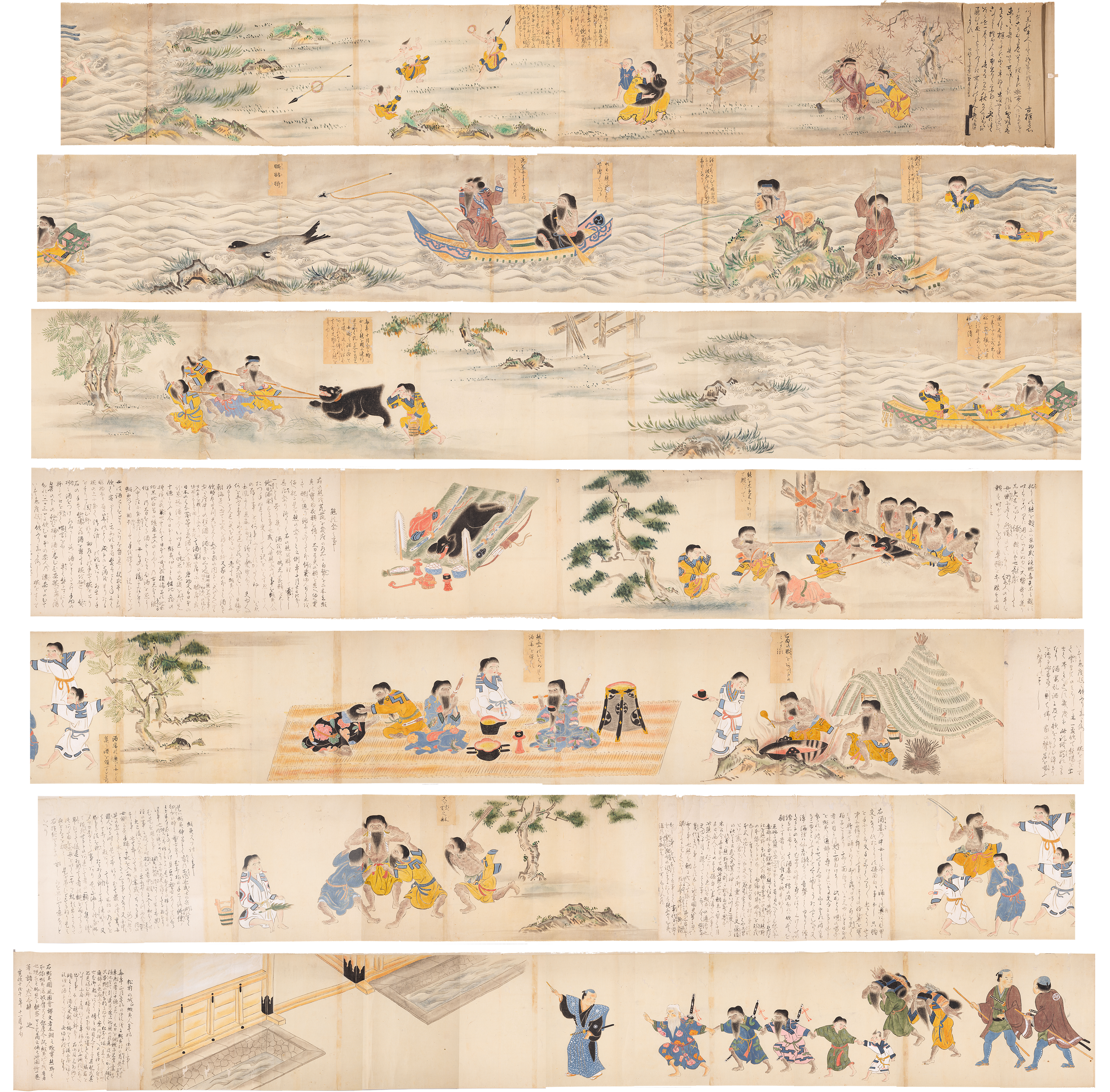
The Depictions of the Ezo Bear Festival and the Customs of the People (Ezo kumamatsuri narabini jinmin fūzoku zue 蝦夷熊祭並人民風俗図絵) is a handscroll painted in color on paper originally by Kodama Sadayoshi 小玉貞良 (n.d.). It measures 27 cm x 1330 cm. It depicts Ainu cultural practices, highlighting the Ainu iyomante “bear sending ceremony” in which a village sacrifices a captured bear that they have raised in captivity for anywhere from one to several years. Ainu believe that gods, or kamuy, exist in all things, and by “sending back” the bear, a kamuy on earth, they return it to the spirit realm after honoring it with gifts and worship.
The scroll is constructed of multiple sheets of paper, some of which are text and others illustrations, that are joined together with an adhesive. The text segments may have been inserted into the scroll at a later date. Some pages with illustrations also feature additional text in the form of small explanatory cards or labels that seems to have been placed on the page after the original scroll was made. Larger images of each scroll segment shown to the right are available to view here.
Little is known about the artist, Kodama Sadayoshi, also known as Kodama Teiryō, who is believed to have been born in Matsumae Domain. He is known to have been active as a painter between 1751 and 1764, and produced numerous genre paintings about Ainu life and customs that served as models for other artists.1Toshikazu Sasaki, “Ainu-e: A Historical Review,” in Ainu: Spirit of a Northern People, Fitzhugh William W. and Chisato O. Dubreuil, eds. (Arctic Studies Center, National Museum of Natural History, 1999), 82–83. From the details in the scroll’s artwork it appears that Kodama paid close attention to the way the culture and practices of the Ainu, likely a result of visiting and observing their communities. Scholars have noted his accuracy compared to later artists, such as Kakizaki Hakyō, stating that “...Sadayoshi, who actually worked thirty years before Hakyo, painted the Aynu [sic] chieftains in their own native costume instead of the gaudy foreign fabrics. Some scholars feel that Kodama’s version is the [sic] closer to fact…”2Toshikazu Sasaki, “Ainu-e: A Historical Review,” in Seiichi Izumi, The World of the Aynus: An Ethnological Record (Kajima Publishing, 1967), 7.
This scroll is part of a larger genre that scholars today refer to as Ainu-e, or “Images of Ainu.” Ainu themselves did not create any representational portrayal of nature due to their belief that evil spirits could enter the imitation of the natural world and cause harm. Ainu art symbolizing the natural world is typically done through abstracted patterns. The depictions of Ainu seen in these early works are thus invaluable to understanding Ainu practices of the past, though they should be evaluated carefully alongside other archaeological and material records as well as Ainu oral histories representing their own past.3Chisato O. Dubreuil, “Ainu-e: instructional resources for the study of Japan’s Other People,” Education about Asia 9, no. 1 (Spring 2004), 10.
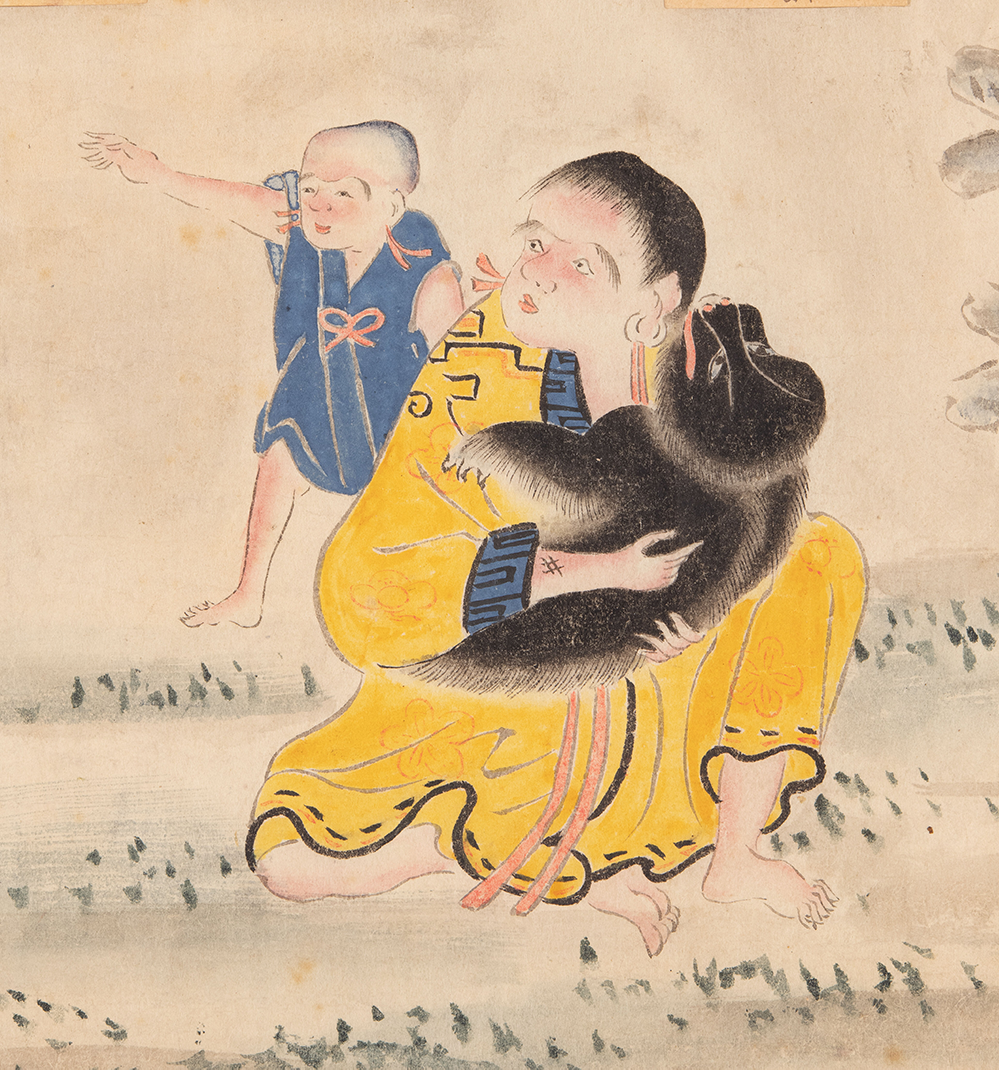
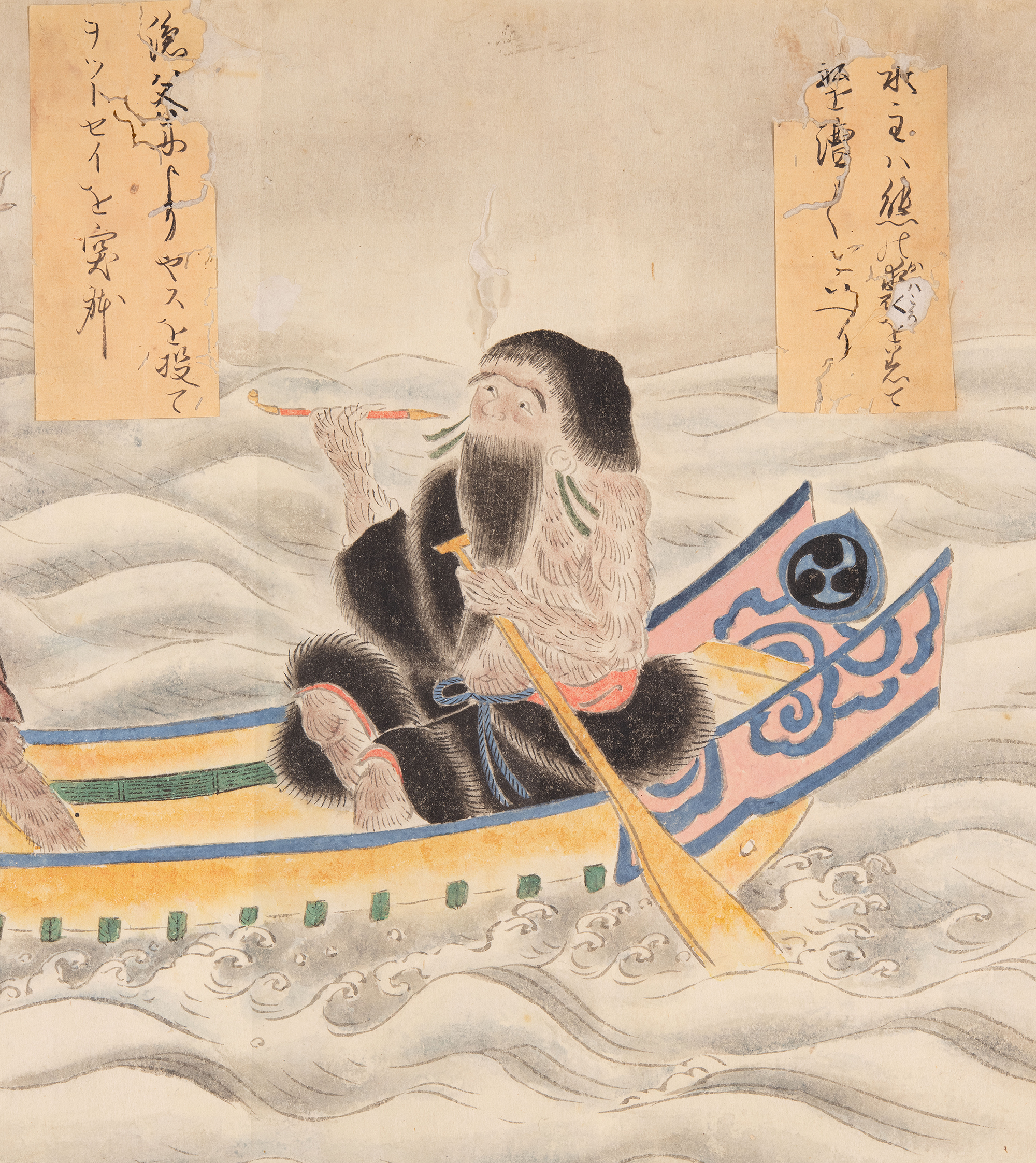
Kodama puts great detail into textiles; clothing of each Ainu person not only has unique designs and varieties of color but also a sense of texture. Throughout the scroll we find many variations on patterns, accessories, and even the way they are worn. Though many black and white or monochrome postcards of Ainu communities from the nineteenth and early twentieth centuries create a sense of a past world in bland or sepia tones, in this scroll we see vivid uses red, yellow, blue, white, green, orange, and pink throughout, providing a window into the vibrant aesthetics and bold patterns in Ainu clothing. Even in depictions where some of the clothing seems at a glance to be plain, when viewed closely, Kodama has placed subtle designs on them. He also includes small accessories or items that add richness to the detail of Ainu life.
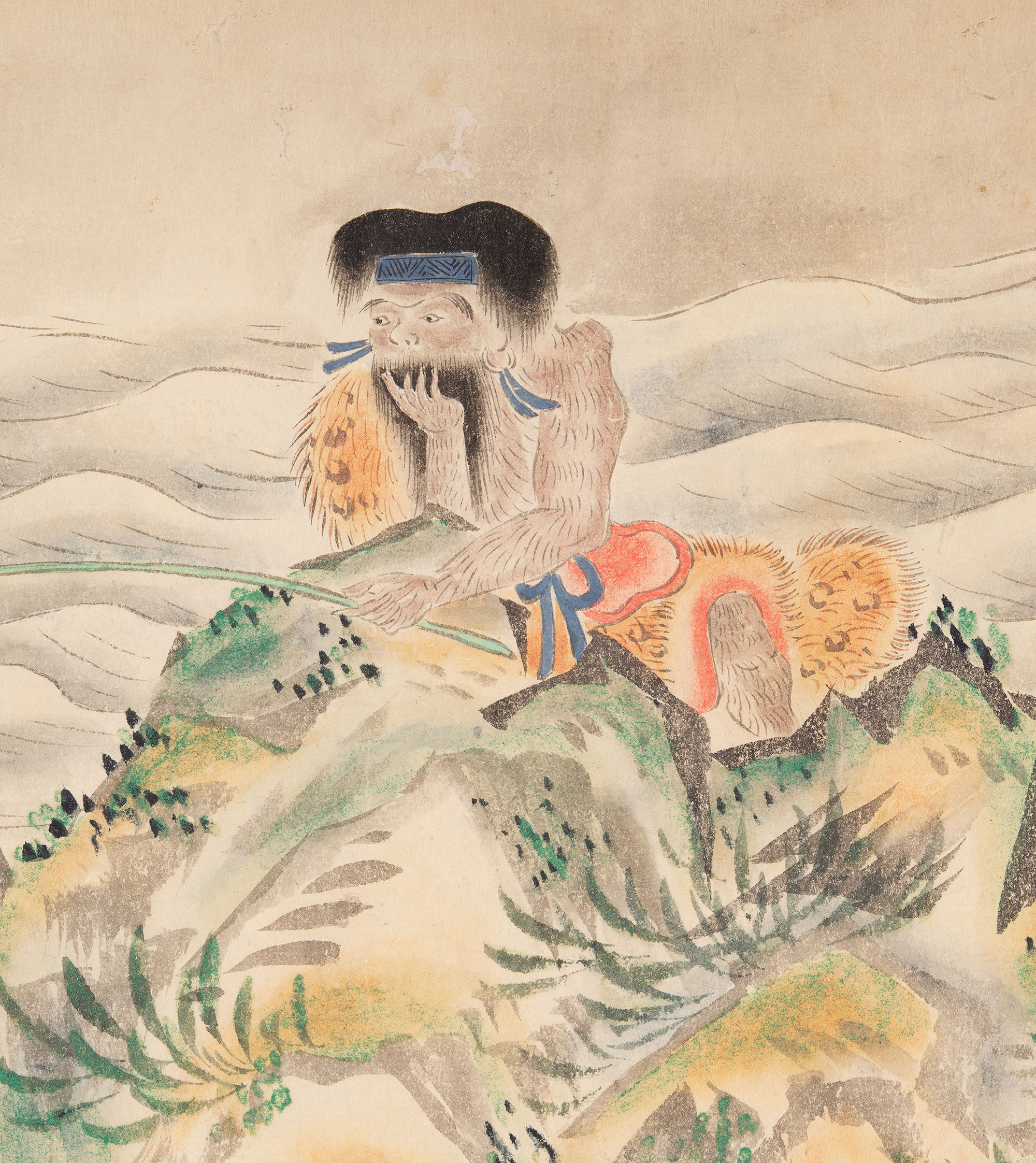
For example, in Figure 3, we see a man on a boat wrapped in what appears to be a pelt of bear fur, leaning back smoking a tobacco pipe. Tobacco was a commodity highly valued by Ainu for which they traded with the Japanese (see details on this in our Curious Views of Edo page). Another man is wearing a robe that appears to be leopard fur, suggesting trade connections Ainu hard with the continent and Eurasia.4Shiro Sasaki, “The Ainu in Northeast Asia,” in Ishuretsuzo, the Image of Ezo: Tracing Persons, Things and the World (Hokkaido Museum, 2015), 121–123. In Figure 4 we also see the Ainu man wearing an embroidered cotton headband, known as matanpushi マタンプシ, which were worn by both men and women and the designs for which varied by region.5Mari Kodama, “Clothing and Ornamentation,” in Ainu: Spirit of a Northern People, Fitzhugh William W. and Chisato O. Dubreuil, eds. (Arctic Studies Center, National Museum of Natural History, 1999), 322–323. We also see both men and women wearing rings in their ears (some tied with small pieces of silk). These forms of traditional jewelry would be banned from use by the Meiji government in 1871 and again in 1876 along with traditional Ainu tattoos for women.6Howell, Geographies of Identity in Nineteenth Century Japan, 179.
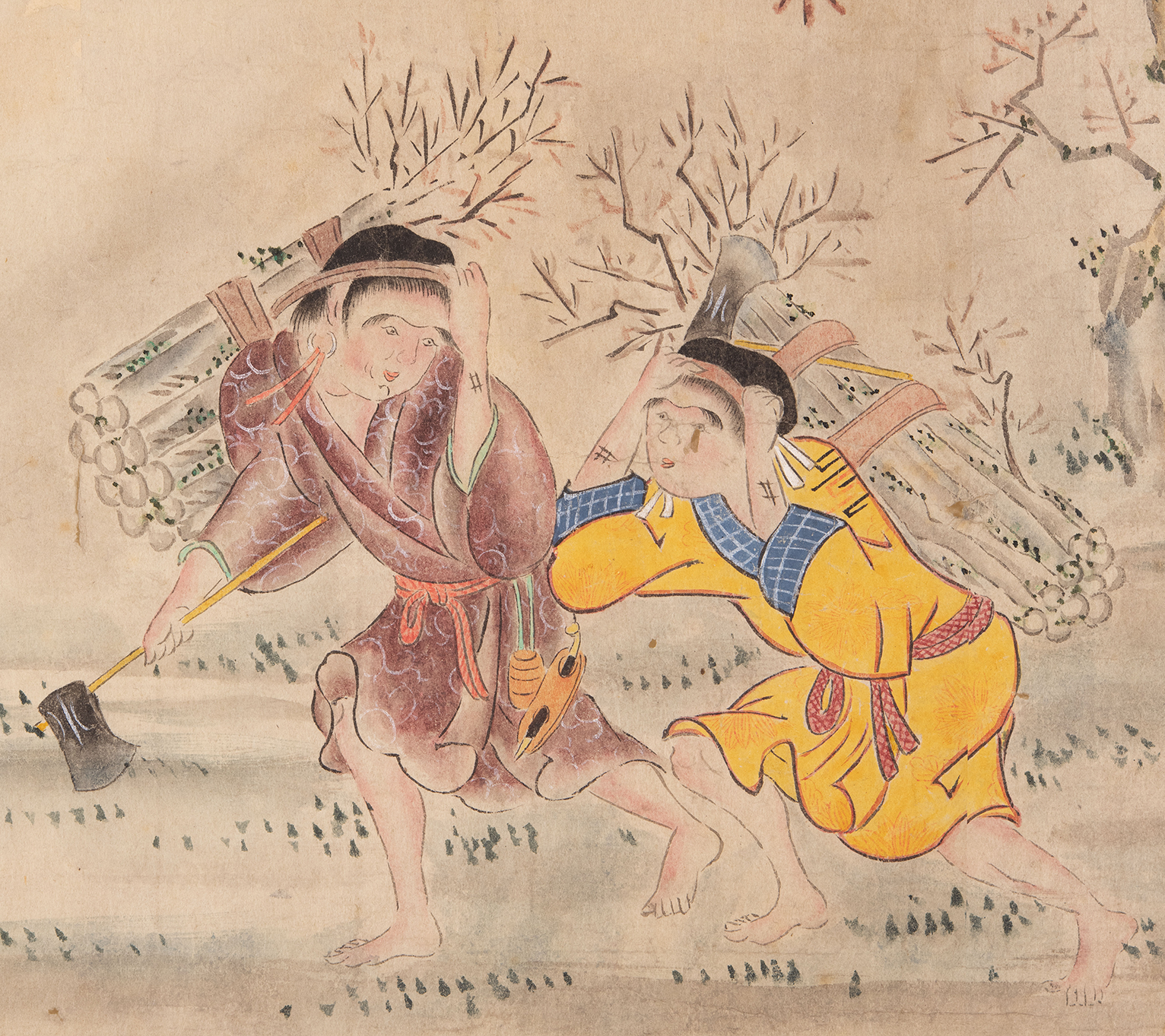
We find many other candid representations of Ainu life in the scroll, such as women returning from chopping and gathering wood while engaged in a conversation (Fig. 5), one holding an axe in her hand and the other with an axe tucked in the stack of wood on her back. In his records of living with the Ainu in the late nineteenth century, missionary John Batchelor (1854–1944) wrote of this task:
In the busy spring time the women used to crawl out of their sleeping places in the small hours of the morning, eat a hasty meal of cold venerable stew, shoulder their tools and proceed to their gardens to chop and hack their plots and sow their seeds. Late at night there would return carrying big bundles of wood on their backs, do what there was to be done in the house, fetch the water (in this I was allowed to help), cook a big meal, eat it and then lie down to sleep.7John Batchelor, Ainu Life and Lore: Echoes of a Departing Race (Tokyo, Kyobunkwan, 1927), 76.
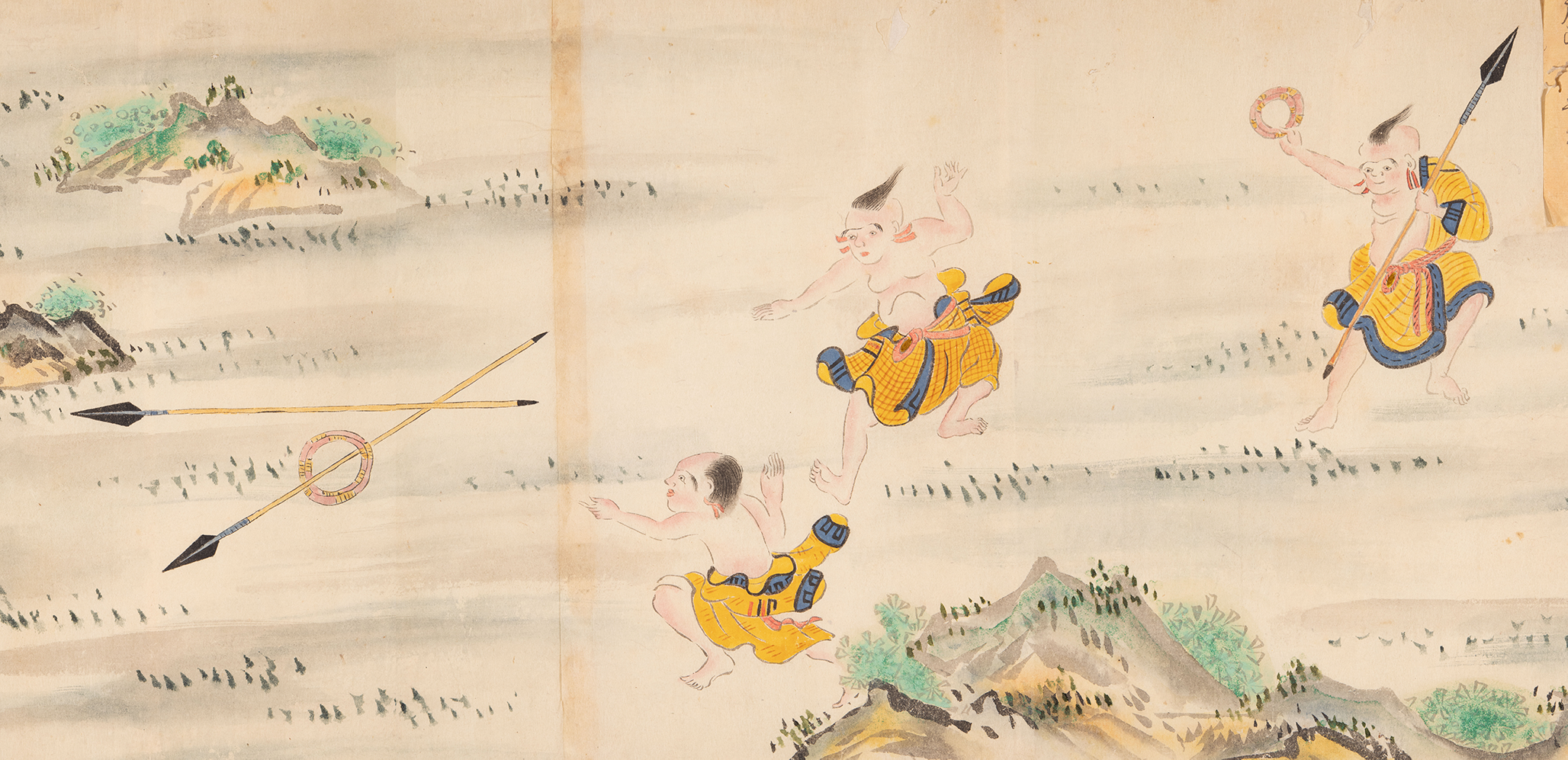
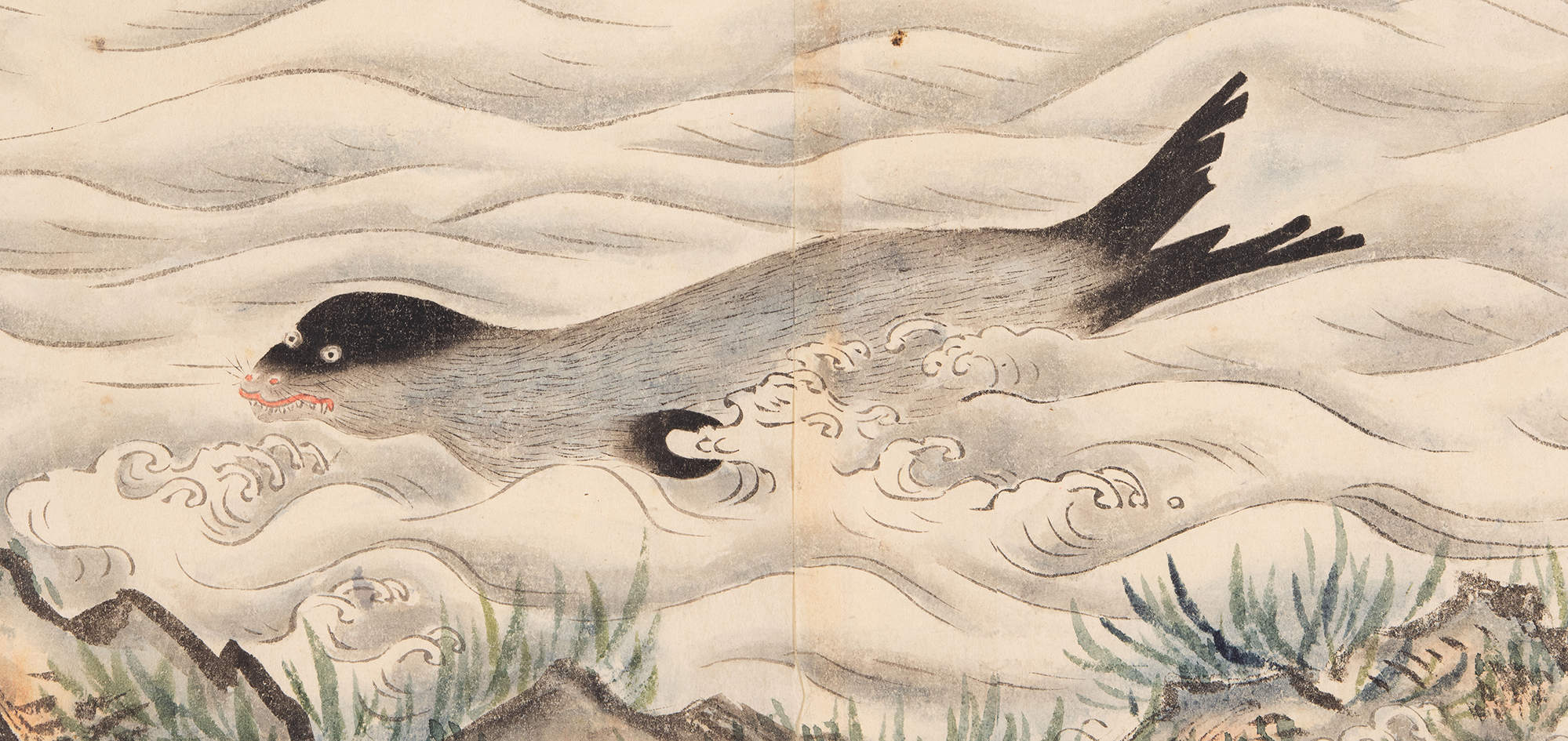
Kodama also portrays young boys playing together by throwing a spear through a hoop (Fig. 6). In this game the hoop was tossed and children would aim to throw their spear through it while it rolled. Such games were not merely play, but enrichment to help develop necessary skills that would be useful later in life, given that the “Ainu’s main animal food source was the salmon, and spearing was an extremely important skill.”8Dubreuil, 10. The scroll also depicts hunting scenes of otter, which were highly prized for their pelts and traded both with the Japanese and Russians.9Brett L. Walker, The Conquest of Ainu Lands: Ecology and Culture in Japanese Expansion, 1590–1800 (University of California Press, 2001), 157–158. Representations of otter hunting appear often in depictions of Ainu. The otter in our scroll appears less than enthused to be hunted (Fig. 7).
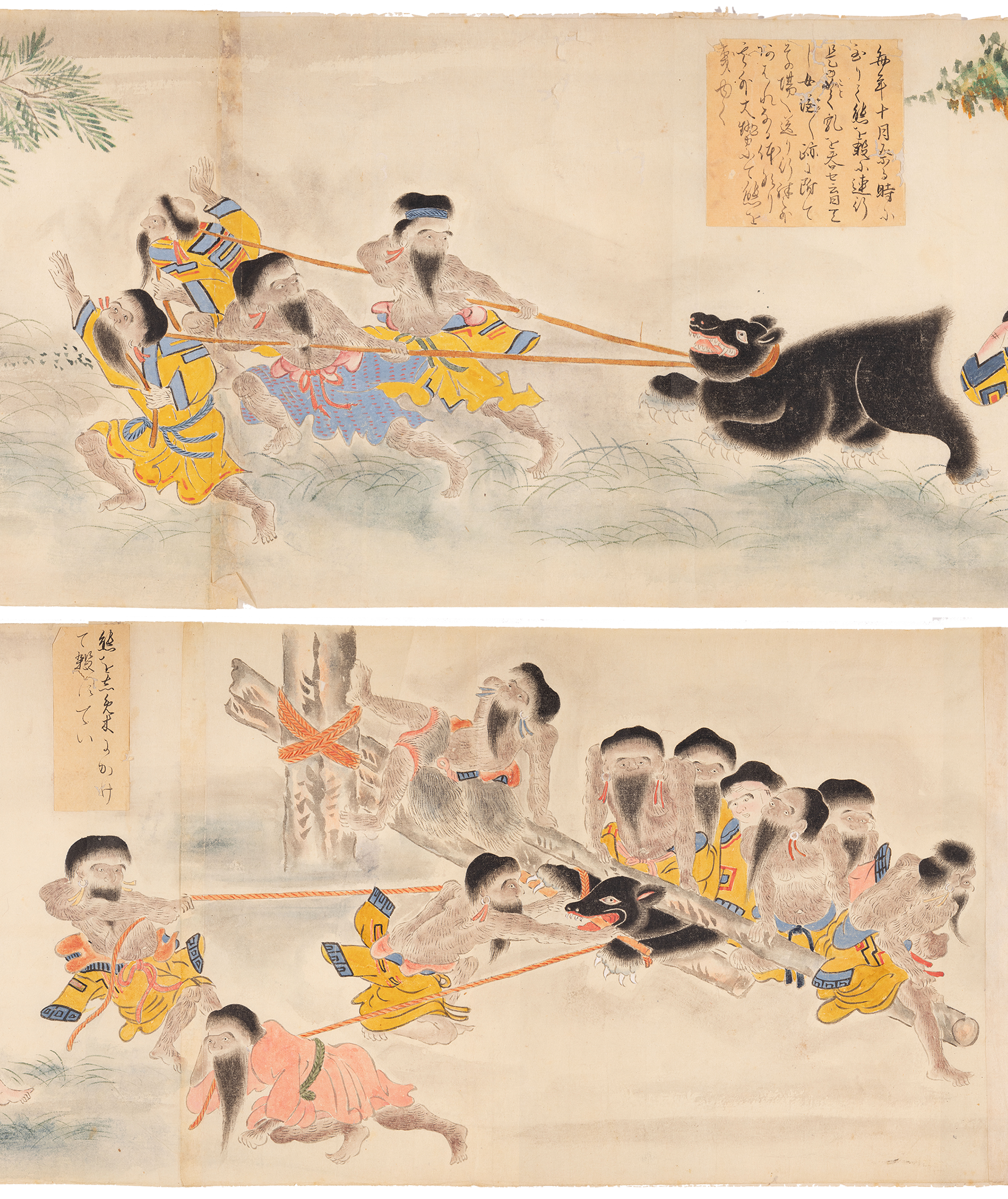
A central part of Kodama’s scroll is representations of the iyomante ceremony and activities leading up to it. He depicts the domestication of a young bear, believed to be a kamuy living in the human world, beginning with its care within the village (see the woman holding a baby bear in Figure 2). He then shows the next steps of its ritual killing and the community's celebration afterwards, with copious attention to preparing food and feasting.
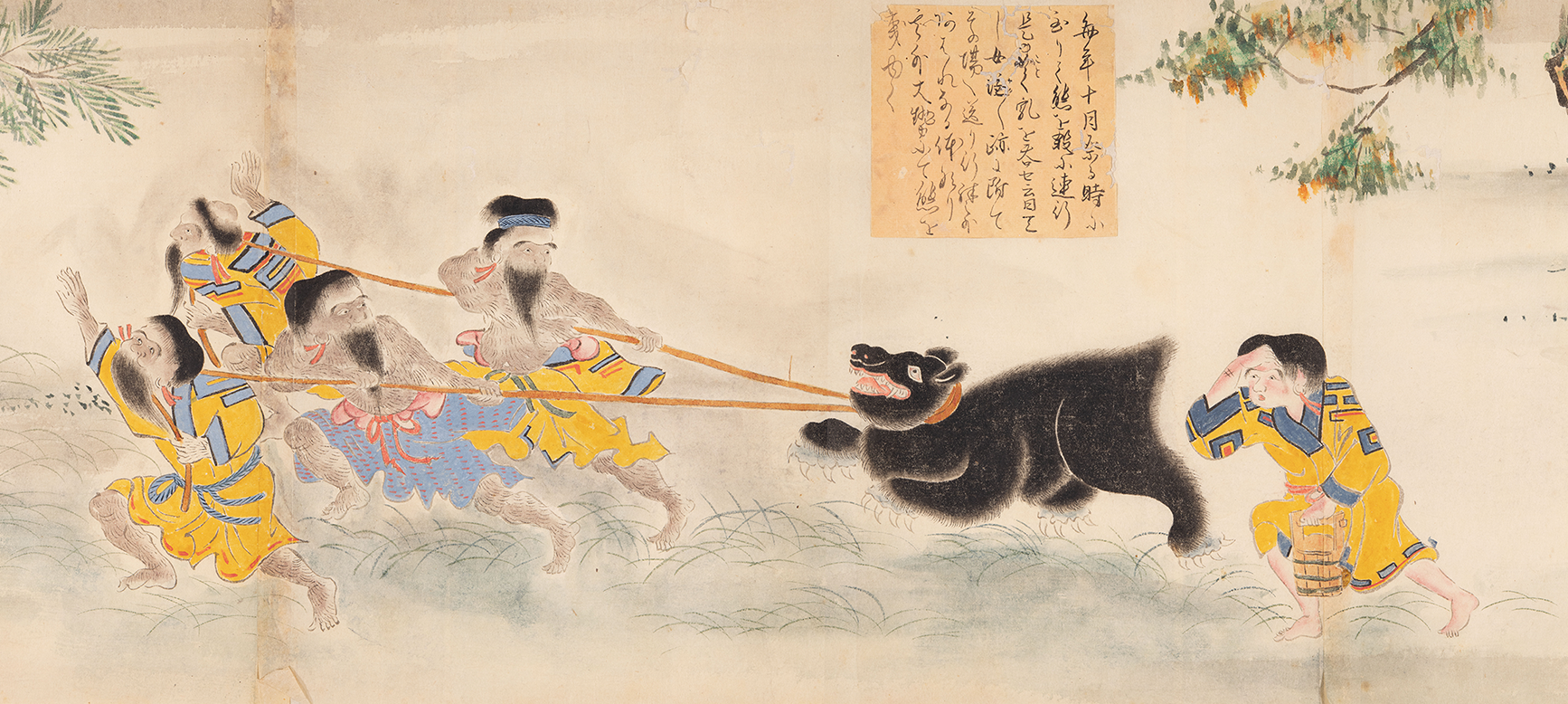
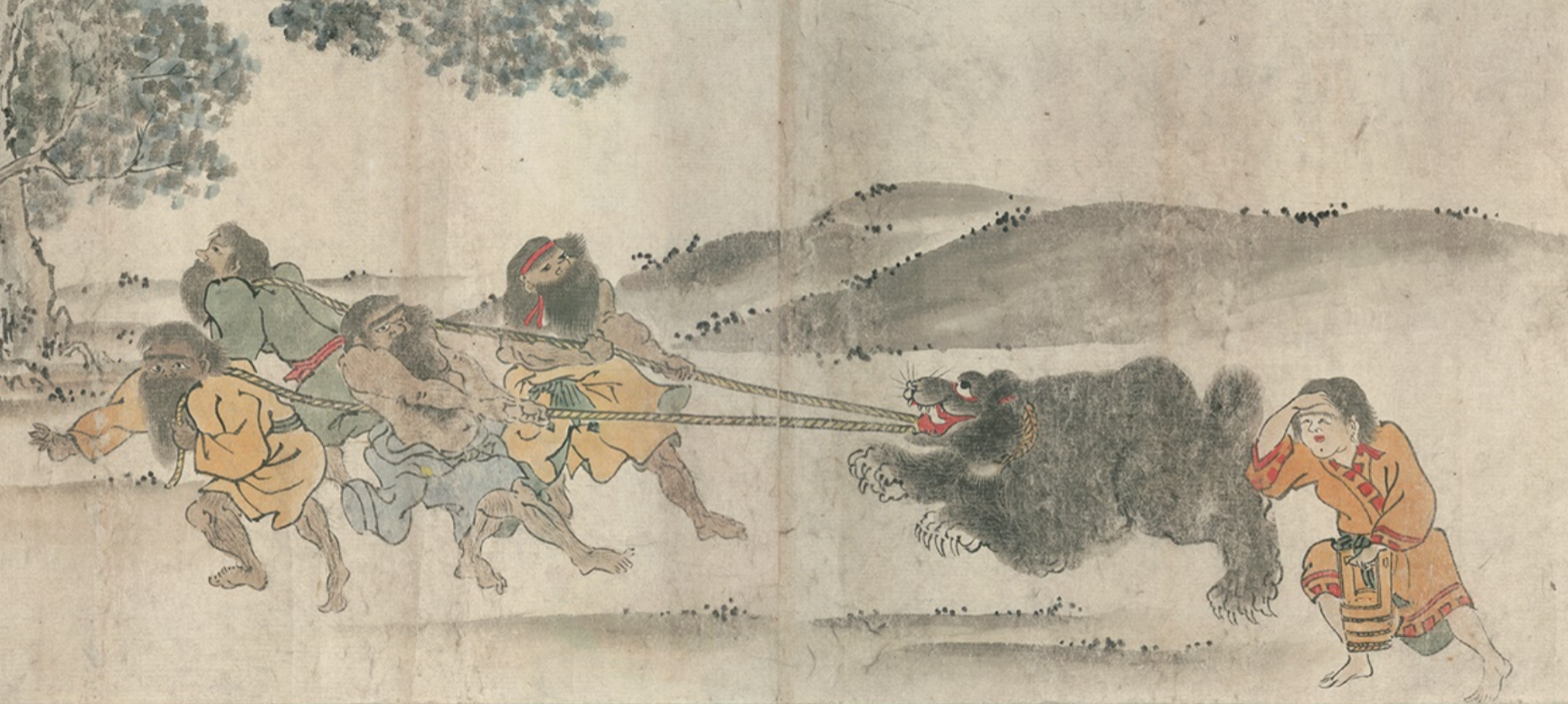
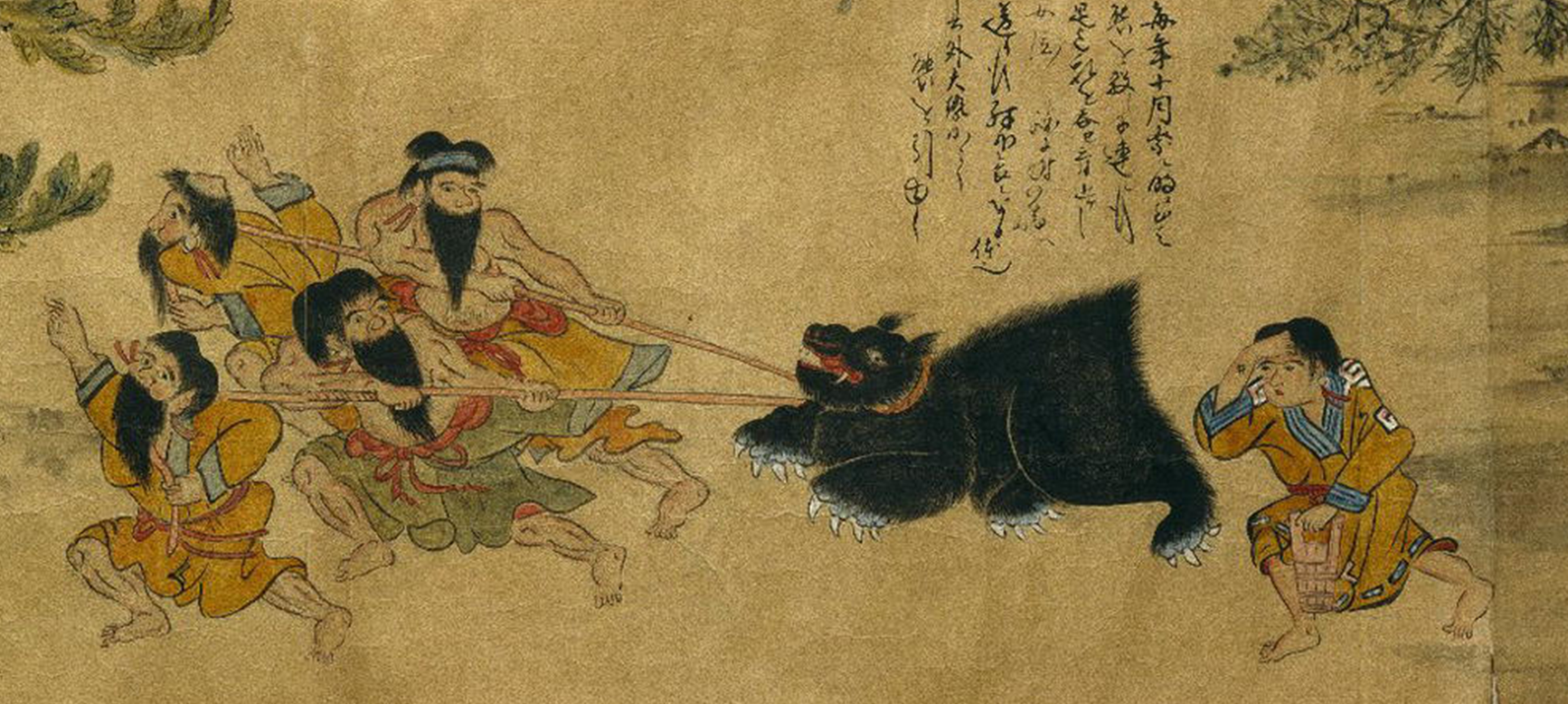
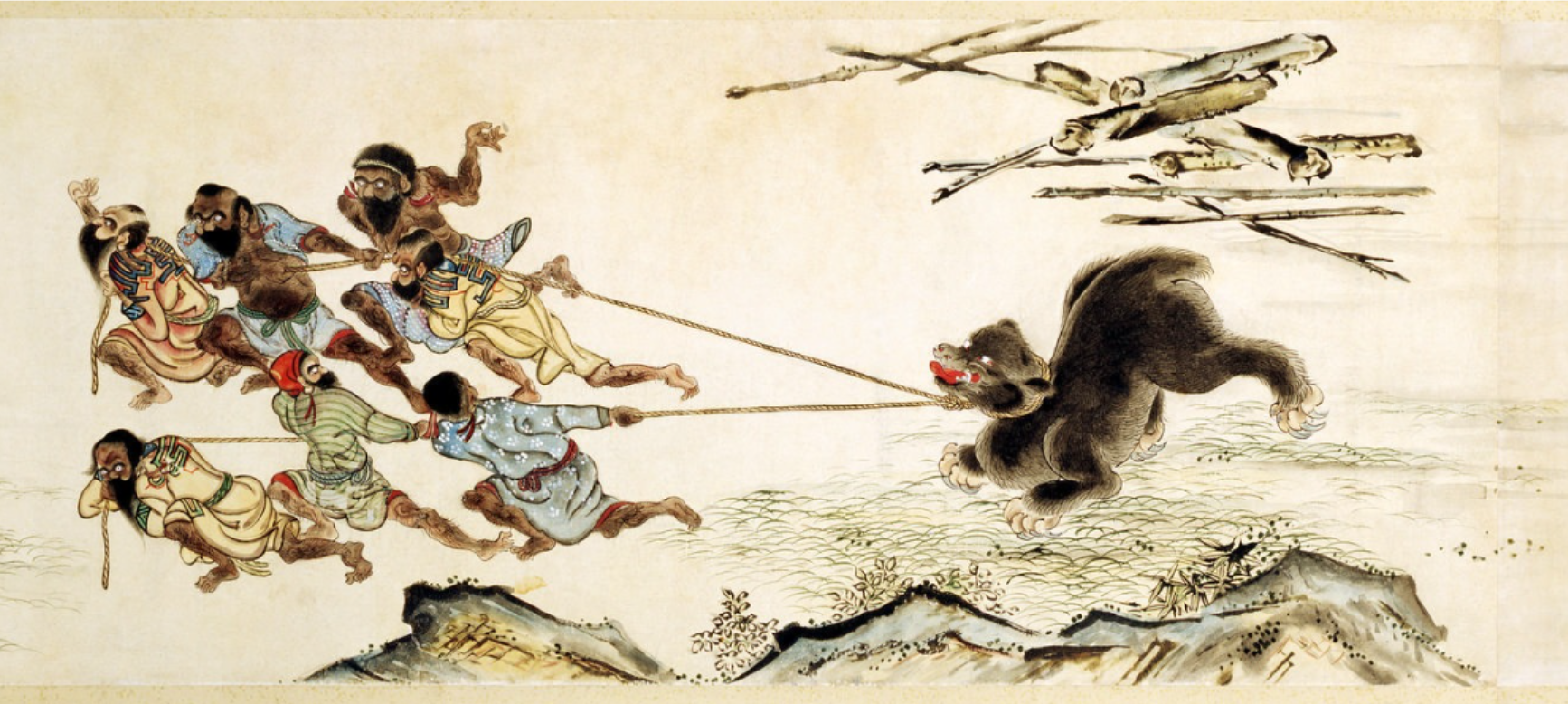
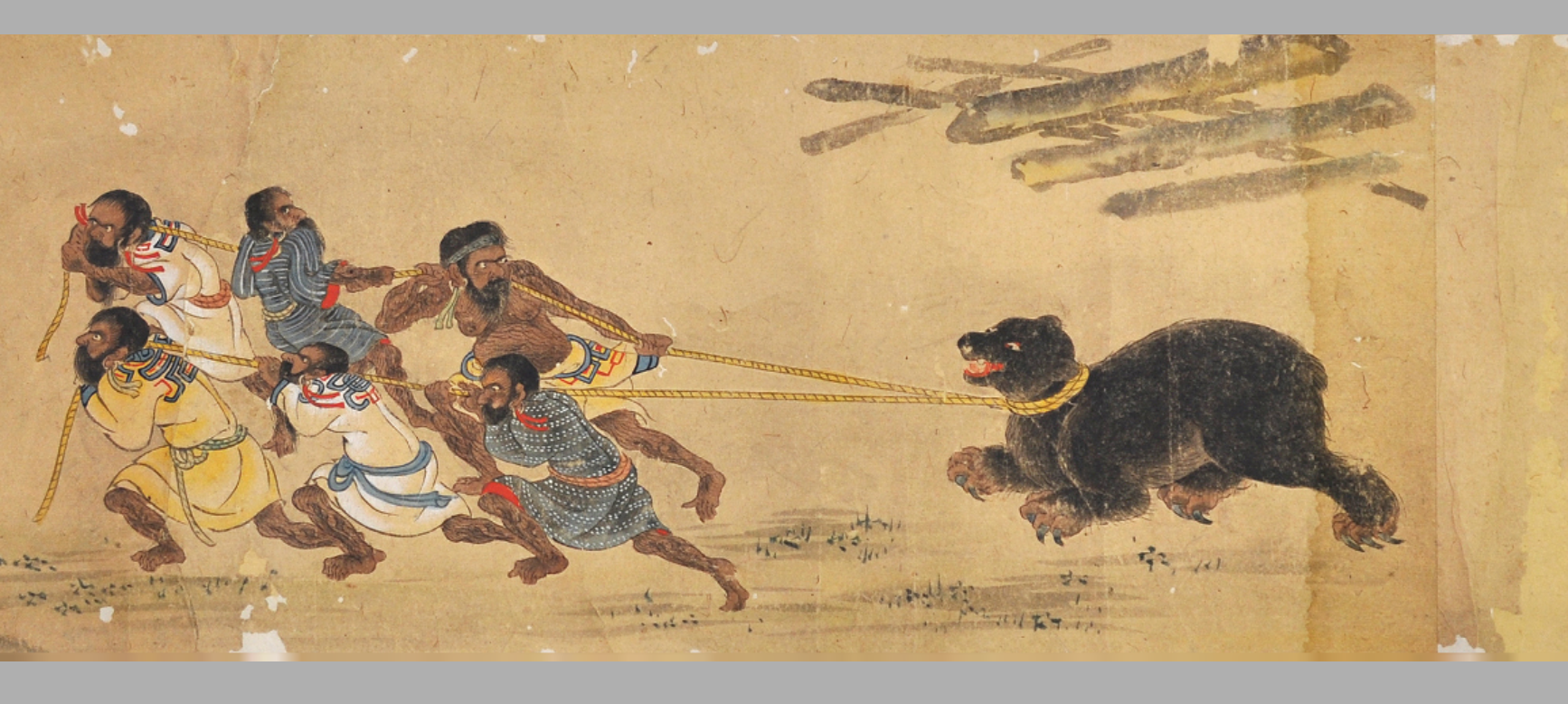
Preparation for the iyomante begins roughly two weeks before it occurs, with men of the village carving inau イナゥ (ritual shaved wands) and women brewing alcohol and preparing food. During the ritual, the bear (kamuy) is led around in a practice intended to encourage the kamuy to dance and play as it enjoys its final moments in the human world.10Iyomante. Ainu seikatsu bunka saigen manyuaru イオマンテ アイヌ生活文化再現マニュアル (The Foundation for Ainu Culture 財団法人アイヌ文化振興・研究推進機構, 2005), 9, 31. In the top image on the right, we see this act as several men tug the bear (now somewhat grown compared to its first appearance in Figure 2) by ropes.
Although the scroll does not depict the shooting of the bear (first with blunt-tipped arrows to excite it, then with real arrows to end its life), it does show members of the village conducting the final ritual strangling of the bear with logs afterwards (Fig. 8) and the placement of the body for worship along with various offerings and gifts, such as millet cakes and ceremonial swords.11For a comprehensive review of the iyomante and other sending ceremonies, see Shigeki Akino. “Spirit-sending Ceremonies.” In Ainu: Spirit of a Northern People. Edited by Fitzhugh William W. and Chisato O. Dubreuil, 248–255. Arctic Studies Center, National Museum of Natural History, 1999.
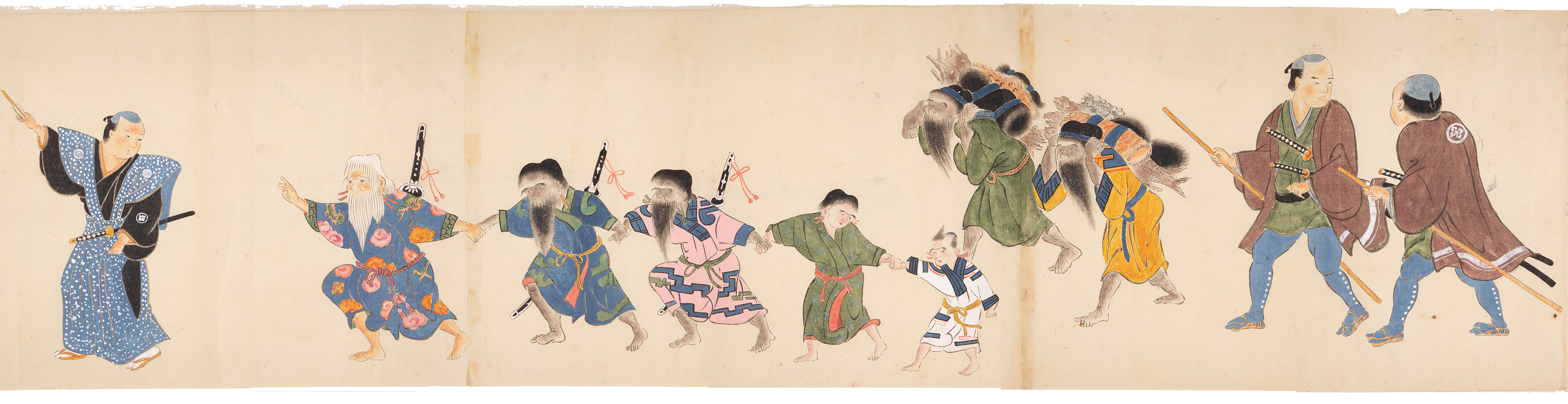
The illustrations at the conclusion of the scroll (Fig. 9) shows Ainu representatives walking with Japanese figures toward Matsumae castle. They carry various items on their backs, including sea otter, which will likely be submitted to the lord as a form of ritual submission.12David Howell, Geographies of Identity in Nineteenth-Century Japan (University of California Press, 2005), 119–121 For historical details on these exchanges, see our page on Curious Views of Ezo.
Copies of the Scroll
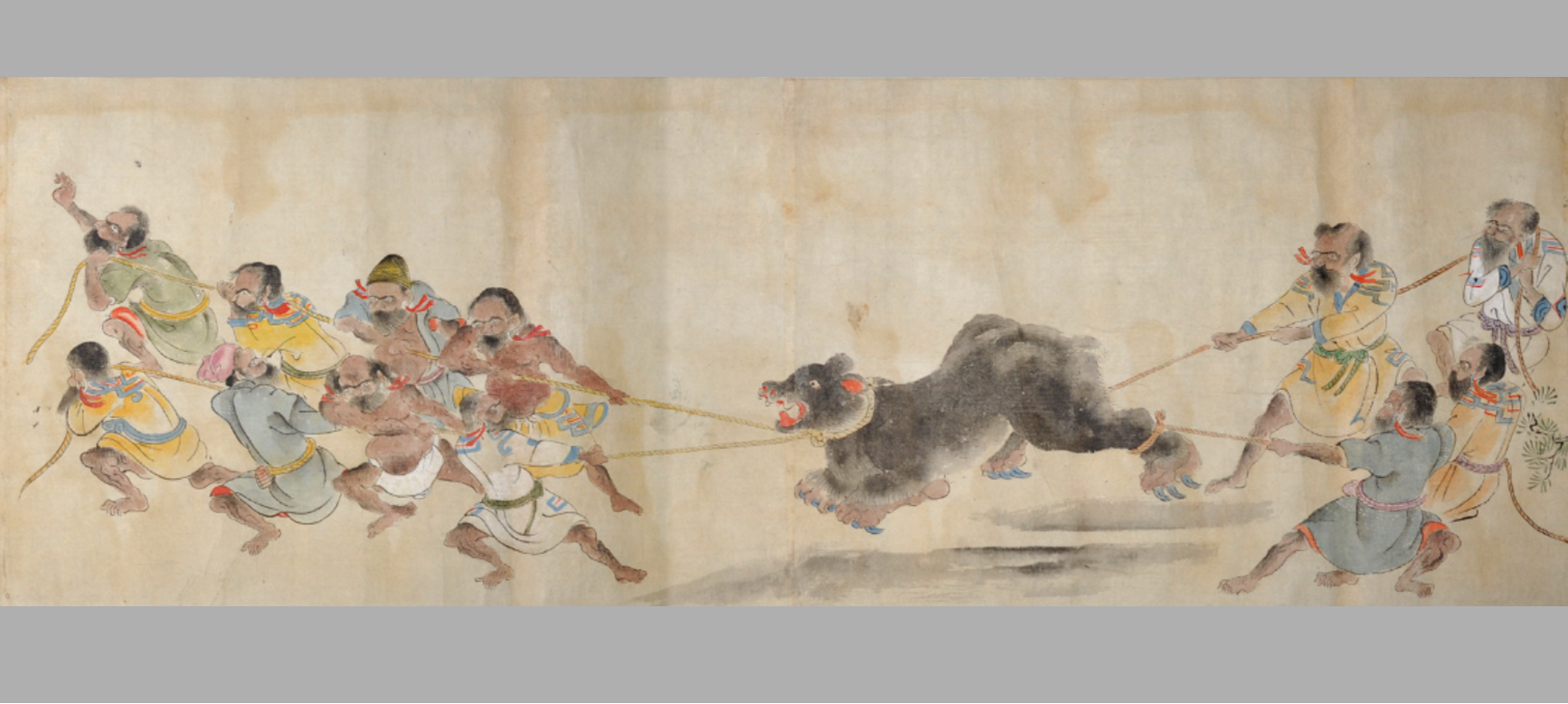
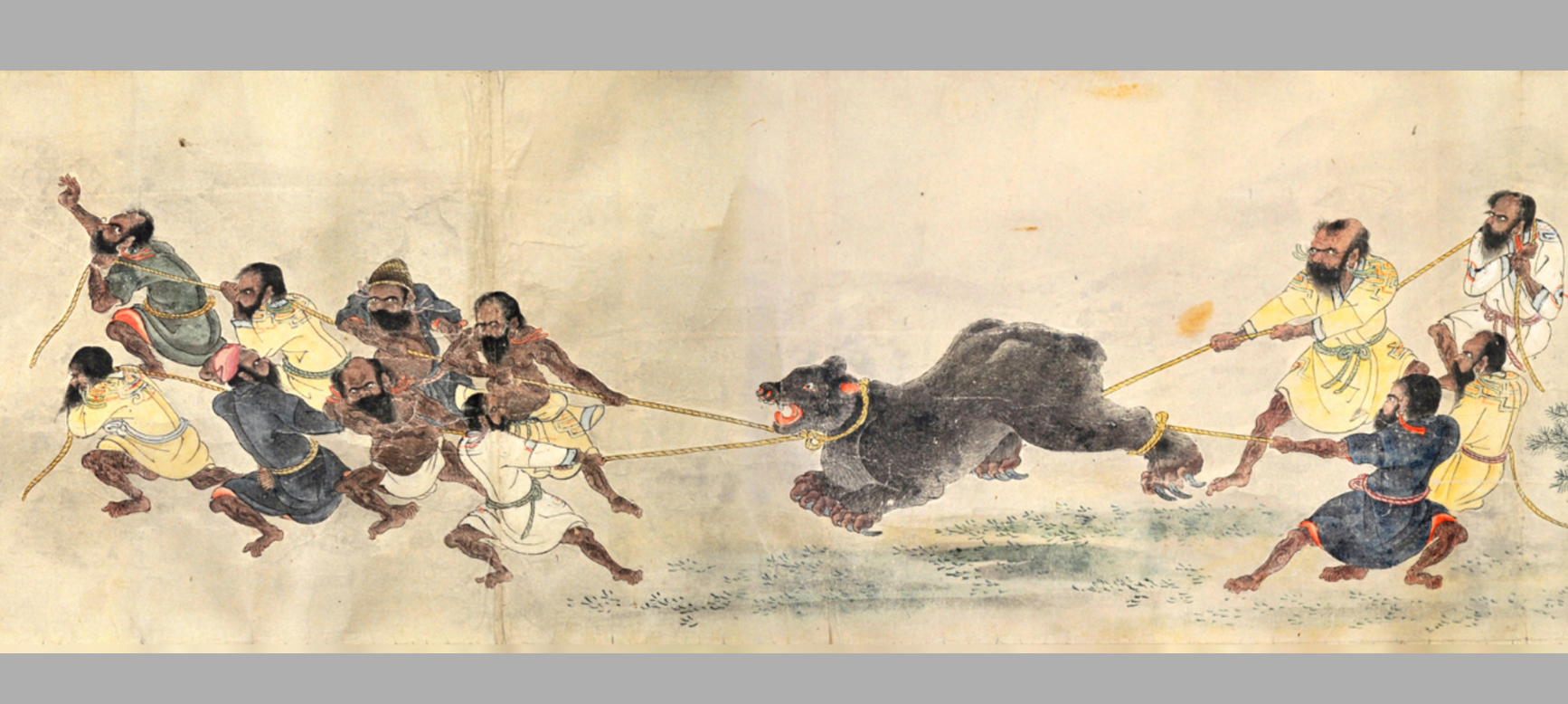
Kodama’s representations of Ainu were repeatedly copied by other artists and ethnographers, resulting in a variety of versions of this scroll being held in collections around the world. The Depictions of the Ezo Bear Festival and the Customs of the People scroll thus exists in various copies and under various names. It is difficult to track precisely where and when the scroll in our collection came to be in the course of copying practices, though the best hint is its inscription listing 1798 as its date. Each copy results in slightly new iterations of the same material, whether changes to the images, the removal or addition of text, or even entirely different sections of content. During the course of our class studies of depictions of Ainu, we analyzed a digital version of the scroll online–identified as Images of Ezo (Ezo-e 蝦夷絵) held by the Hakodate City Museum Digital Archives, not realizing that a copy existed in the UCLA library collections. The Hakodate version has an additional section at the start of the scroll illustrating various Ainu clothing and tools, and contains none of the narrative or explanatory text included in the UCLA scroll. Below, we provide one particular segment, the pulling of the bear on the way to the iyomante ceremony, as it appears in multiple digital collections. The images are presented in roughly chronological order insofar as dates are available.
References
Batchelor, John. Ainu Life and Lore: Echoes of a Departing Race. Tokyo: Kyobunkwan, 1927.
Izumi, Seiichi. The World of the Aynus: An Ethnological Record. Kajima Publishing, 1967.
Kodama, Mari. “Clothing and Ornamentation.” In Ainu: Spirit of a Northern People. Edited by Fitzhugh William W. and Chisato O. Dubreuil, 313–326. Arctic Studies Center, National Museum of Natural History, 1999.
Sasaki Shiro. “The Ainu in Northeast Asia.” In Ishuretsuzo, the Image of Ezo: Tracing Persons, Things and the World, 121–123. Hokkaido Museum, 2015.
O. Dubreuil, Chisato. “Ainu-e: instructional resources for the study of Japan’s Other People.” Education about Asia 9, no. 1 (Spring 2004), 9–17.
Howell, David L. Geographies of Identity in Nineteenth Century Japan. University of California Press, 2005.
Joliffe, Pia M. “Forced Labour in Imperial Japan’s First Colony: Hokkaidō.” The Asia-Pacific Journal: Japan Focus 18, Issue 20, No. 2 (2020): 1–15.
Sasaki Toshikazu. “Ainu-e: A Historical Review.” In Ainu: Spirit of a Northern People. Edited by Fitzhugh William W. and Chisato O. Dubreuil, 79–85. Arctic Studies Center, National Museum of Natural History, 1999.
Walker, Brett L. The Conquest of Ainu Lands: Ecology and Culture in Japanese Expansion, 1590–1800. University of California Press, 2001.