Curious Views of Ezo
Ezogashima kikan 蝦夷島奇観
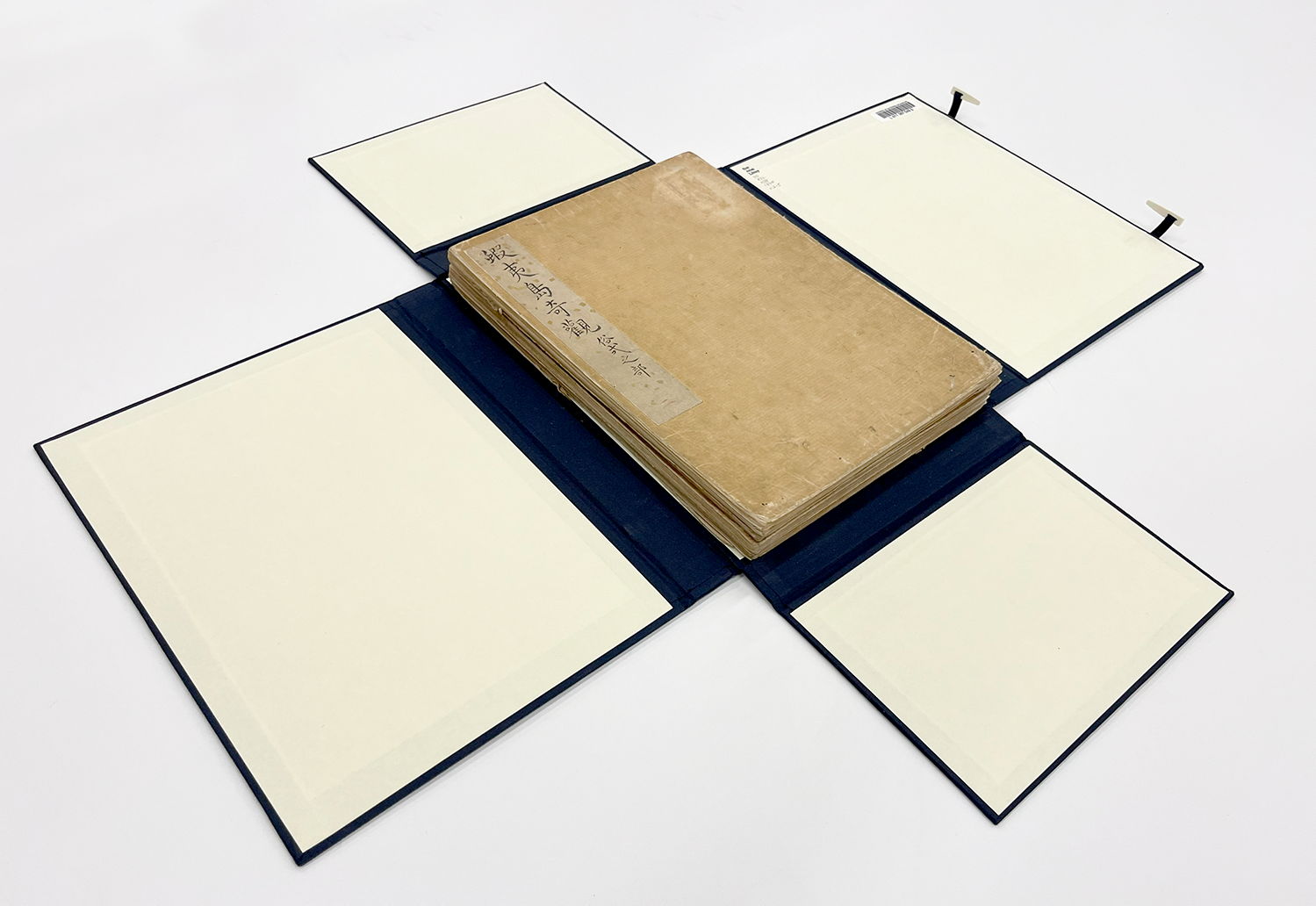
UCLA’s Charles E. Young Research Library holds a four-volume manuscript of Curious Views of Ezo (Ezogashima kikan 蝦夷島奇観) by Hata Awagimaru 秦檍丸 (1764–1808). These volumes feature double leaves of text and color illustrations in folded accordion style (orihon 折り本) format. These volumes are a copy of the original text (completed c. 1799–1800), though the copyist and exact date of reproduction are unknown, possibly between 1804 and 1918. There are an estimated 65 known copies of Ezogashima kikan currently held in various museum and institutional collections. The text was edited, re-edited, and iterated upon repeatedly during its development, the result of which is numerous versions of the text ranging from a single volume to its final form, a 13-volume set held by the Tokyo National Museum that dates to 1807 and is considered the completed version.1Azuma Shunsuke 東俊佑. “Ezogashima kikan shahon no kenkyū (2)『蝦夷島奇観』写本の研究(二).” Hokkaidō hakubutsukan kenkyū kiyō 北海道博物館研究紀要 [Bulletin of Hokkaido Museum] 10 (2025): 149. This 2025 survey provides highly detailed charts comparing different versions and lineages of Ezogashima kikan copies.
Hata Awagimaru, also known by the names Hata no Aokimaro 秦檍麿 and Murakami Shimanojō 村上島之允, was a shogunal official with a deep interest in the Ainu way of life. Hata wrote various texts during the 1790s that were precursors to this manuscript, with Ezogashima kikan developed after Hata accompanied a shogunal survey in 1798. Curious Views of Ezo is considered to be one of the most comprehensive and accurate early modern sources of Ainu history and culture, one which takes a more scholarly approach than most depictions of Ainu as simply “hairy barbarians." In his text, Hata even draws comparisons between Ainu language and customs and ancient Japanese, suggesting a connection between them.2Sasaki Toshikazu 佐々木利和, Ainu-eshi no kenkyū アイヌ絵誌の研究 (Sōfūkan 草風館, 2004), 85–87; Hata Awagimaru 榛檍丸. Ezogashima kikan 蝦夷島奇観. Edo period, Kansei 12 [1800]. Important Cultural Property. Tokyo National Museum. Bunka isan onrain 文化遺産オンライン [Cultural Heritage Online]. Agency for Cultural Affairs. Accessed June 3, 2026. The fourth volume in the UCLA collections depicts not only Ainu customs, but also the daily life and living environment of Japanese people who reside in the north.
Below, our team has selected some notable sections of the manuscript and highlighted their significance to understanding Ainu history and culture.
Iyomante, the “Sending Back” Rite
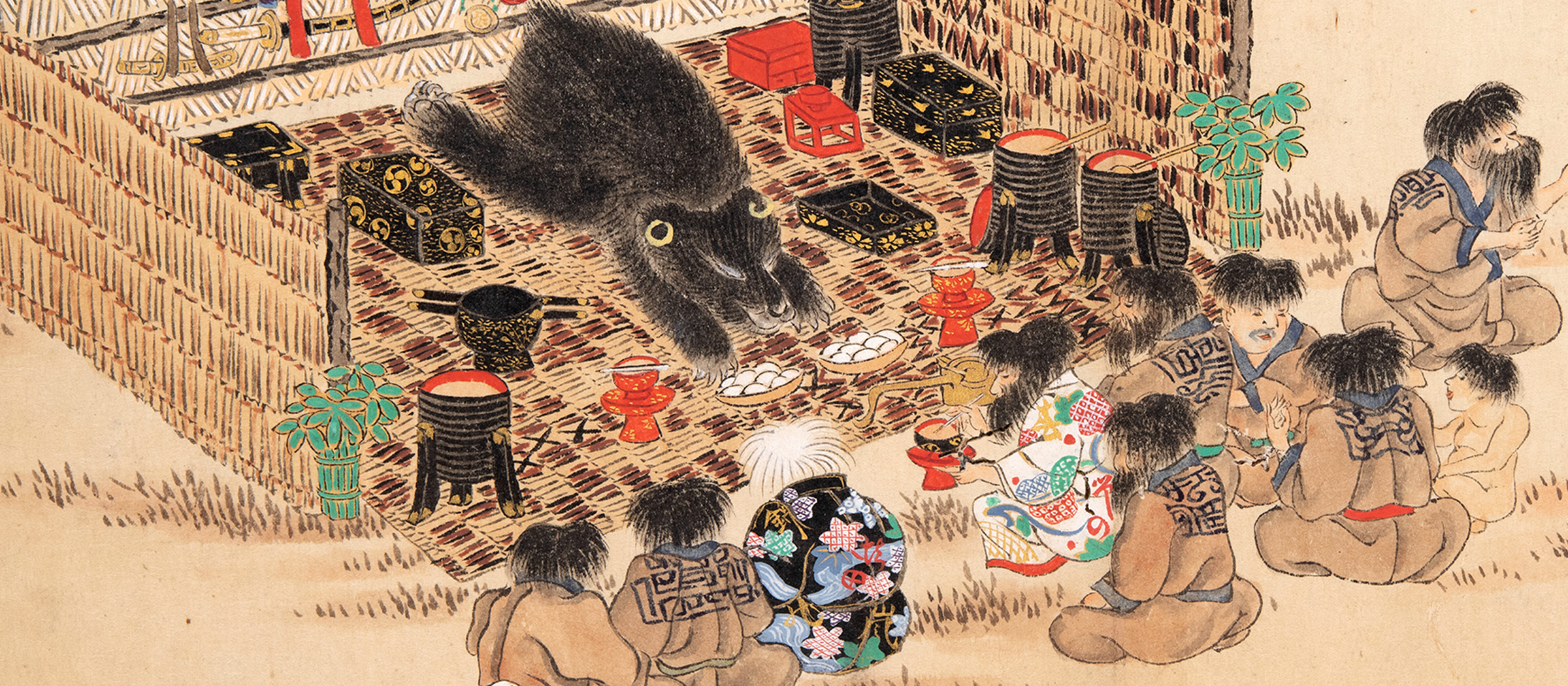
These pages of the Ezogashima kikan depict the Ainu spiritual ceremony known as the iyomante イヨマンテ, or “bear-sending ceremony." It is one of the most important ceremonies in Ainu culture and is depicted in many illustrations and descriptions of everyday Ainu life. The Ainu believe that spirits or deities known as kamuy カムィ reside in all things, and temporarily come to this world. Performing this ritual was a way to release the divine spirit that was temporarily living as the bear and send it back to the spirit world with gifts. This was done to gain favor with the spirit world and in return receive gifts such as food and protection while encouraging the gods to return to this world again.3Akino Shigeki, “Spirit-sending Ceremonies,” in Ainu: Spirit of a Northern People, Fitzhugh William W. and Chisato O. Dubreuil, eds. (Arctic Studies Center, National Museum of Natural History, 1999), 248–250.
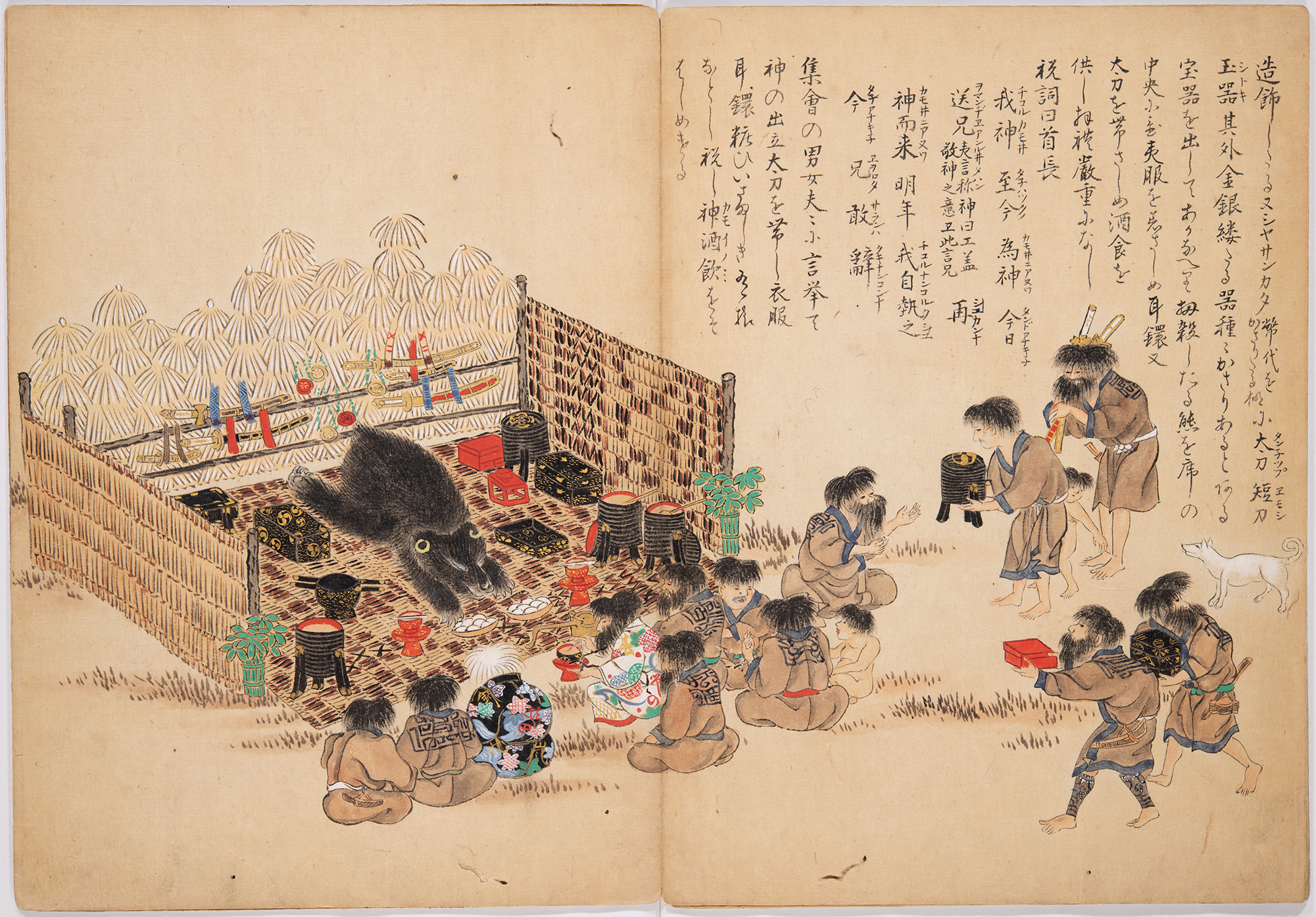
The part of the ceremony depicted above is after a bear has been ceremonially killed. Celebrating with the community, the village would partake in a feast that would include bear meat and rice or millet cakes (seen offered on a plate before the bear in this image). We also see ikupasuy (ceremonial libation sticks) resting on lacquer bowls. The ceremonial space is shown to be decorated with their prized possessions, such as ceremonial swords and lacquerware obtained from the Japanese. The iyomante ritual and other spirit-sending ceremonies reflect the Ainu worldview that humans, animals, and spirits exist in a reciprocal relationship based on respect and mutual aid.4Motomichi Kono, “Ainu and Northwest Coast Peoples: A Comparison,” in Ainu: Spirit of a Northern People, Fitzhugh William W. and Chisato O. Dubreuil, eds. (Arctic Studies Center, National Museum of Natural History, 1999), 118–119.
Below we roughly translate the text in Figure 2 accompanying the iyomante scene. Note that different versions of the text have variations on katakana spellings of Ainu words as well as some minor differences in words or kanji character usage. Some clarifications to the content have been added as notes on the English.
造飾したるヌシヤサンカタ幣代をかざりたる棚に太刀 短刀
玉器其外金銀縷たる器種々かざりあるとある
宝器を出してあがなへり扨殺したる熊を席の
中央に置夷服を着さしめ耳鐶又
太刀を帯さしめ酒食を
供し拝礼厳重になし
祝詞曰首長我神 至今 為神 今日
送兄 夷言称神曰ヱ盖敬神之意ヱ此言兄 再
神而来 明年 我自 執之
集会の男女夫々に言挙て
神の出立太刀を帯し衣服
なとし祝し神酒飲をそ
はじめける
Upon a decorated altar (a shelf adorned with ritual sticks)*This is clarifying commentary inserted into the text. Here meaning inau イナゥ, an Ainu ritual wood shaving stick that is used in rituals for praying to the spirit world. These can be seen behind the shelf with swords hanging on it in Figure 2. they place long swords, short swords, jewelry, and other various items inlaid with gold and silver. The treasures are placed there and the [bear’s life] offered. The killed bear is placed in the center and dressed with barbarian clothing, with rings in its ears and a sword. Food and alcohol are offered with solemn worship.
The chief says words of prayer:
"Our god, you have ascended to godhood! Today, we send back our brother.*The term "brother" in the prayer refers to the bear. (In Ainu language they refer to [it] as a god and come together in worship and speak of it as a brother)*This is commentary placed in smaller text within the prayer. Return to us once again next year, and I will perform [this ritual]. Now we bid our brother farewell."
The men and women assembled speak prayers and proclaim as they raise a drink to the gods, "The god’s departure–adorned with a sword, robes, and earrings–how majestic a sight!"
Goods Exchange with the Japanese
The scene below from Curious Views of Ezo depicts trade between Ainu and Japanese, possibly the uimam ウイマム (referred as omemie お目見え by Japanese) or umsa/omusha オムシャ, rituals in which Ainu representatives visited the Matsumae lord to pay respects and show submission. In return, Ainu would receive goods that, while often considered less valuable by the Japanese, were often prized in or relied on by Ainu communities, such as rice, tobacco, swords, and other items that could not be produced by the Ainu themselves.5David Howell, Geographies of Identity in Nineteenth-Century Japan (University of California Press, 2005), 119–121.
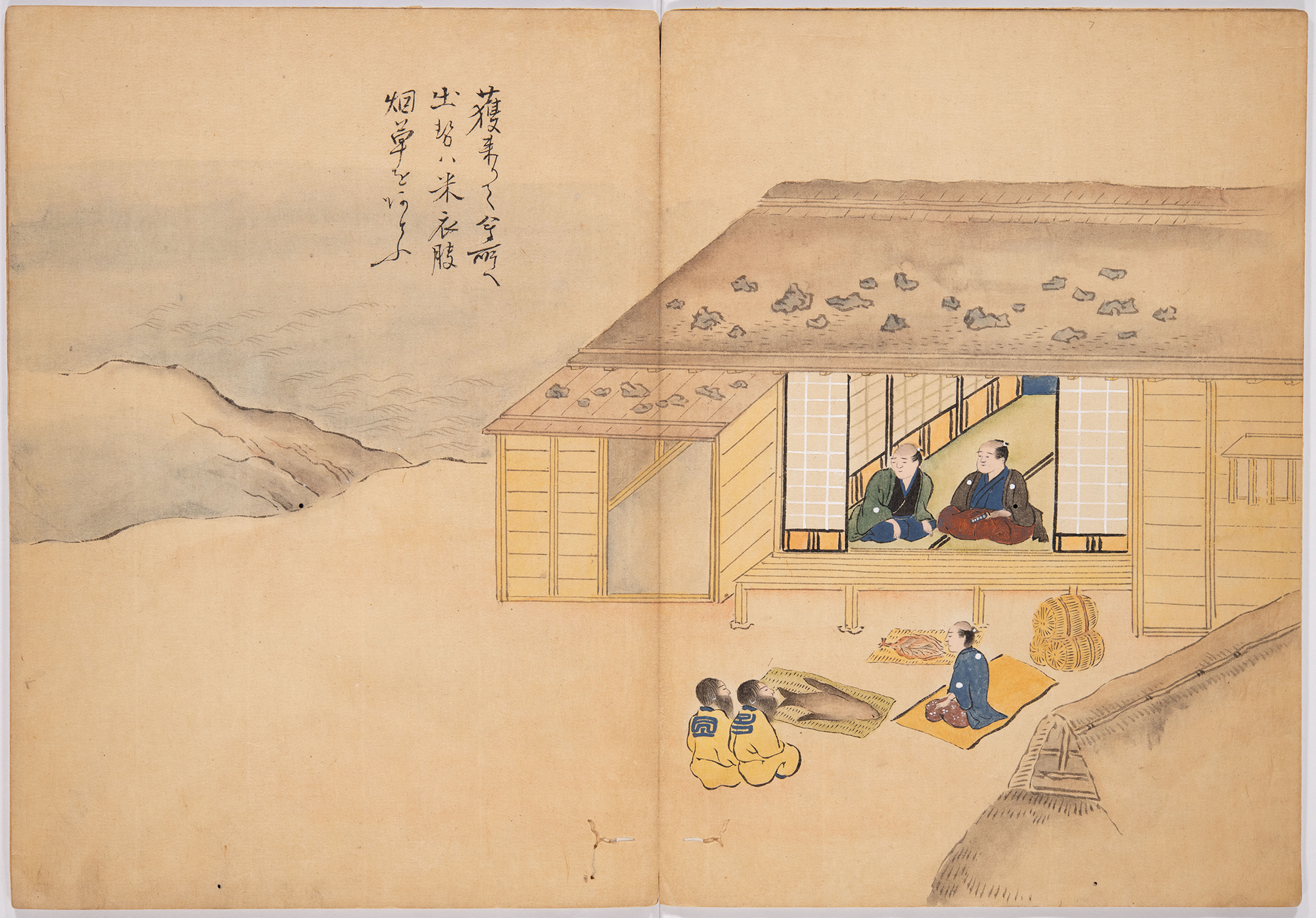
The text from the page above reads:
獲来りて会所へ
出せば米衣服
烟草をあたふWhen [Ainu] catch [something] and bring it to the meeting hall,
they are given rice, clothing, and tobacco.
The practices of uimam and umsa were originally rooted in Ainu culture traditions. Uimam referred to “trade” or exchange between (typically) equal parties, influenced by Ainu culture that heavily values reciprocation. Umsa is a term that refers to greetings conducted after a lengthy separation, one accompanied by various forms of hospitality. Transformed over time by the unequal political and economic dynamics of the North, these rituals eventually came to be used as mechanisms of control and demonstrations of Ainu inferiority.6Howell, 119–120. David Howell argues that these rituals could be interpreted as a form of “constructive misinterpretation”: while the Matsumae domain interpreted it as a display of submission akin to a tributary relationship, the Ainu could interpret the ritual as a form of reciprocal trade in which they obtained goods and provided for their communities.7Howell, 125.
By the time Curious Views of Ezo was created and copied, the unequal relationship between the two sides had become explicit. In this particular painting, the two Ainu individuals sit directly on the ground, while a Japanese attendant or lower-status warrior sits nearby on a mat likely serving as an intermediary between the two parties. Two people, presumably higher ranking, sit higher up on a veranda as they are presented with the goods (a seal or seal skin). One man might be presumed to be the Matsumae lord, given that he wears a sword at his side. The spatial/seating arrangement indicates and reinforces the unequal relationship and social hierarchy embedded within the ritual.
References
Hata Awagimaru 榛檍丸. Ezogashima kikan 蝦夷島奇観. Edo period, Kansei 12 [1800]. Important Cultural Property. Tokyo National Museum. Bunka isan onrain 文化遺産オンライン [Cultural Heritage Online]. Agency for Cultural Affairs. Accessed June 3, 2026. https://online.bunka.go.jp/heritages/detail/523310
Howell, David. Geographies of Identity in Nineteenth-Century Japan. University of California Press, 2005.
Kono Motomichi. “Ainu and Northwest Coast Peoples: A Comparison.” In Ainu: Spirit of a Northern People. Edited by Fitzhugh William W. and Chisato O. Dubreuil, 116–123. Arctic Studies Center, National Museum of Natural History, 1999.
Sasaki Toshikazu 佐々木利和. Ainu-eshi no kenkyū アイヌ絵誌の研究. Sōfūkan 草風館, 2004.
Shigeki Akino. “Spirit-sending Ceremonies.” In Ainu: Spirit of a Northern People. Edited by Fitzhugh William W. and Chisato O. Dubreuil, 248–255. Arctic Studies Center, National Museum of Natural History, 1999.