Hunting Tools
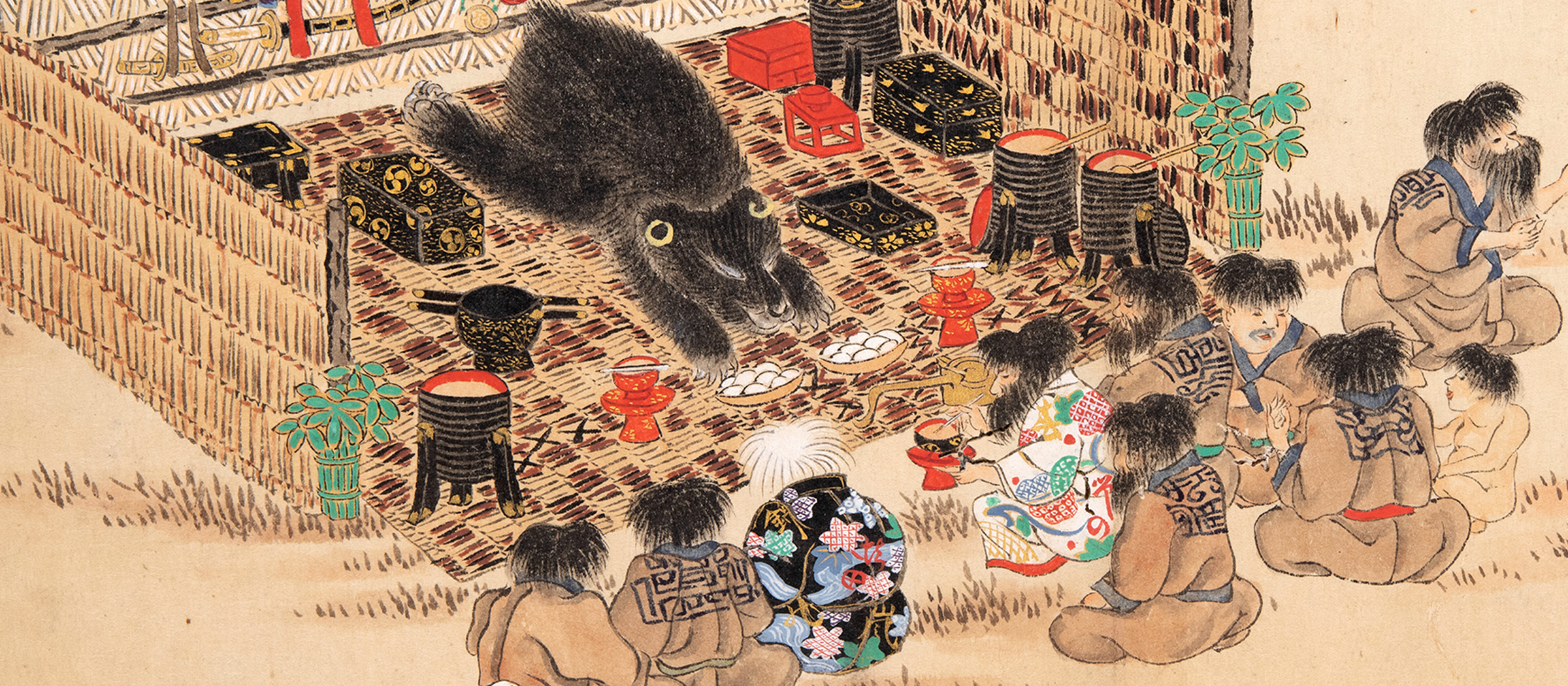
Ainu culture and spirituality is closely connected with the natural world. They believe that gods (known as kamuy カムィ) come into the world as animals, plants, landscape, weather, objects–there are kamuy in all things.1Hisakazu Fujimura, “Kamuy: Gods You can Argue with,” in Ainu: Spirit of a Northern People, Fitzhugh William W. and Chisato O. Dubreuil, eds. (Arctic Studies Center, National Museum of Natural History, 1999), 193. Animals, particularly those that were hunted, were therefore revered as part of a cycle in which gods entered and departed from the human realm. While Ainu are well-known for holding the iyomante イヨマンテ “sending-back” ceremony for returning gods in the form of bears back to the spirit world, similar ceremonies might also be held for owls, foxes, and other animals. Similar, somewhat simplified rituals might also take place at hunting sites where an animal was killed or by the hunting hut to send kamuy back to their world.2Shigeki Akino, “Spirit-Sending Ceremonies,” in Ainu: Spirit of a Northern People, Fitzhugh William W. and Chisato O. Dubreuil, eds. (Arctic Studies Center, National Museum of Natural History, 1999), 249–255. Hunting was therefore not just a way to obtain sustenance or to trade with neighboring communities, but was a relationship between Ainu and their deities.
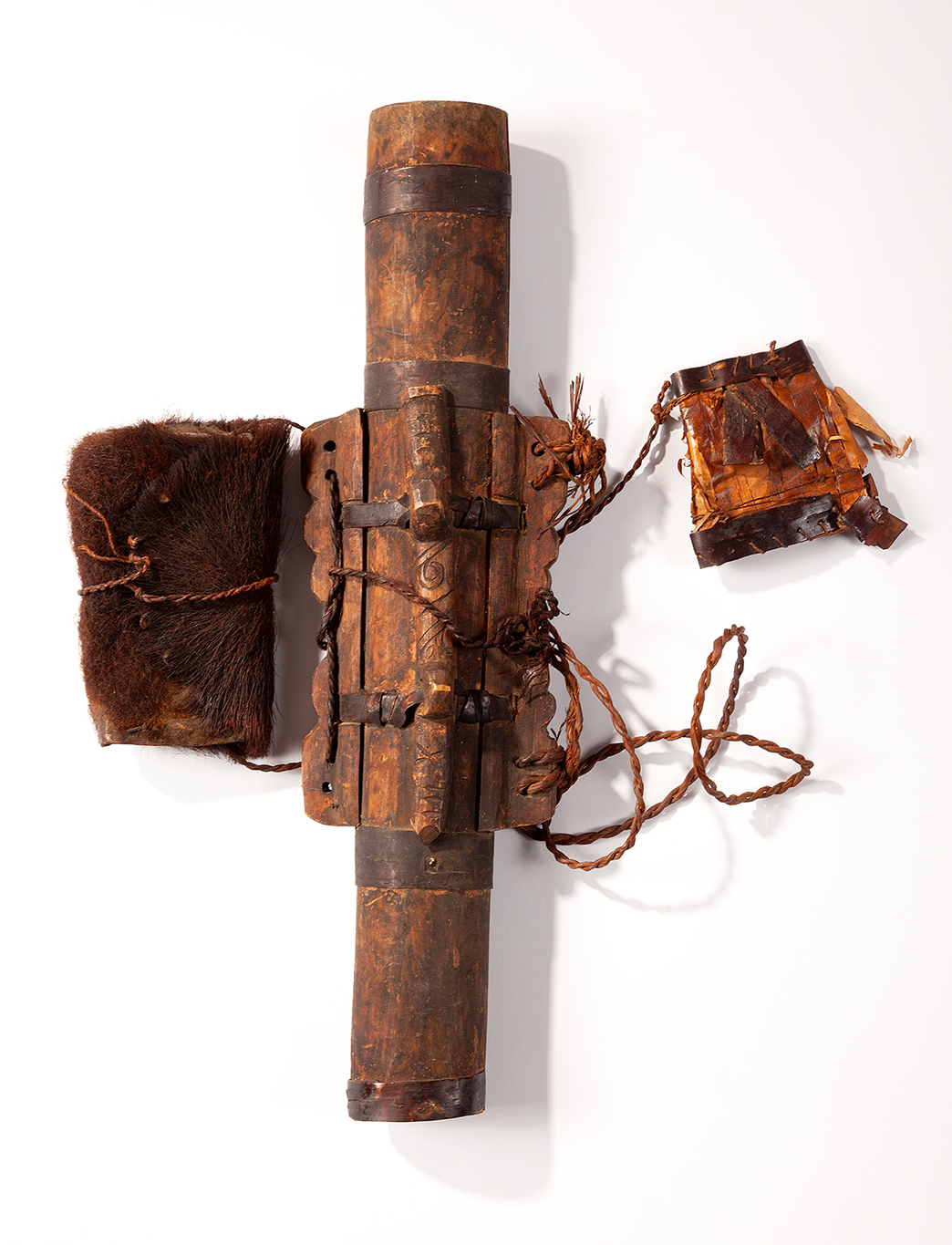
It is no surprise that various hunting tools used by Ainu are prevalent across collections around the world. Figure 1 is a quiver set from the collections of the Fowler Museum at UCLA. In catalog records, the place of origin is given as Hokkaido c. 1917, but we have no other specifics, and it is unclear how this date was arrived at for many of the Ainu items transferred to the Fowler at the same time.
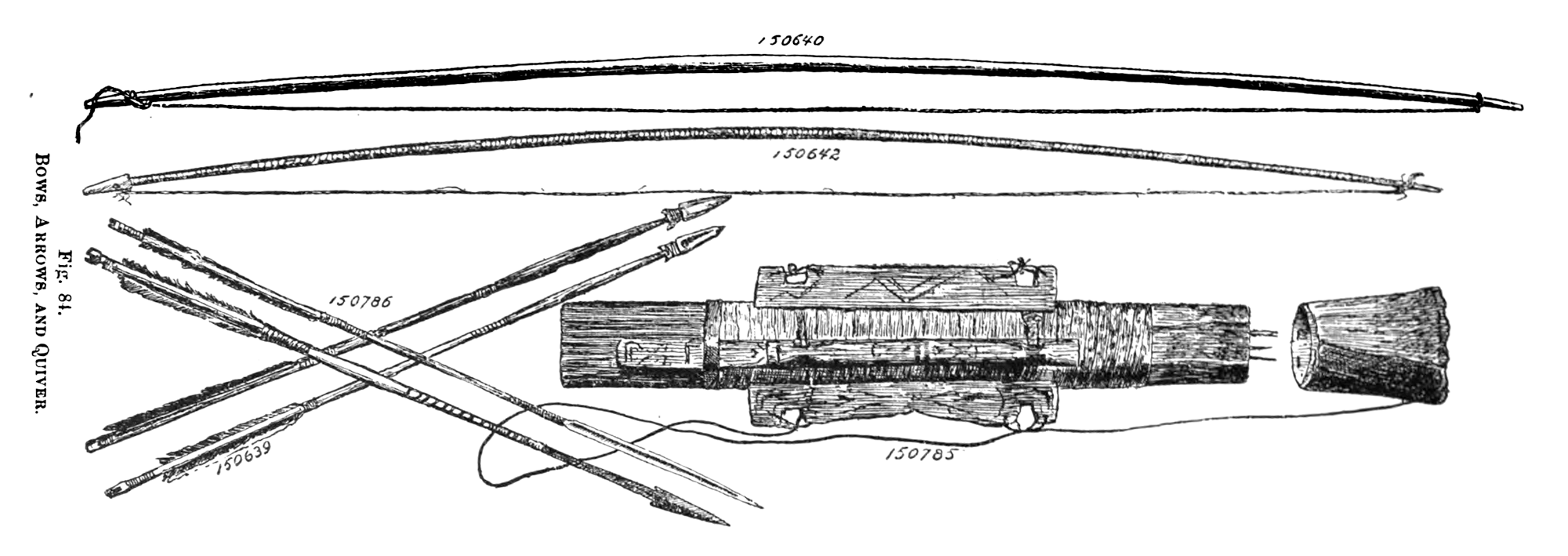
Early nineteenth- and twentieth-century records from Western missionaries and academics who studied Ainu communities note that the quiver is worn under the left arm and is slung using a cord that wraps over the shoulders, although we do not have a strap accompanying the Fowler’s quiver. Figure 2, a diagram from the 1890s made by scientist and curator Romyn Hitchcock (1851–1923) shows that both quivers have similar structures and shapes. Although due to damage (particularly its flattened state) we were unsure as to what the small item attached to the Fowler’s quiver with twine might be, comparing it with the diagram below we can confirm it is a quiver cap.3Romyn Hitchcock, The Ainos of Yezo Japan (Washington: Government Printing Office, 1892), 468. We also see wooden handles on the side that allow the string to connect the attachments and quiver.
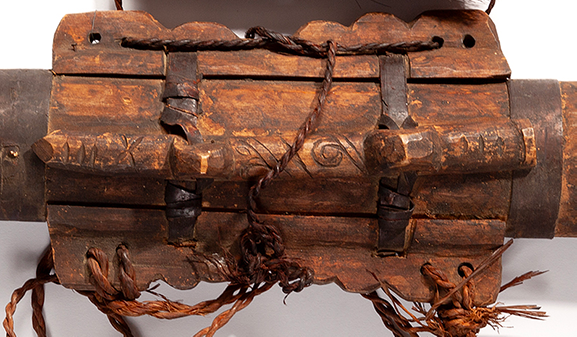
Another previously unidentified feature on the quiver set is the long wooden carving with decorative designs that is attached to the back (Fig. 3). On first glance, this item looks very similar to ikupasuy (libation sticks or prayer sticks), having a similar size, shape, and incised designs. However, diving deeper into our research we found that this may in fact be a pushka-un-ni, a wooden carving built into the quiver that resembles an ikupasuy. Just as ikupasuy, which would have been carried on the hunt for spiritual protection, were unique to the hunter, the pushka-un-ni would carry a symbol matching the ikupasuy. Quivers were thus also unique to the hunter and could identify him should anything befall him on the hunt.4Fosco Maraini, “Ikupasuy: It’s Not A Mustache Lifter!” in Ainu: Spirit of a Northern People, Fitzhugh William W. and Chisato O. Dubreuil, eds. (Arctic Studies Center, National Museum of Natural History, 1999), 329; Mitsunori Keira and Tomoko Keira, “Village Work: Gender Roles and Seasonal Work,” in Ainu: Spirit of a Northern People, Fitzhugh William W. and Chisato O. Dubreuil, eds. (Arctic Studies Center, National Museum of Natural History, 1999), 235.
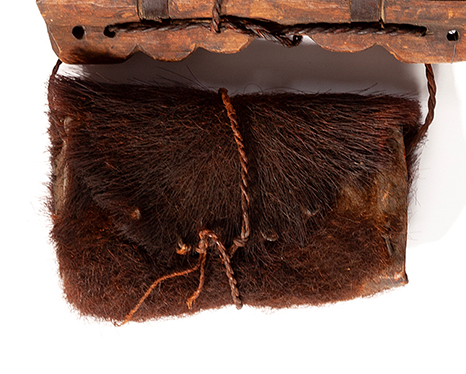
Also attached to the wooden quiver is a small pouch (Fig. 4). Catalog records provided no information on the function or materials of this item, but through research and comparisons with other museum collections we were able to determine that this hunting bag is typically made from bear skin, which seems consistent with its overall texture and color. The bearskin pack would be used to hold items such as kits for making fire, poison, and arrow points.5Hans Dieter Ölschleger, “Technology, Settlement, and Hunting Ritual,” in Ainu: Spirit of a Northern People, Fitzhugh William W. and Chisato O. Dubreuil, eds. (Arctic Studies Center, National Museum of Natural History, 1999), 217.
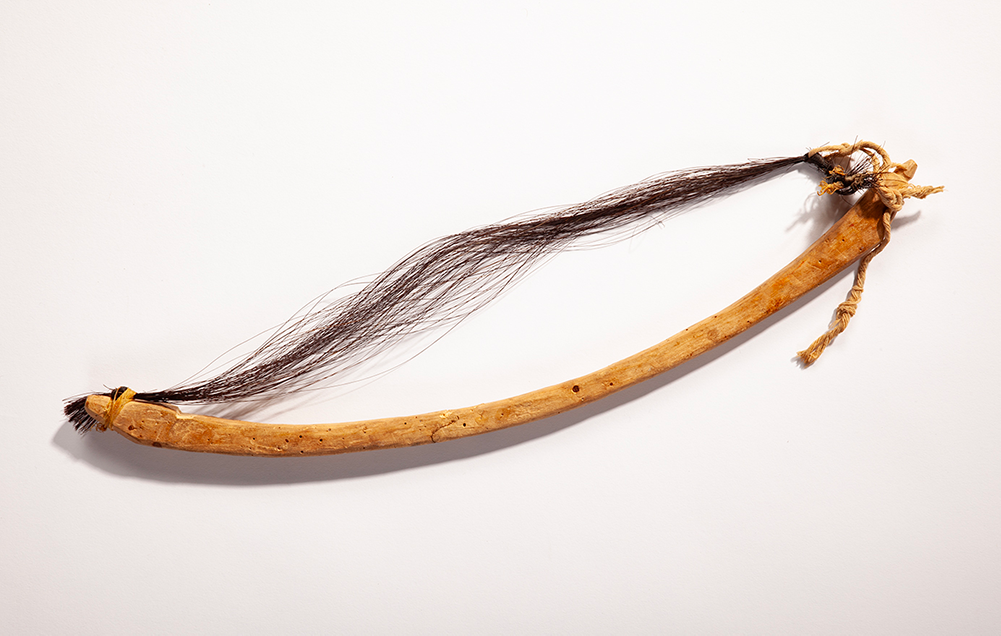
The Fowler Museum at UCLA also holds a wooden bow (Fig. 5) that is 42.5 cm in length. It is made of wood and has a bowstring made of horse hair. On one end of the bow, it seems that the horse hair bowstring came undone and was reconnected with twine. The usual Ainu bow (ku) was typically made of Japanese yew and about a meter in length.6Ölschleger, 210, 215.
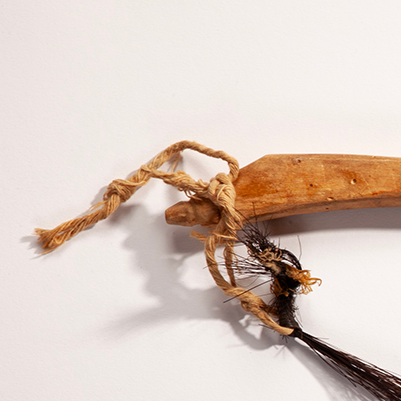
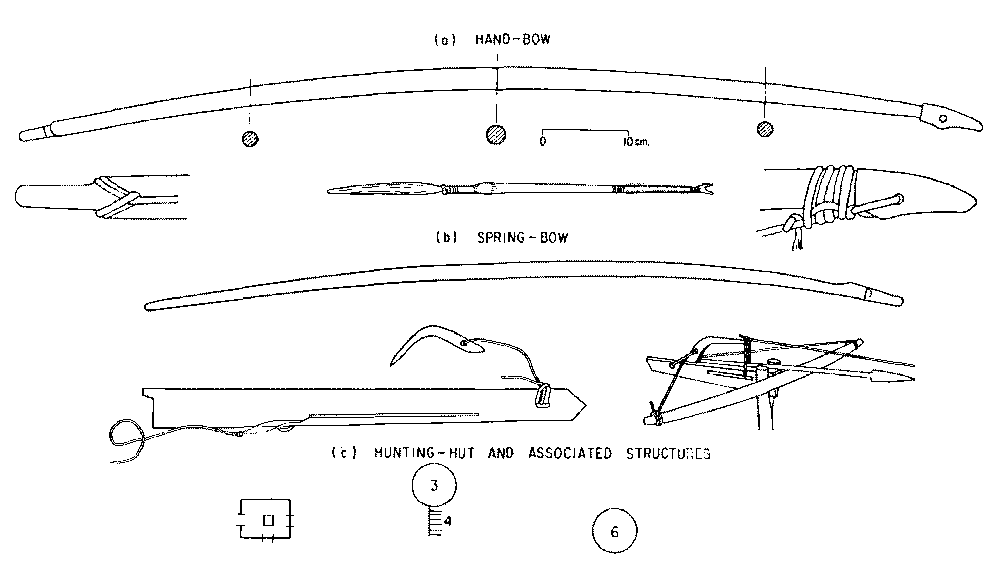
There are two types of bows used by the Ainu, the hand-bow and the amappo アマッポ, a spring-bow, similar to a crossbow, which were used to typically kill deer and bears (Fig.7).7Hitoshi Watanabe, The Ainu Ecosystem: Environment and Group Structure (University of Washington Press, 1964), 31.
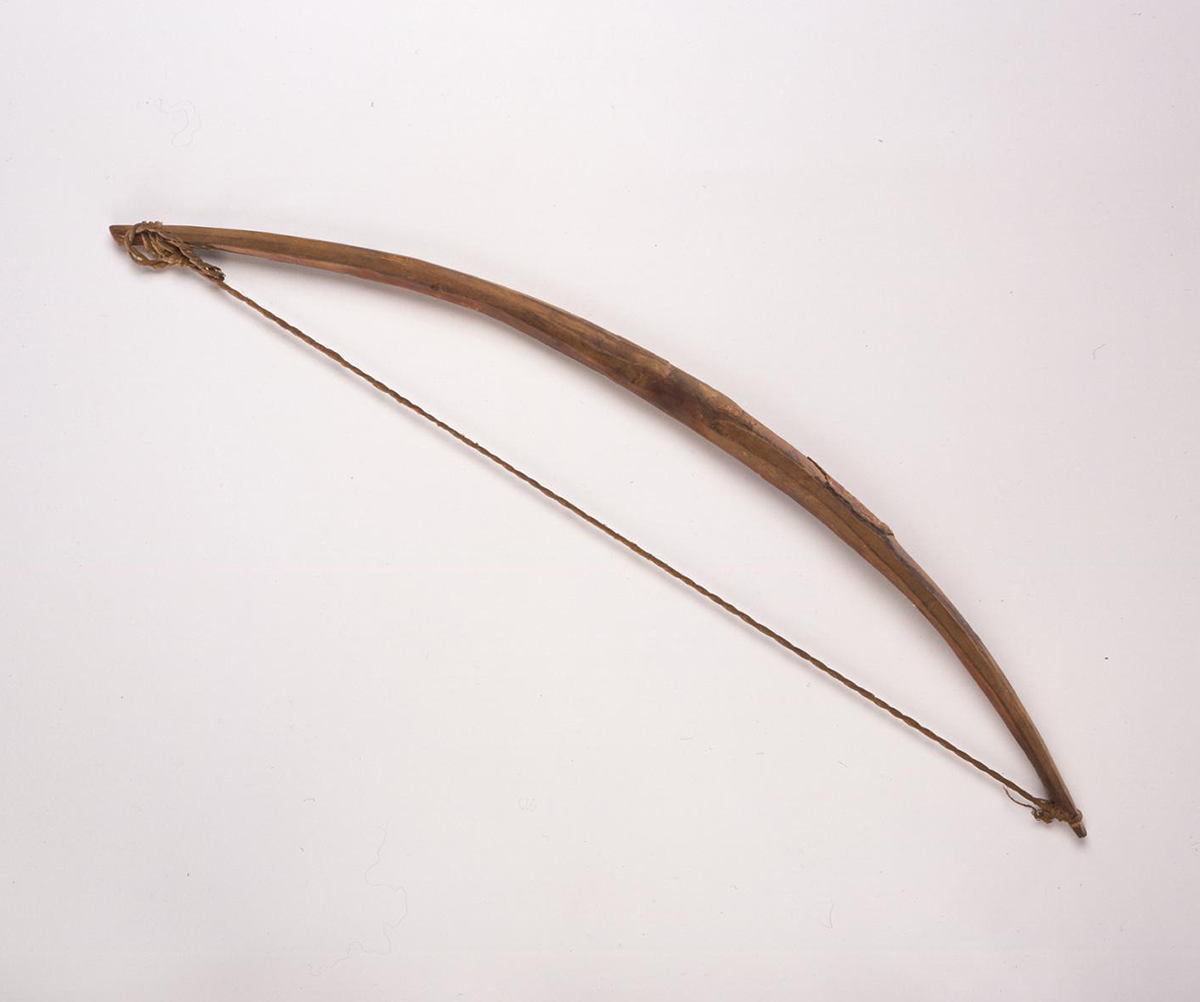
We were unable to find any mention of horse-hair being used as bowstring in our research, so it is unclear whether this was an assumption on the part of a past cataloger. From the current state of the bow in the collection it is not possible to know how fast or accurate this bow could have been. Since poison was usually added to the arrowheads to hunt large animals, so a bow only had to be strong enough to pierce the skin.8Hitchcock, 469. Another possibility we considered was that if it was not feasible for actual hunting, it could have been used either for the spirit sending ceremony to agitate the bear (in which case blunt-tipped arrows would have been used), or it could have been a toy for young boys to play with especially when factoring that it is half the size of a normal handbow.
As children, Ainu boys might engage in “target practice with miniature bows and arrows, spears, or other hunting weapons, aiming at a bear or seal made of pieces of wood, twigs, and grass.”9Emiko Ohnuki-Tierney, The Ainu of the Northwest Coast of Southern Sakhalin (Prospect Heights, Illinois: Waveland Press, Inc., 1984), 58. We compared the Fowler bow to the others, such as the bow in Figure 8 from the Penn Museum, which is described as “Male child’s bow.” The length of the Fowler Collection’s bow (42.5 cm), which is identical to that Penn Museum, so we find it is quite likely that the bow in the UCLA collections is also a child’s bow.
Among the collection of Ainu artifacts is also a set of five wooden arrows ranging from 49 cm to 53.5 cm in length (Fig. 9). The points of the arrows are somewhat dulled and extend to about half way of the staff where the neck starts then taper to a flat end all the way to the nock of the arrow.
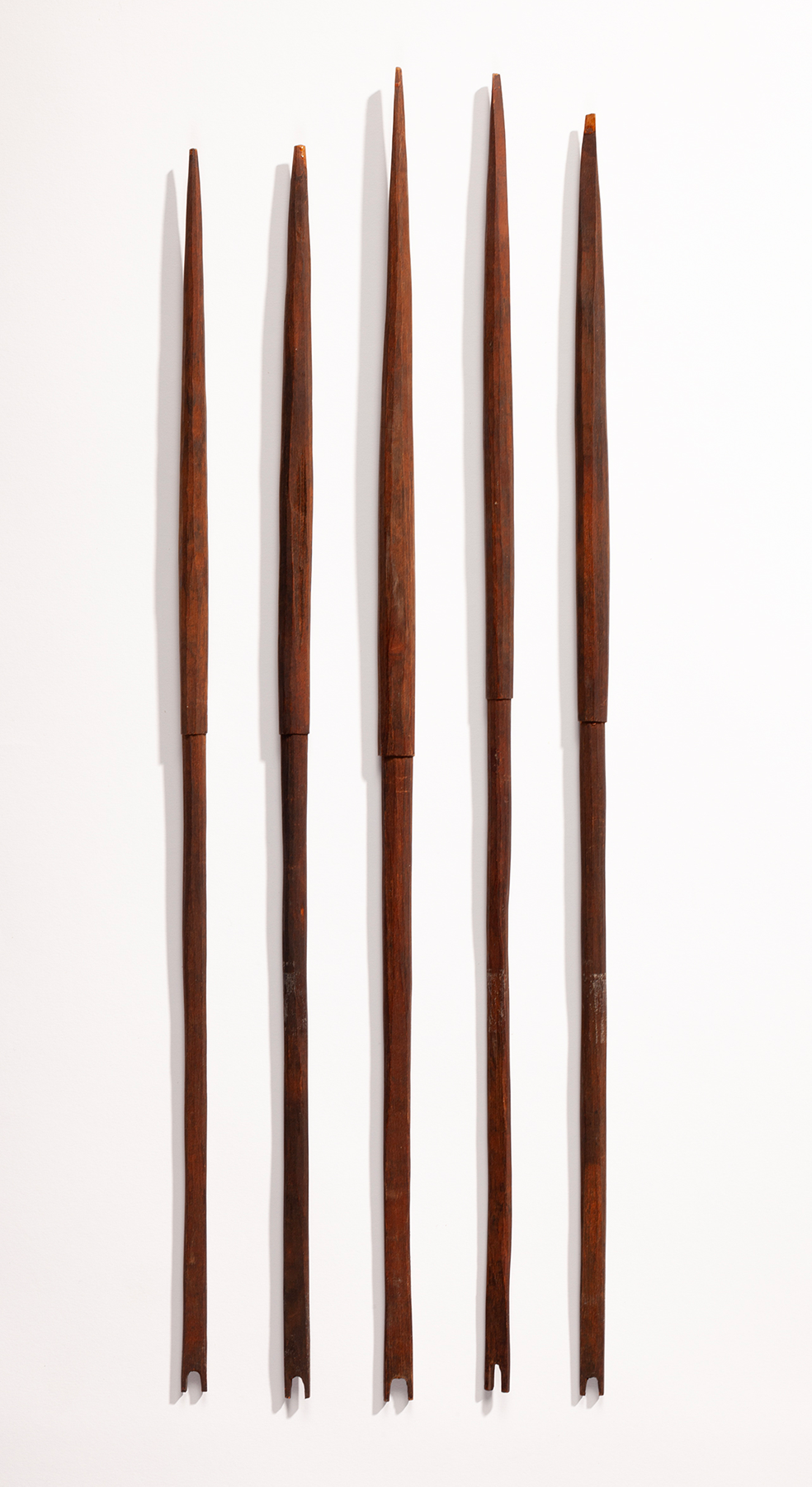
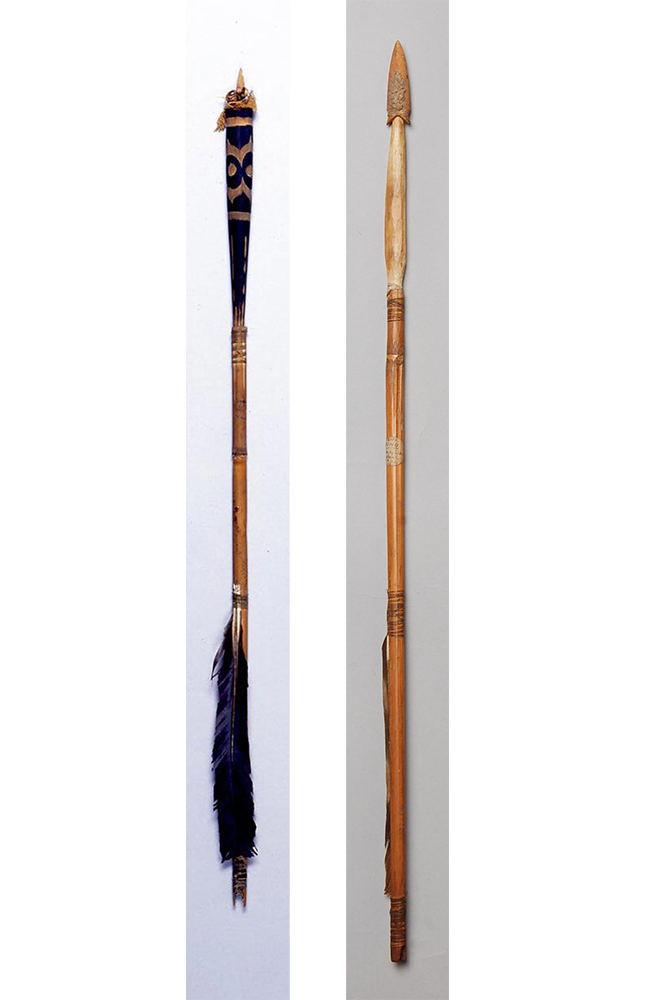
These arrows, although made of wood, do not seem to be designed to have a bamboo or any type of arrowhead for that matter attached to them. It is possible that these may also have been used for young boys to play games with. In addition, the end part of the arrow flattens as it gets closer to the nock. These arrows might have been tapered off in order ease the pain of beginner or children's fingers. If we compare them to Ainu arrows from other collections (Figs. 10 & 11) we can see the stark contrast with those that feature arrow heads and feather details.
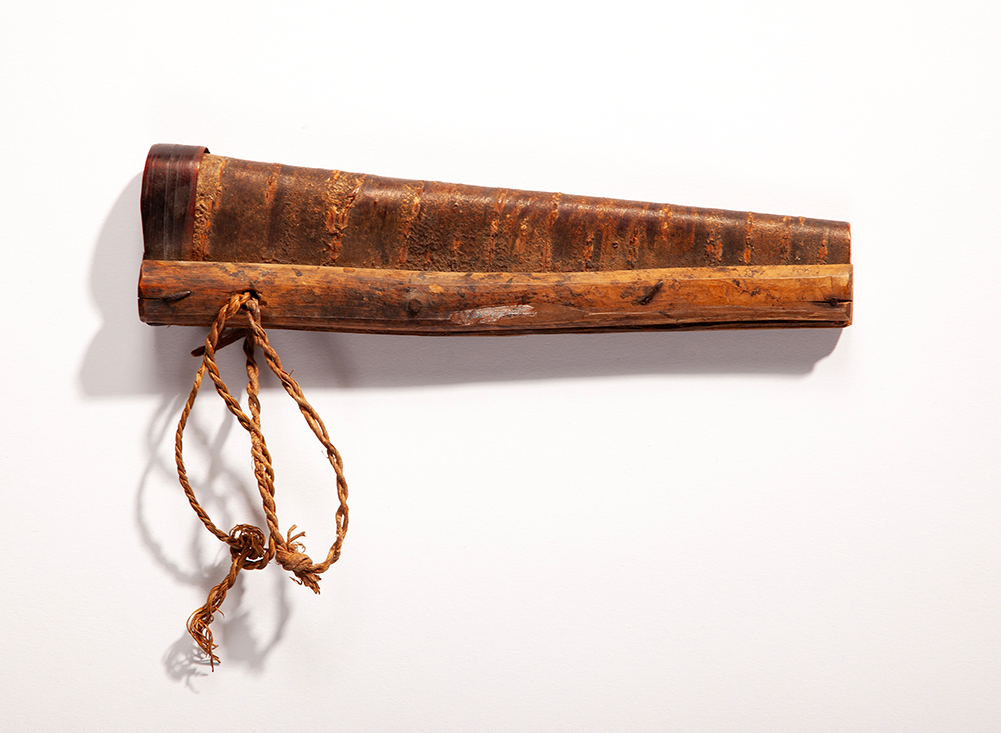
Although we did not have the opportunity to do extended research on the knife holder (Fig. 12) held in the Fowler collections, it measures 20.5 cm × 5 cm and is made from wood, nails, bark, and fiber.
Given the sacrality of carving to Ainu, more ornate knife holders with delicately incised designs on wood or even ivory can be found in many collections.10Keira and Keria, 234. The simple nature of the holder in the Fowler collection suggests this may have been a more practical hunting item, rather than a knife used for ritual carving.
References
Akino, Shigeki. “Spirit-sending Ceremonies.” In Ainu: Spirit of a Northern People. Edited by William W. Fitzhugh and Chisato O. Dubreuil, 248–255. Arctic Studies Center, National Museum of Natural History, 1999.
Hitchcock, Romyn. The Ainos of Yezo Japan. Washington: Government Printing Office, 1892.
Keira, Mitsunori, and Keira, Tomoko. “Village Work: Gender Roles and Seasonal Work." In Ainu: Spirit of a Northern People. Edited by William W. Fitzhugh and Chisato O. Dubreuil, 234–239. Arctic Studies Center, National Museum of Natural History, 1999.
Maraini, Fosco. “Ikupasuy: It’s Not a Mustache Lifter!” In Ainu: Spirit of a Northern People. Edited by William W. Fitzhugh and Chisato O. Dubreuil, 327–333. Arctic Studies Center, National Museum of Natural History, 1999.
Ohnuki-Tierney, Emiko. The Ainu of the Northwest Coast of Southern Sakhalin. rospect Heights, Illinois: Waveland Press, Inc., 1984.
Ölschleger, Hans Dieter. “Technology, Settlement, and Hunting Ritual.” In Ainu: Spirit of a Northern People, Fitzhugh William W. and Chisato O. Dubreuil, 208–222. Arctic Studies Center, National Museum of Natural History, 1999.
Watanabe, Hitoshi. The Ainu Ecosystem: Environment and Group Structure. University of Washington Press, 1964.