Weaving & Textiles
Basket (saranip)
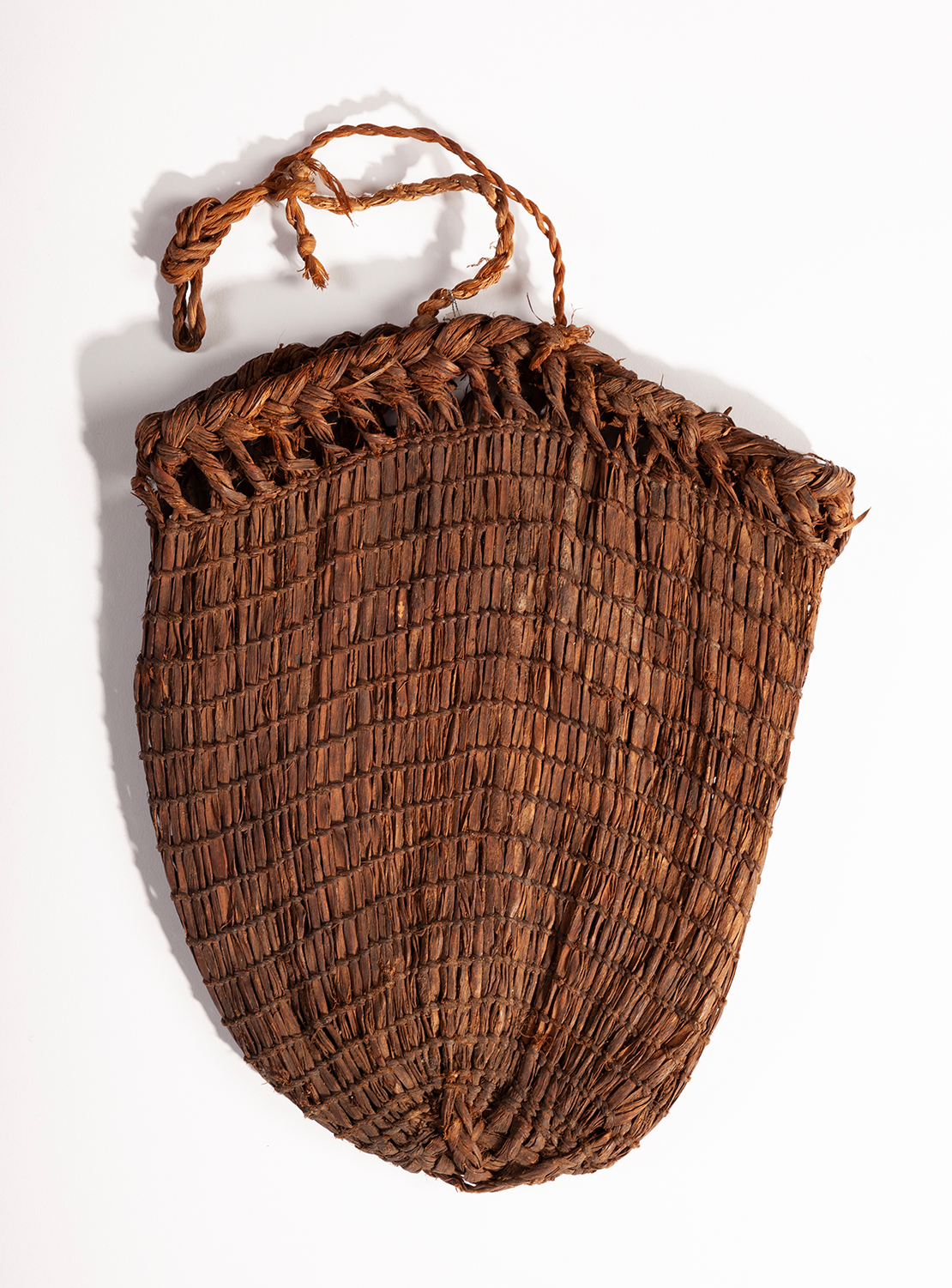
This is a traditional Ainu basket known as a saranip (サラニプ), woven from bark and fiber. Like many of the Ainu-related objects in the Fowler Museum that were transferred from the UCLA Anthropology Department in 1965, its date is tentatively given as 1917, though we cannot be sure of its exact time of creation. The information in the catalog originally listed the item simply as “basket” from Hokkaido prefecture. The basket measures 24 cm in length and 29 cm in width. The surface of the basket is slightly darkened, with uneven discoloration and staining across the surface, suggesting both its age and its past daily use. However, the weave remains intact with no significant tears and the shape is relatively well kept together.
The size of this basket does not match the usual size of a saranip, which typically measures around 47 cm in length and 40 cm in width; instead, it is similar to a pon-saranip ポンサラニプ, which usually measures around 33 cm in height and 28 cm in width. Pon- ポン is the Ainu prefix for “small,” translating directly to “small basket”. While both are used to carry crops or tools while harvesting and traveling through mountains, rivers or fields, saranip are used by adults while pon-saranip is used by children.1Amu: Saranip. Ainu seikatsu bunka saigen manyuaru 編むーサラニプーアイヌ生活文化再現マニュアル (The Foundation for Ainu Culture 財団法人アイヌ文化振興・研究推進機構, 2004), 17–34. The size difference in the Fowler basket suggests it may be pon-saranip, an interesting possibility given that the collections may also hold a young boy’s bow.
Saranip are usually made by women from tree barks harvested from around May to mid June. The most commonly used barks are elm trees, Japanese linden, and beach grass. However, regional and individual variations exist and sometimes different parts of the same saranip can be made of different materials.2Nelson Graburn and Molly Lee, “Saranip and Tenki: Ainu Basketry and North Pacific Affinities” in Ainu: Spirit of a Northern People, ed. Fitzhugh William W. and Chisato O. Dubreuil, eds. (Arctic Studies Center, National Museum of Natural History, 1999), 301–306. Only the inner bark is used, and in order to prepare it the bark is boiled, washed, dried, threaded, and woven into threads. These threads are then woven in specific patterns to make the basket. A strip of bark is secured around the skinned tree to avoid the part of the bark still on the tree from drying up and peeling off, which could cause the tree to wilt or die.3Amu: Saranip, 9–11.
Aside from the size and use, saranip can be further categorized by how they are made. Factors such as whether it is hand woven or done using a kind of loom or weaving stand known as an iteseni イテセニ, as well as the weaving techniques and the treatment of the rim of the saranip are helpful indicators of when and where these baskets were created. Scholars have used these details as well as the geographic and historical distribution of saranip collected in museums throughout Hokkaido to provide potential clues into the purpose of a particular saranip and the region where it was made.4Ōsaka Taku 大坂拓, “Ainu no minzoku no hentai: chiikisa to nendaisa, oyobi ‘miyagemono,’ ‘dentō kōgeihin’ to shite no keishō アイヌ民族の編袋―地域差と年代差、及び「土産物」・「伝統工芸品」としての継承―,” Bulletin of Ainu Culture Research Center, Hokkaido Museum 北海道博物館アイヌ民族文化研究センター研究紀要 4 (2019), 25–26. In the case of the basket in the Fowler museum, a study by researcher Ōsaka Taku offers some insights. Ōsaka classifies saranip mainly by their body structure, the design of the rim of the basket, and the weaving pattern (Fig. 2). These elements are impacted by the basket’s warp (vertical material extending from the base of the basket up to the rim) and the weft (the material that extends horizontally, interlocking with the warp).
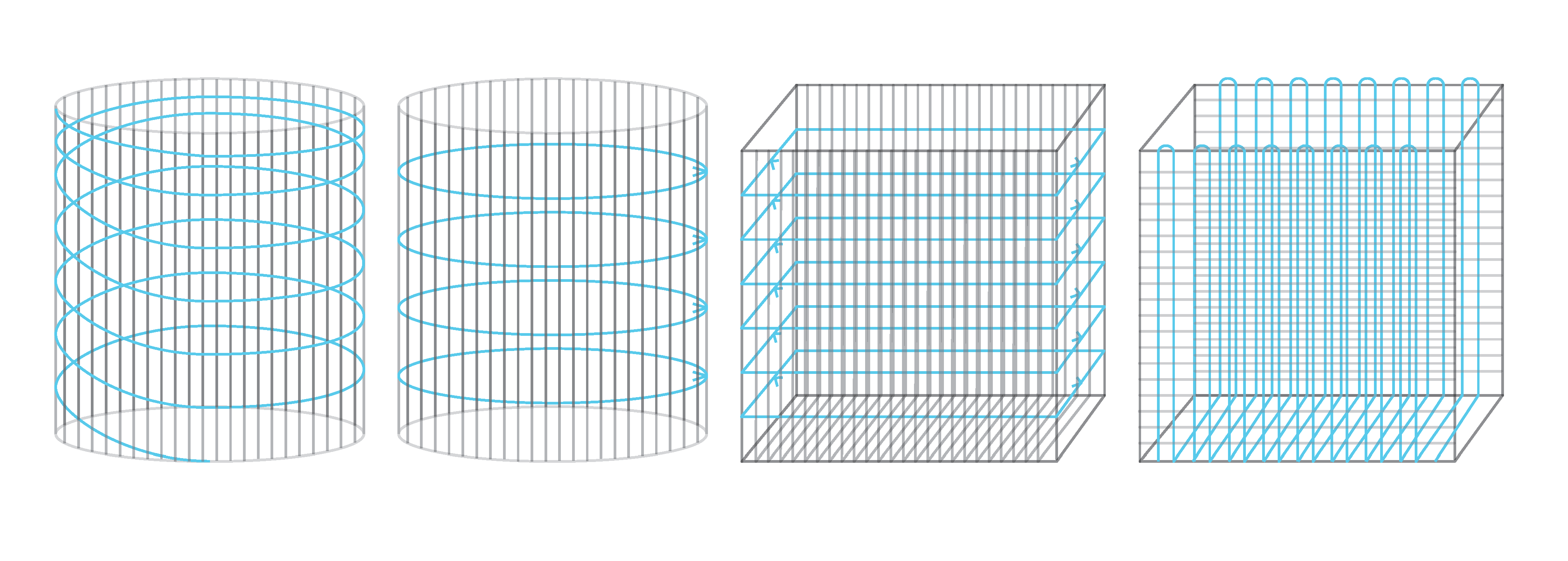
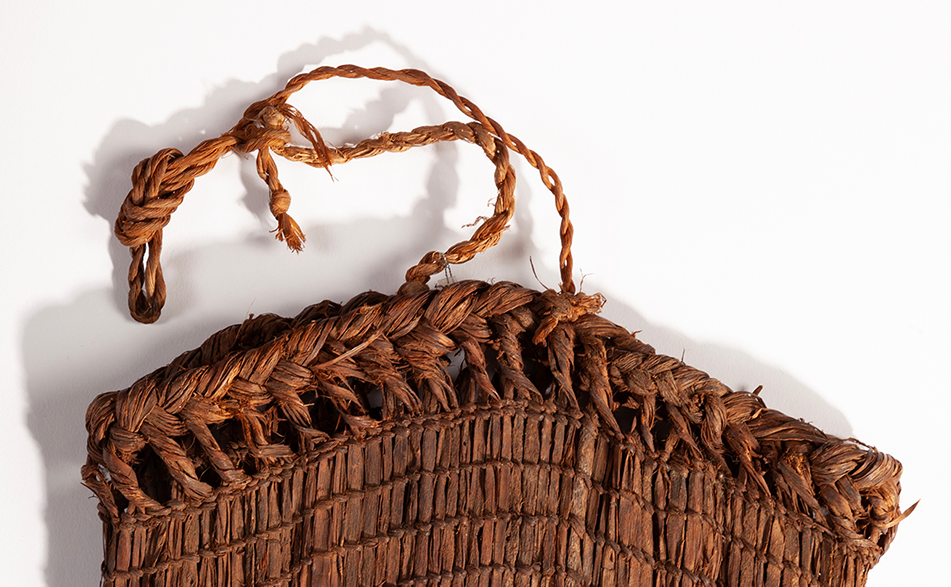
The Fowler Museum saranip closely resembles Ōsaka’s classifications as body structure and weave 1a and type 3 rim, meaning it has a “spiral weave with two weft elements combined with upright warp elements in a horizontal twist pattern,” and the rim braids together three to six warp elements into a single group. One thing worth noting is that there is a clear distinction between the type I body structure, which would have been done freehand, and the type II structure, which is often seen in saranip made with weaving stands.5Ōsaka, 29–30.
Saranip were widely used by Ainu communities in the Hokkaido region from the late eighteenth to early nineteenth centuries (with the exception of the Sakahlin area) and there are regional differences in style, and techniques employed. By 1950, saranip stopped being produced in many locations, and the traditional techniques were often simplified, particularly through the use of weaving stands. Some locations, such as Nibutani and its surrounding areas, produced saranip in large quantities for commercial purposes in response to a surge in postwar tourism and the increased popularity of Ainu handicrafts in Hokkaido.6Ōsaka, 56–57; Saitō Reiko 齋藤玲子. “Ainu kōgei no 200nen: sono rekishi gaikan アイヌ工芸の200年:その歴史概観.” In Sekai no naka no Ainu āto 世界のなかのアイヌ・アート, Yamazaki Kōji 山崎幸治 and Itō Atsunori 伊藤敦規, eds., (Center for Ainu and Indigenous Studies, Hokkaido University 北海道大学アイヌ・先住民研究センター, 2017), 52–53. By the 1980s, not only were there fewer saranip of the type in the Fowler museum being produced, but the simplified versions might also make use of cotton threads and fine fibers.7Ōsaka, 56-57. As we have seen, the commercialization of Ainu goods to some extent imposed changes to the method and amount of saranip produced, the material used, the function, and even the style of the saranip. Over time, less emphasis was put on the original role of saranip and more on mass production, signaling a transition from an everyday tool made with traditional techniques to a more widely-manufactured souvenir.
Basket (yar-su)
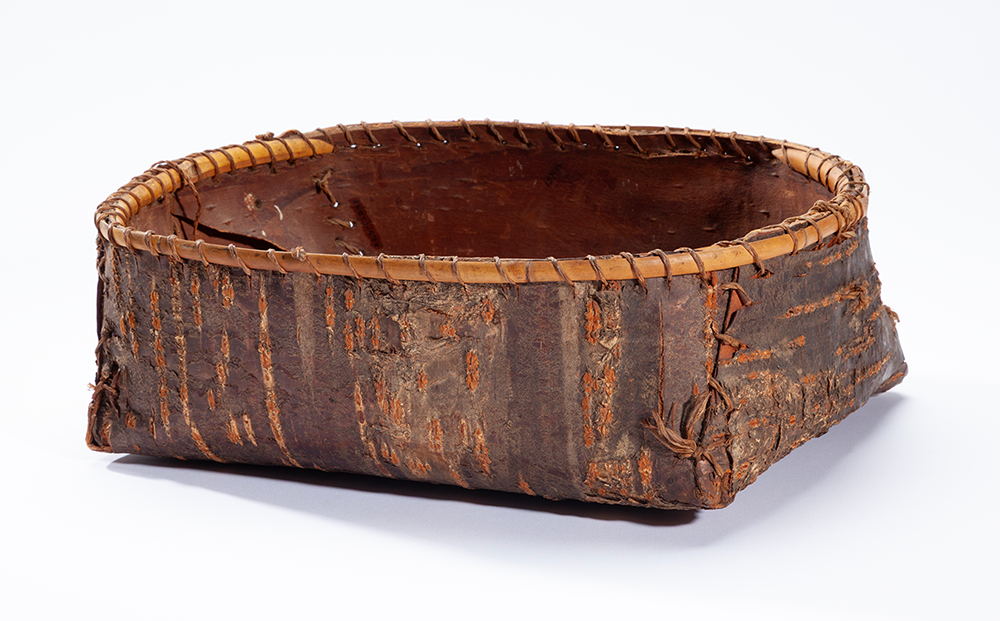
In addition to the saranip explored above, the Fowler Museum at UCLA also holds a container made from bark, bamboo, and fibers that is likely a yar-su ヤラス. Part of the donations from 1965 that are labeled as c. 1917, we do not know the exact date or a specific maker. The basket measures 33.5 cm × 10 cm × 22 cm.
The basket body is made out of strips of tree bark that are folded and stitched with strings. The rim of the basket is stitched to a bent bamboo stick that runs along roughly three-fourths of the rim. The ridges on the tree barks, on the side folded up, are placed parallel to the rim in accordance with the grain, a technique used so the bark does not split or break when folded. The form and function of yar-su differ, with some serving as straightforward baskets or containers, some being proofed to carry water, and some even used as cooking vessels (with the bottom of the basket scorched with soot until it becomes a tar-like substance).8Satō Masahiko 佐藤昌彦, “Considerations on Using ‘Yar−su (Bark Pot)’ for Teaching Material (1) − Exploring the Educational Value of Traditional Ainu Folk Art ヤラス(樹皮の鍋)の教材化考(1)―アイヌ民族の伝統的造形の教育的意義と造形教材としての可能性を探る―,” Bijutsu kyōikugaku: bijutsuka kyōikugaku kaishi 美術教育学―美術科教育学会誌― 21 (2000), 136–138. The basket in our collection has bamboo sticks stitched on and strings sewing the folded parts of the bark onto the container body securely, creating small holes throughout. As with many traditional Ainu tools and art, there are variations across disparate regions and communities. Many similar bark-made containers collected by museums around the world reflect the different types of yar-su (Figs. 4–7).
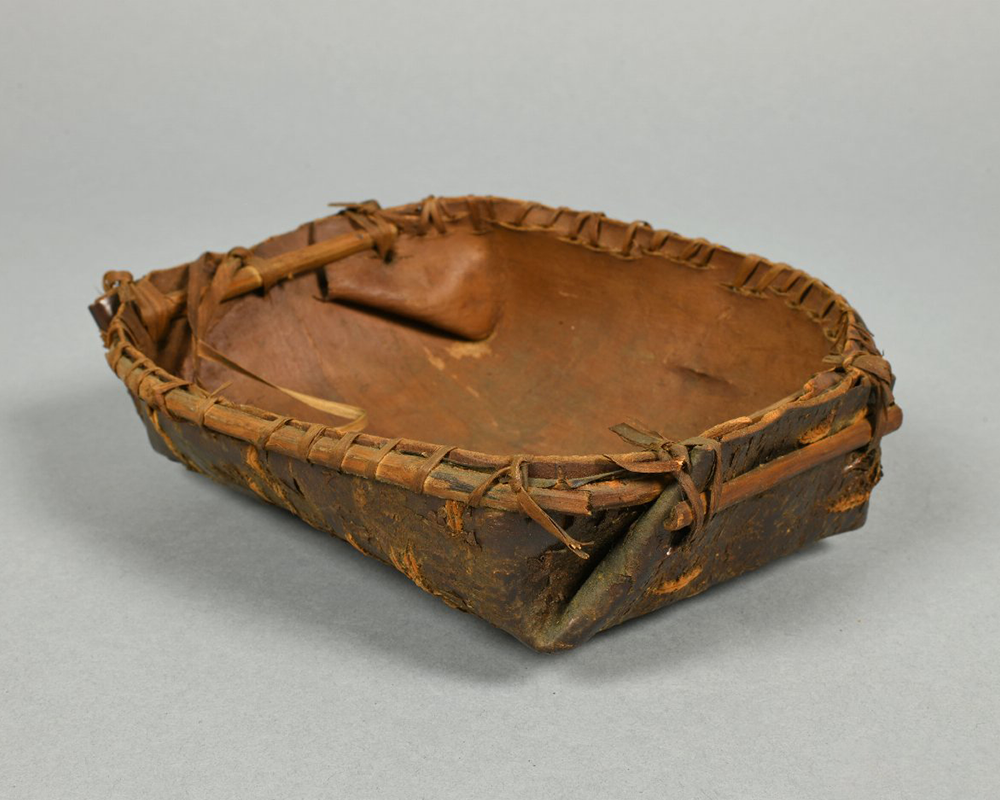
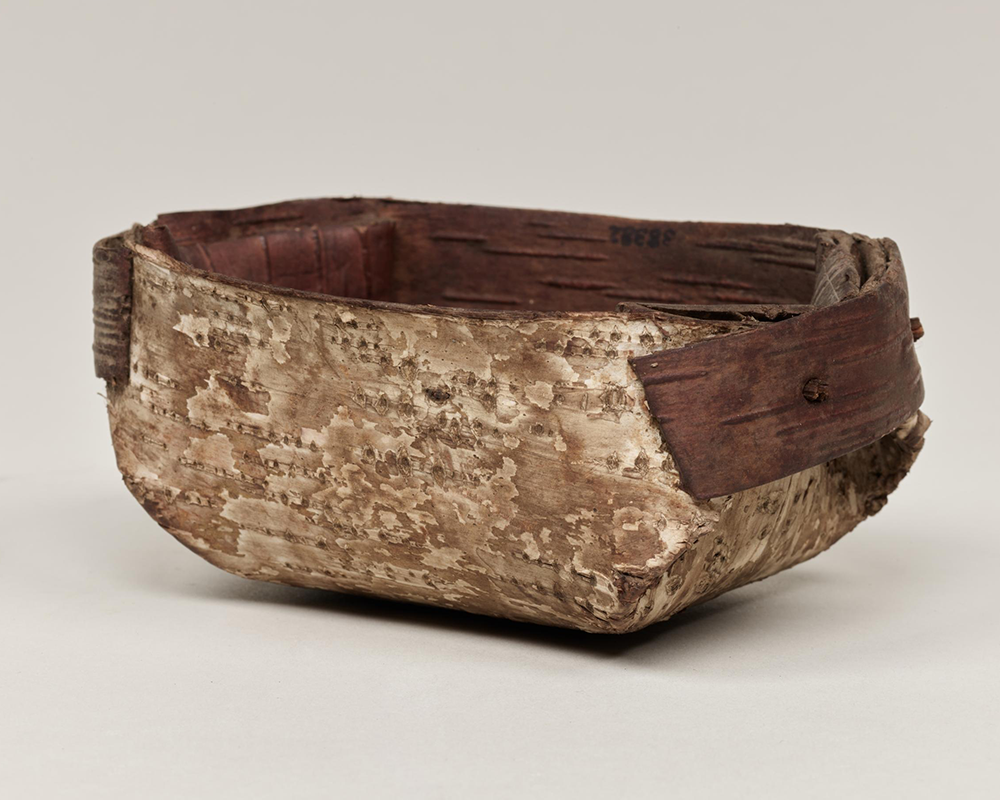
Figure 4 shows a cooking vessel. Although the shape is more rectangular than the bark basket in the Fowler collection, braced with straight pieces of wood on the edges instead of curved into a circle, we find similarities in the way the bark edges are braced along the rim and in the way the rim of hte basket is secured with wrapped strips. Figure 5, made of birch bark strips, is a slightly different design, having large strips of bark woven through the sides of the container to secure the shape.
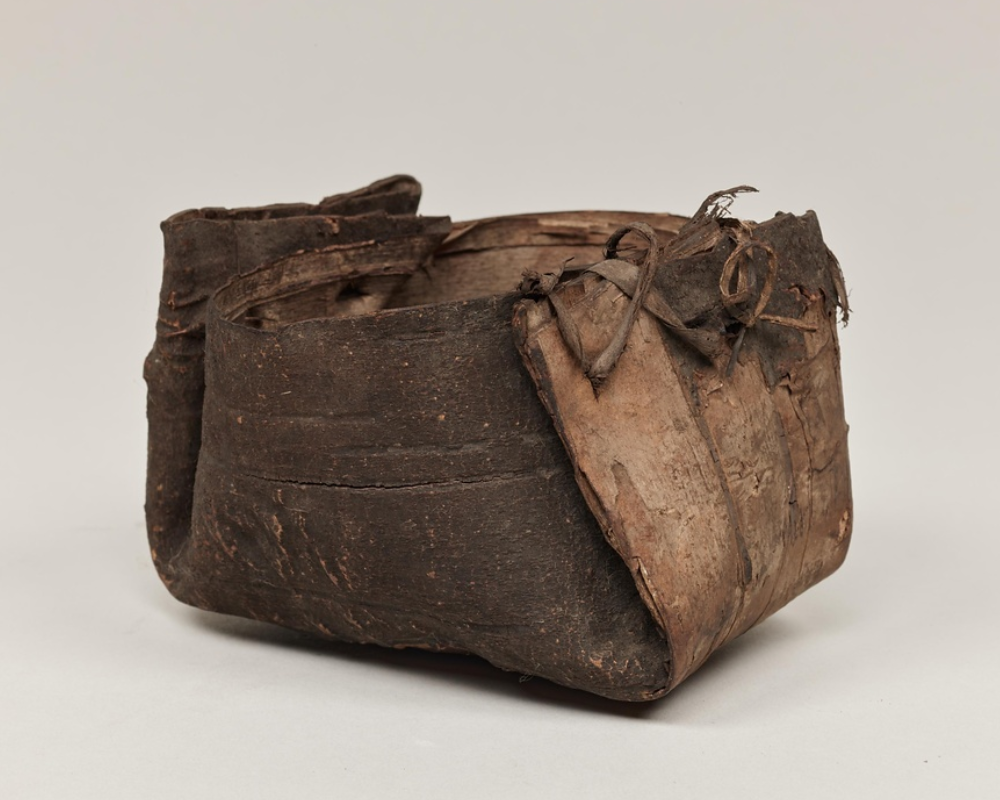
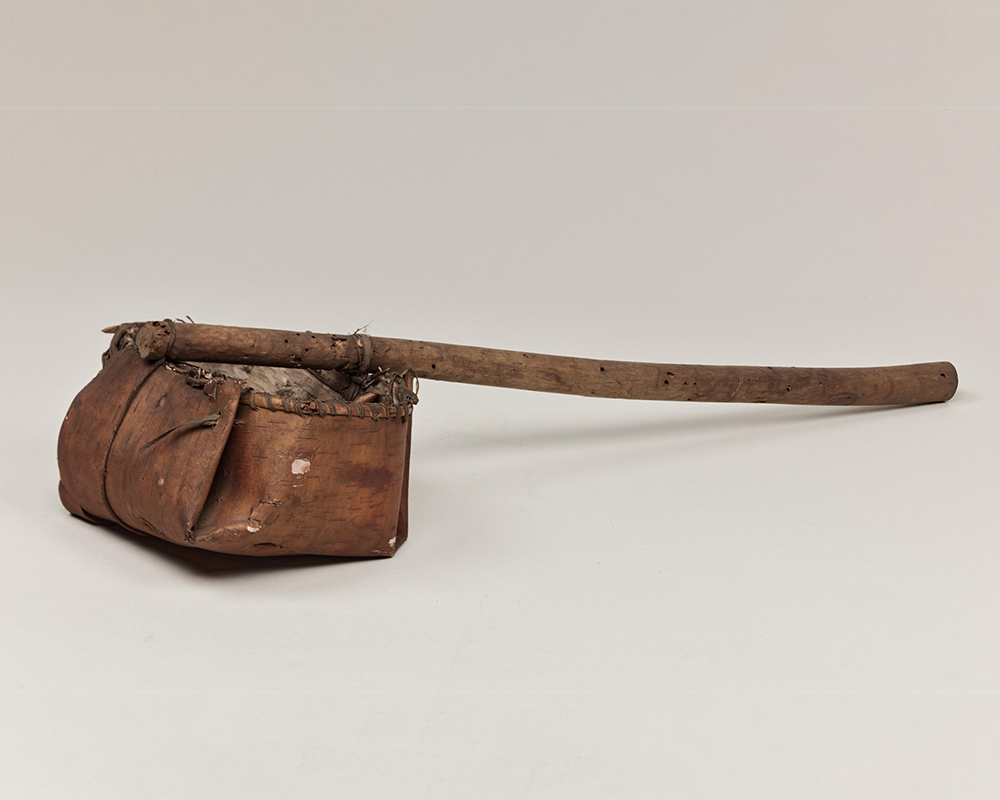
Figures 6 and 7 above are examples of bark baskets that have been designed to hold water. On the left, we see an example of a water container that lacks a characteristic pole for dipping and carrying, which we find preserved in the example on the right. While Figure 6 does not have a distinct rim, Figure 7 has a similar rim to the Fowler's basket, with a strip of wood lining the edges, secured with strips wrapped around for additional strength and cohesion. From the examples above, it is easy to see that these items varied as needed for practical use.
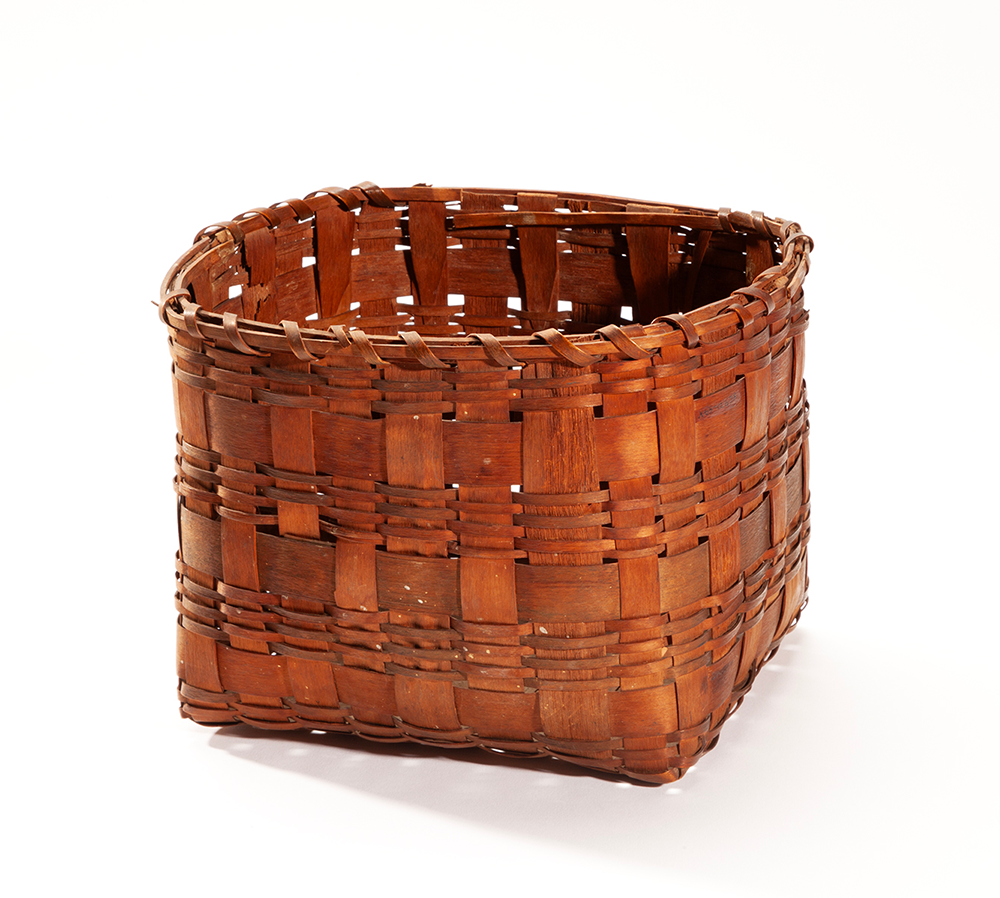
The Fowler museum also holds a third basket (Fig. 8), woven from what the catalog identifies as possibly being cedar. More research is required, but it appears to be a fairly conventional basket shape.
Mat (goza)
Among the Fowler’s woven objects dating to c. 1917 there is also an item labeled as an Ainu “storage mat” with no materials or additional information provided. The mat measures 56cm in length and 40cm in width, although due to the delicate nature of the fibers we were unable to view it unrolled.
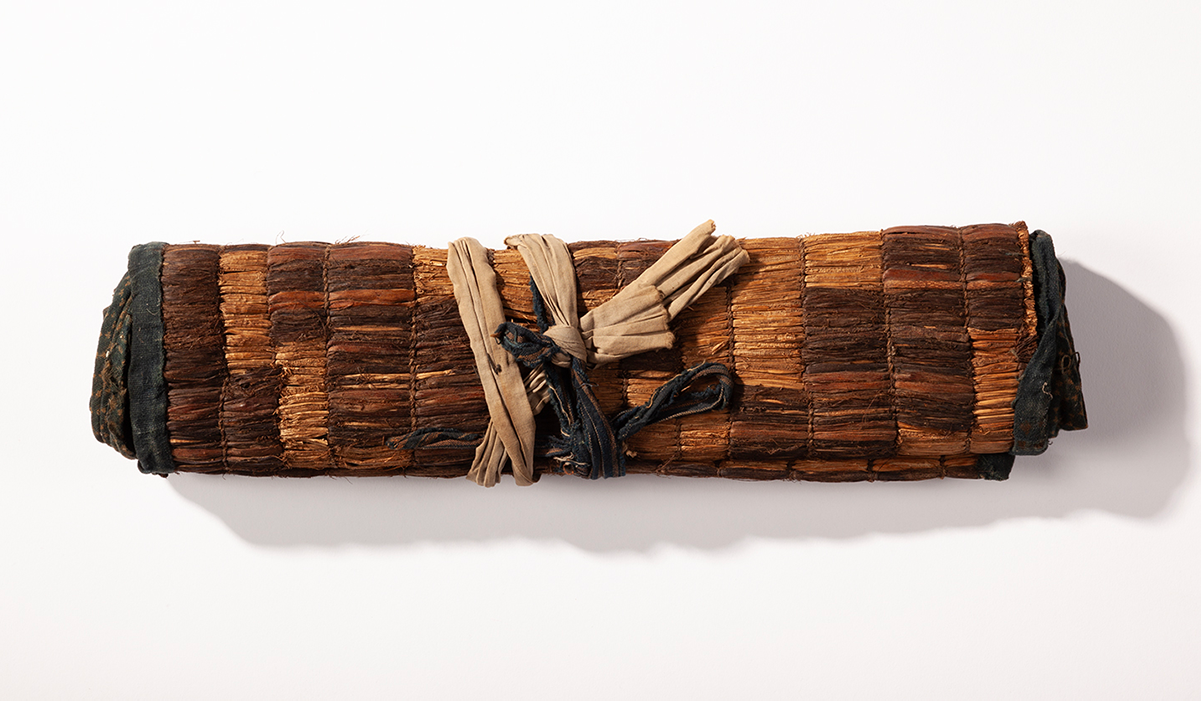
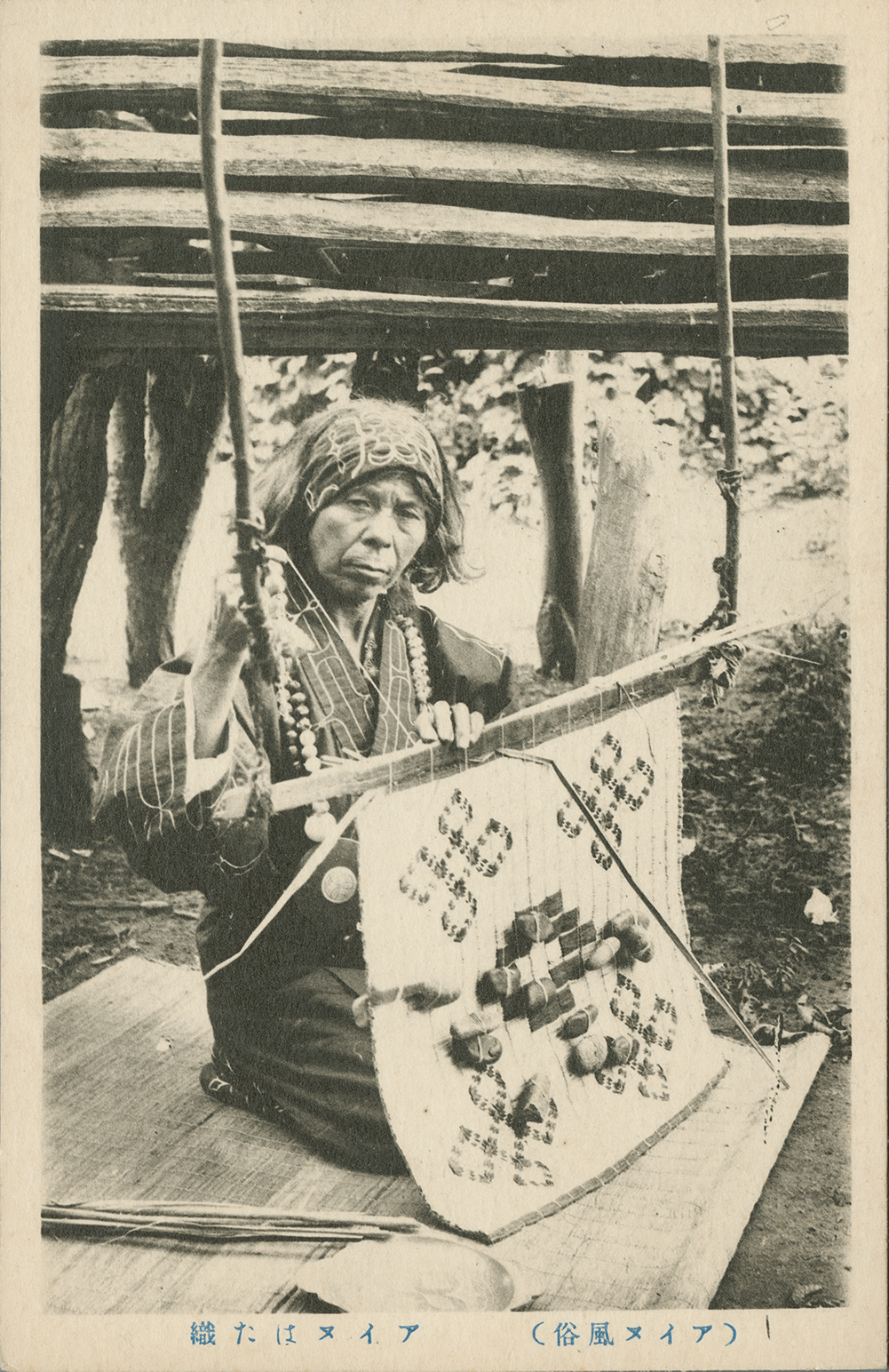
This mat was most likely collected as a traditional Ainu mat known as goza ゴザ. Goza are generally divided into two categories based on the presence or absence of patterns. Goza weaved without pattern were used daily as floor mat or curtain, while goza with patterns were used as decorative floor or wall mats during special events like the bear-sending ceremony (iyomante イヨマンテ), housewarming celebrations (chisenomi チセノミ), or even used as sails for traditional Ainu ships. Goza with patterns have specific terms for each type depending on the size, pattern and usage.9Tateru: Sosen no jigai no chisezukuri. Ainu seikatsu bunka saigen manyuaru 建てるー祖先の時代のチセづくりー アイヌ生活文化再現マニュアル (The Foundation for Ainu Culture 財団法人アイヌ文化振興・研究推進機構, 2000), 53; Amu: Goza. Ainu seikatsu bunka saigen manyuaru 編むーゴザー アイヌ生活文化再現マニュアル (The Foundation for Ainu Culture 財団法人アイヌ文化振興・研究推進機構, 2006), 9; 23. View the iyomante detail of our page on the Curious Views of Ezo to see an example of goza hung on either side of the ceremony dais.
As with most Ainu textiles, patterns on goza are almost always symmetrical. Goza are made by Ainu women with a twining tool called iteseni イテセニ (Fig. 10). Mats are often made from cattails collected during autumn and twined in March and April, which are called “itese months,” itese meaning “to sew.”10Amu: Goza, 8.
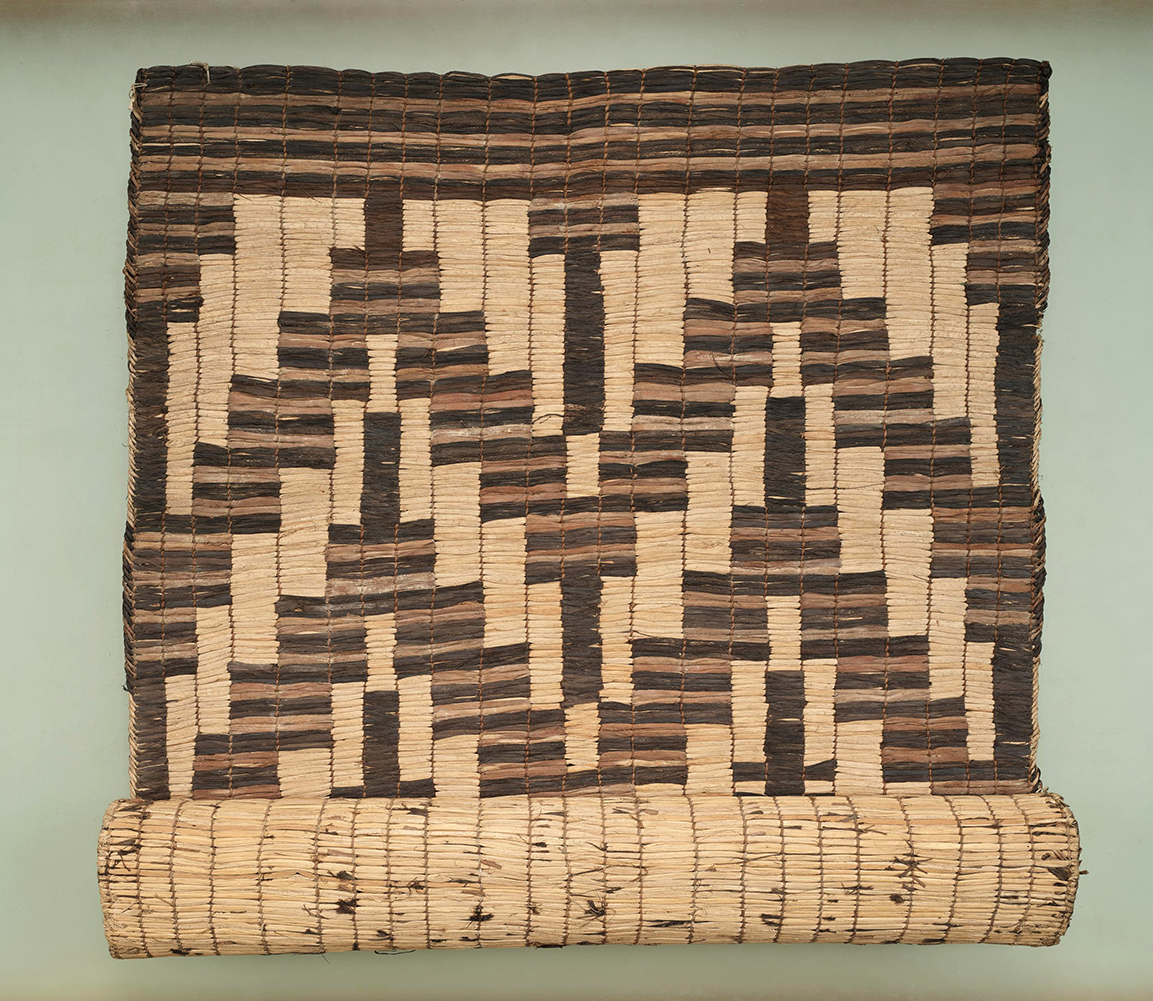
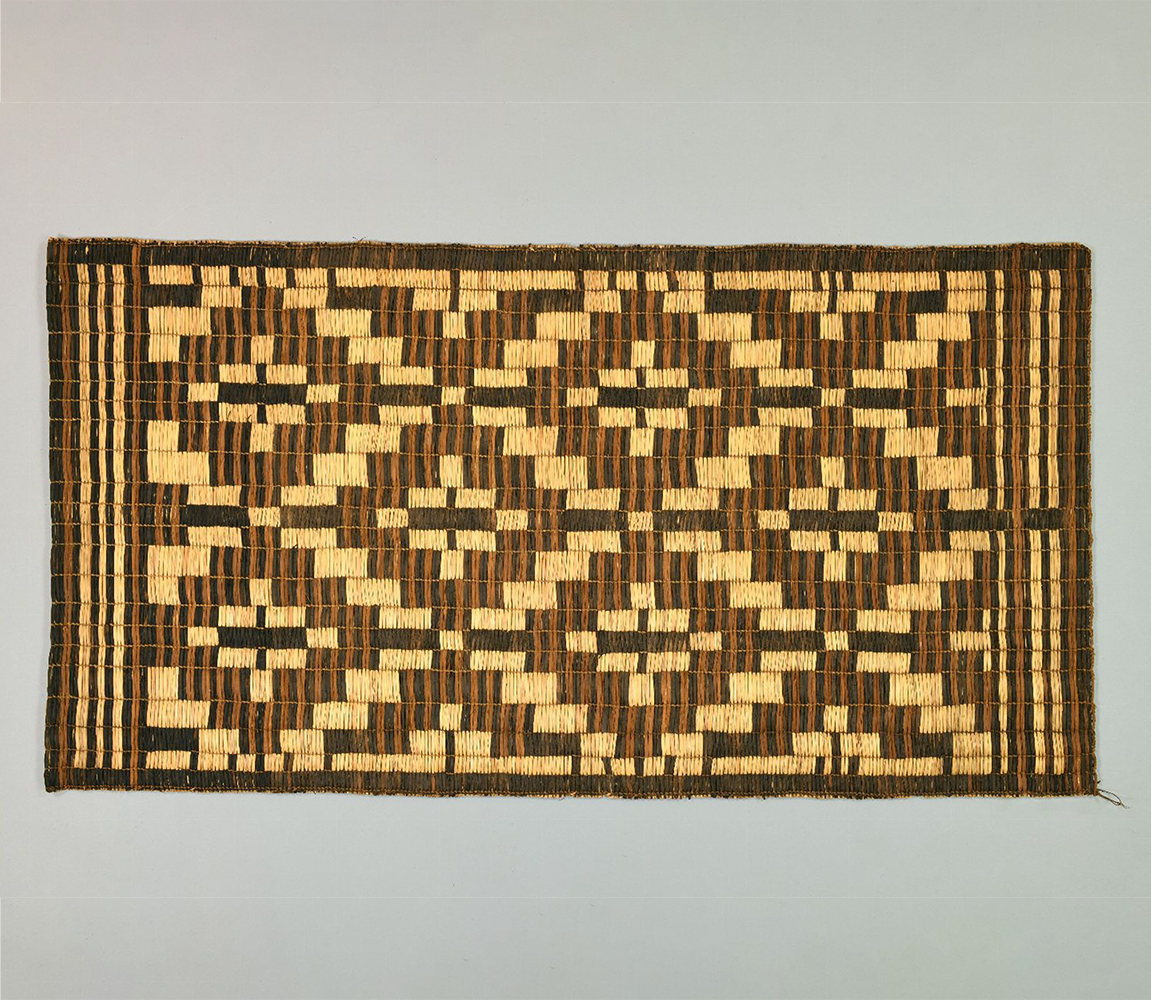
From what we can see on the outside, the mat in our collection most closely resembles a nikapunpe ニカプンペ. This type of goza has symmetrical black and brown diamond patterns. Yew wood crumbs, amber bark, and twigs and roots of beach rose are used as brown color dye. Oak leaves, the husk of Japanese walnuts or its rotten bark, and fruits of Japanese alder are used as black color dye.11Amu: Goza, 8, 38–39. In Figures 11 and 12 you can see the distinction between the brown and black shades in the pattern. However, the size of the mat in the Fowler is considerably smaller than a typical one, and has only one column of patterns compared to some other nikapunpe seen in different museums. A width of 100 cm and length of 217 cm is considered a pon-nikapunpe mat (pon being the prefix for “small” in Ainu language), so it is likely the mat in our collection also belongs to that category.12Amu: Goza, 59.
References
Amu: Goza. Ainu seikatsu bunka saigen manyuaru 編むーサラニプーアイヌ生活文化再現マニュアル. The Foundation for Ainu Culture 財団法人アイヌ文化振興・研究推進機構, 2006. https://www.ff-ainu.or.jp/manual/files/2006_13.pdf
Amu: Saranip. Ainu seikatsu bunka saigen manyuaru 編むーサラニプーアイヌ生活文化再現マニュアル. The Foundation for Ainu Culture 財団法人アイヌ文化振興・研究推進機構, 2004. https://www.ff-ainu.or.jp/manual/files/2004_09.pdf
Graburn, Nelson and Molly Lee. “Saranip and Tenki: Ainu Basketry and North Pacific Affinities.” In Ainu: Spirit of a Northern People. Edited by Fitzhugh William W. and Chisato O. Dubreuil, 301–308. Arctic Studies Center, National Museum of Natural History, 1999.
Ōsaka Taku 大坂拓. “Ainu no minzoku no hentai: chiikisa to nendaisa, oyobi ‘miyagemono,’ ‘dentō kōgeihin’ to shite no keishō アイヌ民族の編袋―地域差と年代差、及び「土産物」・「伝統工芸品」としての継承―.” Bulletin of Ainu Culture Research Center, Hokkaido Museum 北海道博物館アイヌ民族文化研究センター研究紀要 4 (2019): 25–60, https://www.hm.pref.hokkaido.lg.jp/wp-content/uploads/2025/01/bulletin_ACRC_vol4_02_p025_060s.pdf
Saitō Reiko 齋藤玲子. “Ainu kōgei no 200nen: sono rekishi gaikan アイヌ工芸の200年:その歴史概観.” In Sekai no naka no Ainu āto 世界のなかのアイヌ・アート. Edited by Yamazaki Kōji 山崎幸治 and Itō Atsunori 伊藤敦規, 45–60. Center for Ainu and Indigenous Studies, Hokkaido University 北海道大学アイヌ・先住民研究センター, 2017. https://minpaku.repo.nii.ac.jp/records/8234
Satō Masahiko 佐藤昌彦. “Considerations on Using ‘Yar−su (Bark Pot)’ for Teaching Material (1) − Exploring the Educational Value of Traditional Ainu Folk Art ヤラス(樹皮の鍋)の教材化考(1)―アイヌ民族の伝統的造形の教育的意義と造形教材としての可能性を探る―." Bijutsu kyōikugaku: bijutsuka kyōikugaku kaishi 美術教育学―美術科教育学会誌― 21 (2000): 135–147.
Tateru: Sosen no jigai no chisezukuri 建てるー祖先の時代のチセづくりー. Ainu seikatsu bunka saigen manyuaru 編むーゴザーアイヌ生活文化再現マニュアル. The Foundation for Ainu Culture 財団法人アイヌ文化振興・研究推進機構, 2000. https://www.ff-ainu.or.jp/manual/files/2000_01.pdf